背景介绍:
植物酚类物质具有清除自由基,抗氧化,抗衰老的作用,具有较高的营养价值和医疗保健作用而广泛应用于化妆品、食品、医药等领域。本试剂盒检测原理是在碱性条件下,酚类物质将钨钼酸还原,产生蓝色化合物,在760 nm处有特征吸收峰,测 760 nm 处的吸光值,即可得样品总酚含量。可以检测植物组织、果汁和蜂蜜等液体样本。
组份表:
| P1524795 | 组件 | 物理外观 | 48T
| 96T
| 储存 | 单次测试使用量 |
| P1524795A | 试剂一 | 黄色液体 | 2.5 mL | 5 mL | 2-8℃. 避光 | 每次反应需使用50 uL |
| P1524795B | 试剂二 | 无色透明液体 | 2.5 mL | 5 mL | 2-8℃ | 每次反应需使用50 uL |
| P1524795C | 标准品 | 白色粉末 | 10 mg | 20 mg | 2-8℃
| 按照需求使用 |
实验器材:
研钵(匀浆机)、冰盒(制冰机)、台式离心机、可调式移液枪、水浴锅(烘箱、培养箱、金属浴)、 96 孔板、离心管、酶标仪、60%乙醇、蒸馏水(去离子水、超纯水均可)。
指标测定:
建议先选取1-3个差异大的样本(例如不同类型或分组)进行预实验,熟悉操作流程,根据预实 验结果确定或调整样本浓度,以防造成样本或试剂不必要的浪费!
样本提取:
组织样本: 称取约0.1g新鲜样本(若水分充足,可增加样本取样质量);或者称取约0.03g烘干样本(将样本 在105℃下杀菌3min,然后60℃烘干至恒重,粉碎,过40-60 目筛,得到烘干样本),加入1.5mL 的 60%乙醇(若鲜样需研磨均质),60℃振荡提取2h(若蒸发用60%乙醇定容至1.5mL),25℃×12000rpm, 离心10min,取上清待测。 【注】:若样本量较少,可同比例缩减样本量,如取0.02g干样,加入1mL60%乙醇,60℃振荡提取2h。25℃×12000rpm, 离心10min,取上清,用60%乙醇定容至1mL待测。
液体样本:直接检测;若浑浊,离心后取上清检测。
细菌/培养细胞: 先收集细菌或细胞到离心管内,离心后弃上清;取约500万细菌或细胞至EP管中,加入1mL 的 60%乙醇,60℃振荡提取2h(若蒸发用60%乙醇定容至1mL),25℃×12000rpm,离心10min,取上 清待测。 【注】:若增加样本量,可按照细菌或细胞数量(104个):提取液体积(mL)为500:1比例进行提取。
检测步骤:
酶标仪预热30min(等待仪器过自检程序亦可),调节波长至760nm。
对于总酚含量较高的样本如茶叶,一般需用蒸馏水稀释后再检测如稀释50倍,也可先选取2个样 本做预测定,找出适合本次检测样本的稀释倍数D。
在96孔板中依次加入:
| 试剂组分(µL) | 测定管 | 空白管(仅做一次) |
| 样本 | 10 |
|
| 试剂一 | 50 | 50 |
| 混匀,25℃室温件下,暗处静置3min |
| 试剂二 | 50 | 50 |
| 蒸馏水 | 90 | 100 |
| 混匀,25℃室温静置30min,全部液体转移至96孔板中, 测定760nm吸光值A,ΔA=A测定管-A空白管。 |
【注】:1.吸光值大于1,样品适当稀释再测定,计算公式里乘以稀释倍数D。 2.若ΔA在零附近,可增加样本取样质量W,或加大样本上样量V1(如增至30µL,则蒸馏水相应减少, 保持总体积不变),则改变后W和V1需代入计算公式重新计算。 3.若待检测样本有强背景色(如蓝色),需做一个样本自身对照:即试剂一用50μL蒸馏 水替换,其他步骤同测定管,△A=A测定-A对照。
结果计算:
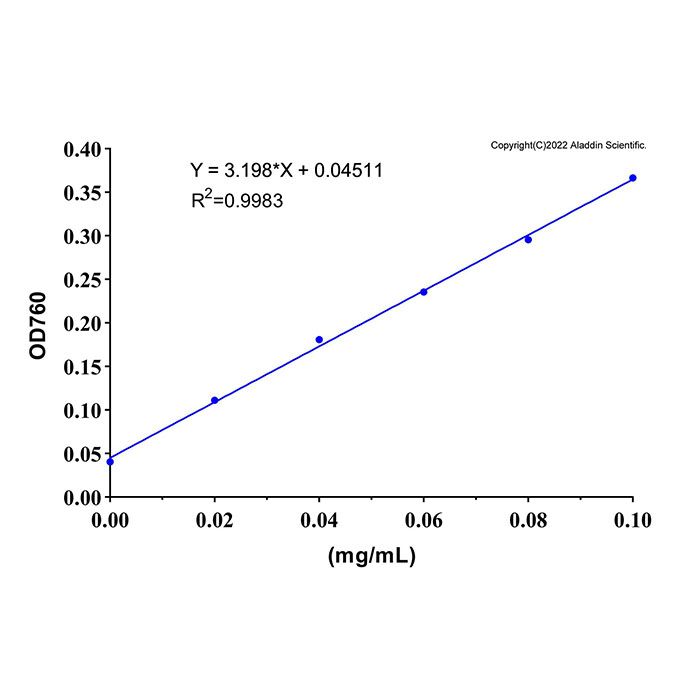
标准曲线:y=3.1975x+0.0451,x是标准品质量(µg),y是ΔA。

总酚(TP)含量(mg/mgprot)= (ΔA - 0.0451) ÷ 3.1975 × 10⁻³ ÷ (V1 ÷ V × Cpr) × D
总酚(TP)含量(µg/mL)=(ΔA-0.0451)÷3.1975÷V1×D
总酚(TP)含量(mg/104cell)= (ΔA - 0.0451) ÷ 3.1975 × 10⁻³ ÷ (V1 ÷ V × 500) × D
V---加入提取液体积;
V1---反应中样品体积,0.01mL;
D---稀释倍数,未稀释即为1;
W---样品质量,g。
500---细菌或细胞总数,万;
Cpr---上清液蛋白浓度,mg/mL,建议使用本公司的BCA蛋白含量检测试剂盒。
附:标准曲线制作过程:
1.标曲为非必做实验,用户可根据实验需求制作标曲,亦可直接采用说明书计算公式进行结果计算。
2.制备标准品母液(10mg/mL):向标准品EP管里面加入1mL提取液(60%乙醇),超声完全溶解;
3.将母液用60%乙醇稀释成六个浓度梯度的标准品,例如:0,0.02,0.04,0.06,0.08,0.1mg/mL。也可根据实际样本调整标准品浓度。
4.标准品稀释参照表如下:
| 吸取标准品母液50uL,加入4.95mL60%乙醇,混匀得到0.1mg/mL的标准品稀释液待用 |
| 标准品浓度(mg/mL) | 0 | 0.02 | 0.04 | 0.06 | 0.08 | 0.1 |
| 标准品稀释液(uL) | 0 | 80 | 160 | 240 | 320 | 400 |
| 60%乙醇(uL) | 400 | 320 | 240 | 160 | 80 | 0 |
| 各标准管混匀待用 |
5.依据测定管的加样表操作,根据结果,以各浓度吸光值减去0浓度吸光值,过0点制作标准曲线。
| 试剂组分(µL) | 标准管 | 0浓度管(仅做一次) |
| 标品 | 10 | |
| 试剂一 | 50 | 50 |
| 混匀,25℃室温件下,暗处静置3min |
| 试剂二 | 50 | 50 |
| 蒸馏水 | 90 | 100 |
| 混匀,25℃室温静置30min,全部液体转移至96孔板中, 测定760nm吸光值A,ΔA=A测定管-A空白管。 |
注意事项:
1、本产品仅作科研用途。
2、为了您的安全和健康,请穿实验服并佩戴一次性手套操作。
Background Introduction:
Plant phenolic substances have the functions of eliminating free radicals, antioxidation and anti-aging. They have high nutritional value and medical health benefits and are widely used in cosmetics, food, medicine and other fields. The detection principle of this kit is that in an alkaline condition, phenolic substances will reduce tungsten molybdate, generating a blue compound. There is a characteristic absorption peak at 760 nm. Measuring the absorbance value at 760 nm can obtain the total phenolic content of the sample. It can detect liquid samples such as plant tissues, fruit juices and honey.
Components:
| P1524795 | Components | Appearance | 48T | 96T | Storage | Quantity Per Test |
| P1524795A | Reagent 1 | Yellow liquid | 2.5 mL | 5 mL | 2-8℃. Store in the dark | 50 uL for 1 reaction |
| P1524795B | Reagent 2 | Colorless clear liquid | 2.5 mL | 5 mL | 2-8℃ | 50 uL for 1 reaction |
| P1524795C | Standard Sample | White powder | 10 mg | 20 mg | RT | Use as per requirements |
Experimental equipment:
Beaker (homogenizer), ice box (ice maker), benchtop centrifuge, adjustable pipette, water bath (oven, incubator, metal bath), 96-well plate, centrifuge tube, microplate reader, 60% ethanol, distilled water (deionized water, ultrapure water are both acceptable).
Index Determination:
It is recommended to select 1-3 samples with significant differences (such as different types or groups) for a preliminary experiment first. This will help you get familiar with the operation process. Based on the results of the preliminary experiment, determine or adjust the sample concentration to prevent unnecessary waste of samples or reagents!
Sample extraction:
- Sample collection: Weigh approximately 0.1g of fresh sample (if the sample is sufficiently moist, increase the sample collection quality); or weigh approximately 0.03g of dried sample (kill the sample at 105℃ for 3 minutes, then dry it at 60℃ until constant weight, grind and sieve through a 40-60 mesh sieve to obtain the dried sample), add 1.5 mL of 60% ethanol (if the fresh sample needs to be ground and homogenized), shake and extract at 60℃ for 2 hours (if volume adjustment is needed, dilute to 1.5 mL with 60% ethanol), at 25℃ at 12000 rpm, centrifuge for 10 minutes, and take the supernatant for testing. [Note]: If the sample quantity is small, reduce the sample quantity proportionally, for example, take 0.02g of dry sample, add 1 mL of 60% ethanol, shake and extract at 60℃ for 2 hours. At 25℃ at 12000 rpm, centrifuge for 10 minutes, take the supernatant, and adjust to 1 mL with 60% ethanol for testing.
- Liquid sample: Directly test; if cloudy, centrifuge and take the supernatant for testing.
- Bacteria/Cultured Cells: First, collect the bacteria or cells into a centrifuge tube, then centrifuge and discard the supernatant; take approximately 5 million bacteria or cells into an EP tube, add 1 mL of 60% ethanol, and perform an 2-hour 60℃ shaking extraction (if for evaporation, dilute to 1 mL with 60% ethanol), at 25℃ at 12000 rpm, centrifuge for 10 minutes, and take the supernatant for testing. [Note]: If increasing the sample volume, you can extract according to the ratio of bacterial or cell quantity (10^4) : extraction liquid volume (mL) as 500:1.
Detection steps:
- Allow the enzyme detector to preheat for 30 minutes (or wait for the instrument to complete its self-check program). Then adjust the wavelength to 760 nm.
- For samples with high total phenol content, such as tea, it is usually necessary to dilute them with distilled water before testing, for example, by diluting 50 times. Alternatively, two samples can be selected for prediction and determination to find out the appropriate dilution factor D for this test.
- Add successively in the 96-well plate:
| Reagent components(µL) | Measurement tube | Blank tube (used only once) |
| Sample | 10 | |
| Reagent 1 | 50 | 50 |
| Mix well. At 25℃ room temperature, let it stand in the dark for 3 minutes. |
| Reagent 2 | 50 | 50 |
| Distilled water | 90 | 100 |
| Mix well, let it stand at room temperature (25℃) for 30 minutes. Transfer all the liquid to a 96-well plate. Measure the absorbance at 760nm (A), and calculate ΔA as A (test tube) - A (blank tube). |
[Note]: 1. If the absorbance value is greater than 1, dilute the sample appropriately before measurement and multiply the calculation formula by the dilution factor D. 2. If ΔA is near zero, increase the sample sampling mass W or increase the sample loading volume V1 (for example, increase it to 30 µL, then reduce the distilled water accordingly to keep the total volume unchanged). Then, the new W and V1 need to be substituted into the calculation formula for re-calculation. 3. If the sample to be tested has a strong background color (such as blue), a sample self-control should be made: replace the reagent with 50 µL distilled water, and follow the same steps as the test tube, then ΔA = A test - A control.
Result calculation:
Standard curve: y = 3.1975x + 0.0451, where x represents the mass of the standard sample (µg) and y represents ΔA.
Total phenol (TP) content (mg/g dry weight) = (ΔA - 0.0451) ÷ 3.1975 × 10⁻³ ÷ (V1 ÷ V × W) × D
Total phenol (TP) content (mg/mg prot) = (ΔA - 0.0451) ÷ 3.1975 × 10⁻³ ÷ (V1 ÷ V × Cpr) × D
Total phenol (TP) content (µg/mL) = (ΔA - 0.0451) ÷ 3.1975 ÷ V1 × D
Total phenol (TP) content (mg/10^4 cells) = (ΔA - 0.0451) ÷ 3.1975 × 10⁻³ ÷ (V1 ÷ V × 500) × D
V --- Add the volume of the extracting liquid;
V1 --- Volume of sample in the reaction, 0.01 mL;
D --- Dilution factor, 1 for undiluted solution;
W---Sample quality, g;
500---Total number of bacteria or cells, in thousands;
Cpr - Protein concentration in the supernatant, mg/mL. It is recommended to use the BCA protein content detection kit of our company.
Appendix: Procedure for preparing the standard curve:
1.The calibration curve is not a mandatory experiment. Users can create the calibration curve according to their experimental needs, or they can directly use the calculation formulas provided in the manual to calculate the results.
2. Prepare the standard stock solution (10mg/mL): Add 1 mL of the extraction solution (60% ethanol) into the standard EP tube, and ultrasonicate to completely dissolve it;
3. Dilute the mother solution with 60% ethanol to obtain six concentration gradients of standard samples, for example: 0, 0.02, 0.04, 0.06, 0.08, 0.1 mg/mL. The concentration of the standard samples can also be adjusted according to the actual sample.
4. The reference table for standard sample dilution is as follows:
| Take 50 uL of the standard solution stock solution, add 4.95 mL of 60% ethanol, and mix well to obtain a 0.1 mg/mL standard dilution solution for later use. | | Standard concentration (mg/mL) | 0 | 0.02 | 0.04 | 0.06 | 0.08 | 0.1 | | Standard diluent (uL) | 0 | 80 | 160 | 240 | 320 | 400 | | 60% ethanol (uL) | 400 | 320 | 240 | 160 | 80 | 0 | | All the standard tubes have been mixed and are ready for use. |
|
5.According to the sample addition table of the measuring tube (as shown below), based on the results, subtract the absorbance value at 0 concentration from the absorbance value at each concentration, and then plot a standard curve through the 0 point.
| Reagent components(µL) | Standard tube | 0 concentration tube (used only once) | | Standard Sample | 10 | | | Reagent 1 | 50 | 50 | | Mix well. At 25℃ room temperature, let it stand in the dark for 3 minutes. | | Reagent 2 | 50 | 50 | | Distilled water | 90 | 100 | | Mix well, let it stand at room temperature (25℃) for 30 minutes. Transfer all the liquid to a 96-well plate. Measure the absorbance at 760nm (A), and calculate ΔA as A (test tube) - A (blank tube). |
|
Notes:
1. This product is for research use only.
2. For your safety and health, please wear a lab coat and disposable gloves during operation.

 ZJ26F0838234


 危险品化学品经营许可证(带存储)