
 C2618092
计算溶液所需的质量、体积或浓度。
苯基葡聚糖
有货
,适用于对基线干扰要求严格的色谱和分析工作流程。
室温,充氩,干燥。常规运输 。请查阅批次 COA 获取详细规格。
SDS、COA、产品数据表及规格说明书均可下载。可通过批号查询获取批次 COA。
在色谱分析、有机合成和交叉偶联反应领域已被 0 篇同行评审文献引用。
We have a long experience in synthesizing phenyl-dextran with a wide range of different molecular weight, from 5 kDa to 150 kDa. Phenyl-dextran is also known as Phenoxy dextran, DexP, phenoxy-derivatized dextran or 1-Phenoxy-2-hydroxypropyl dextran. Phenyl-dextrans may be used in the preparation of hydrophobic gels and hydrophobic coatings. After purification, the products are controlled for solubility, mean molecular weight, degree of substitution, and loss on drying.
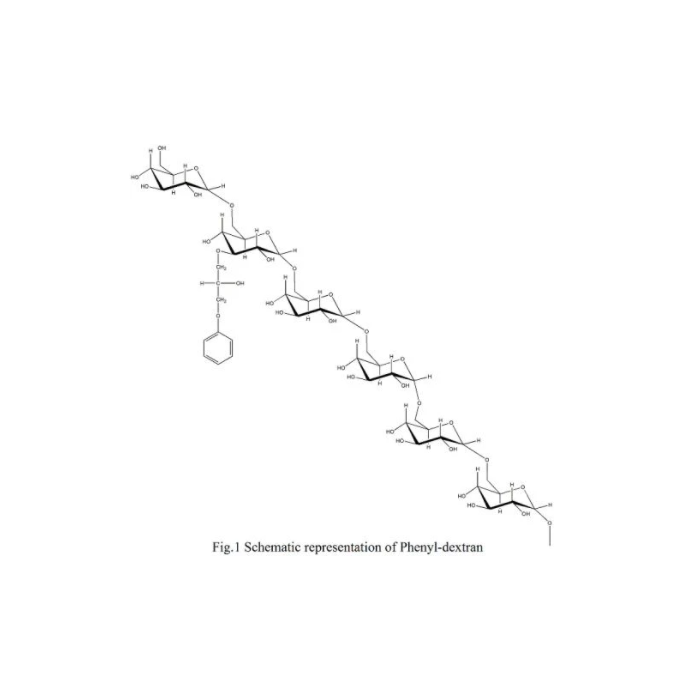
Structure
Phenyl-dextrans are synthesised from selected controlled dextran fractions, derived from Leuconostoc mesenteroides B512F, by reacting with an appropriate epoxide. The phenyl content ranges from 0.34 to 0.4. The phenyl content expressed as w/w is around 22%.
Application
Several applications of phenyl-dextran have appeared in patents. The essential property of phenyl-dextran is its potential for coating plastic and related surfaces to impart a more hydrophilic character. This property has proved of value in many diagnostic devices.
Product description:
Phenyl-dextrans are synthesised from selected controlled dextran fractions, derived from Leuconostoc mesenteroides B512F, by reacting with an appropriate epoxide. The phenyl content ranges from 0.34 to 0.4. The phenyl content expressed as w/w is around 22%.
Phenyl-dextrans are synthesized from selected controlled dextran fractions, derived from Leuconostoc mesenteroides B512F, by reacting with an appropriate epoxide. After purification, the products are controlled for solubility, mean molecular weight Mw, degree of substitution, and loss on drying. A specification may be obtained on request. The products are designated by the approximate molecular weights of the dextran fractions used. Thus, for example, the product PhDex40 has a molecular weight of approx. 40000. The dextran fractions used have weight average molecular weights (Mw) from 4000 to 2000000 and are carefully controlled by GPC (gel permeation chromatography) optical rotation and loss on drying. The actual molecular weight is determined by GPC. This value is supplied with the Certificate of Analysis. The dextran used is from Leuconostoc mesenteroides B-512F which is essentially a linear α- (1-6)-linked glucose chain with however a low percentage (2-5%) of α-(1-3) branches distributed along the chain.
Phenyl-dextrans are white, odourless powders which are readily soluble in water or electrolyte solutions. The product has a pronounced hydrophobic character by virtue of the phenyl groups attached. Since phenyl-dextrans may coat hydrophobic surfaces, it was decided to run the GPC determination of Mw in water on a dedicated Superose column, in order to minimize the risks for interaction with component in the GPC system. The values obtained are nevertheless lower than the starting dextran fraction – and this is attributed to some interaction in the gel or plastic components. Phenyl-dextrans are insoluble in most organic solvents, for example, ethanol, methanol, acetone, chloroform, ethyl acetate etc. The purity is controlled by determination of weight average molecular weight Mw, specific optical rotation, phenyl content and Loss on drying. Tests are performed in production for free phenyl contaminants. The phenyl content as determined by the absorbance at 269nm ranges from 0.34 to 0.4 (value as degree of substitution i.e. number of substituents per glucose molecule). The phenyl content expressed as w/w is around 22%.
The phenyl substituent is bound to the dextran by ether linkages which confer excellent stability to the substituents in both acid and alkaline conditions. Providing the product is stored in air-tight containers in the dark, it will be stable for at least 5 years at ambient temperatures. Dextran itself had been studied in many prospective stability tests and has a shelf life of at least 5 years.
Storage and stability:
Phenyl-dextran is stable for more than 6 years when stored dry in well-sealed containers at ambient temperature.
Solubility:
Phenyl-dextran dissolves readily in water. The product is water soluble at low concentrations but requires prolonged stirring. At higher concentrations the phenyl dextran will aggregate giving the solution an opaque appearance.
Application:
A number of applications of phenyl-dextran have appeared in patents. The essential property of phenyl-dextran is its potential for coating plastic and related surfaces to impart a more hydrophilic character. This property has proved of value in many diagnostic devices.


 危险品化学品经营许可证(带存储)