
计算溶液所需的质量、体积或浓度。
为什么选择此级别
,适用于对基线干扰要求严格的色谱和分析工作流程。
储存与运输
-80℃储存。特低温运输 。请查阅批次 COA 获取详细规格。
质量文档
SDS、COA、产品数据表及规格说明书均可下载。可通过批号查询获取批次 COA。
文献证明
在色谱分析、有机合成和交叉偶联反应领域已被 9 篇同行评审文献引用。
概述
Procaine HCl是一种钠离子通道的,NMDA受体以及乙酰胆碱受体抑制剂, IC50分别为60 μM, 0.296 mM何45.5 μM,也是一种,5-HT3抑制剂,KD为1.7 μM。A sodium channel blocker and DNA methylation inhibitor
应用:
盐酸普鲁卡因已被用作 Krebs Henseleit 缓冲液的组分,用于孵育静息长度的左心室心脏组织。也用作诱导试验中 M9 培养基的诱导剂
Information
Procaine (Novocaine) is an inhibitor ofsodium channel,NMDA receptorandnAChRwithIC50of 60 μM, 0.296 mM and 45.5 μM, which is also an inhibitor of5-HT3withKDof 1.7 μM.
In vitro
Procaine acts mainly by inhibiting sodium influx through voltage gated sodium channels in the neuronal cell membrane of peripheral nerves. When the influx of sodium is interrupted, an action potential cannot arise and signal conduction is thus inhibited. The receptor site is thought to be located at the cytoplasmic (inner) portion of the sodium channel. Procaine has also been shown to bind or antagonize the function of N-methyl-D-aspartate (NMDA) receptors as well as nicotinic acetylcholine receptors and the serotonin receptor-ion channel complex. Procaine is an inhibitor of the mechanisms of Ca-induced Ca release and caffeine-induced Ca release in various types of muscle preparations. 0.5 mM Procaine blocks individual sarcoplasmic reticulum Ca2+ release channels in planarlipid bilayers. Procaine does not reduce the single channel conductance nor appreciably shorts the mean open times of the channel, rather, it increases the longest closed time. Procaine is a DNA-demethylating agent with growth-inhibitory effects in human cancer cells. 0.5 mM Procaine produces a 40% reduction in 5-methylcytosine DNA in MCF-7 breast cancer cell line. Procaine can also bind to CpG-enriched DNA, and demethylates densely hypermethylated CpG islands, leading to restoring gene expression of epigenetically silenced genes. Procaine treatment (0.5 mM) induces an increase in the mitotic index of cells in M phase. Procaine treatment (1 mM) reduces cell proliferation by ~40%. Procaine influences red cell shape and deformability. 45 mM Procaine almost completely prevents the discocyte-echinocyte transformation associated with ATP depletion. Similar concentrations of Procaine normalize the viscosity and filterability, but have no effect on cell volume, osmotic fragility, or monovalent cation composition of cells undergoing ATP depletion.
In vivo
Procaine is an excitant of limbic system cells. 15 mg/kg Procaine increases cellular activity in amygdala ventral hippocampus, nucleus accumbens, temporal neocortex and ventromedial hypothalamus of awaken cat. Procaine facilitates transmission of evoked excitatory activity from the amygdala to the ventromedial hypothalamus. Procaine influences frequency and amplitude of reticularly elicited hippocampal rhythmical slow activity. Procaine (0.5 μL, 20% wt/vol) injected at points in the ascending system anterior to the supramamillary nucleus, in the region of the medial forebrain bundle or in the medial septum, reduces the amplitude of reticularly elicited rhythmical slow activity (RSA) but has no effect on its frequency. Procaine injected at points in the ascending system from just anterior to the reticular formation stimulation site, up to, and including the supramamillary nucleus, reduces both the frequency and amplitude of reticularly elicited RSA. Procaine (80mg/kg) increases the duration and propagation of epileptiform afterdischarges (ADs) produced by electrical stimulation of the amygdala in rats. Porcaine also increases the rate of seizure development (kindling) produced by repeated stimulation of the amygdala. Procaine would itself act as convulsants in well kindled subjects. Procaine produces a weak but significant increase in the amplitude of the transcallosal evoked potential. Procaine influences generation of auditory brain stem responses (ABRs). Procaine (30 μL of 1% solution) injection into the trapezoid body of guinea pig affects many of the components of the scalp-derived ABR: N2 is delayed making P2 broader in duration, P3 and N3 are lost, P4 is shortened in latency, broadened in duration but unaffected in amplitude, and N4 is considerably attenuated. Only P1 and N1 are unaffected by the procaine injection. Procaine increases the therapeutic index of cisplatin by improving antitumor activity of cisplatin and reducing its nephrotoxicity. Simultaneous administration of cisplatin and Procaine (40 mg/kg) to BDF1 mice produces 50% lethal dose (LD50) and 90% lethal dose (LD90) values approximately two times higher than those observed with cisplatin alone. Simultaneous administration produces a higher cure rates compared with cisplatin alone (50% vs 9%). The increased blood urea nitrogen (BUN) levels observed 4-7 days following a single administration of cisplatin, as well as the tubular degenerative changes detected by light microscopy, are not observed when the same doses of cisplatin are given simultaneously with Procaine.
Cell Data
cell lines:
Concentrations:
Incubation Time:
Powder Purity:≥99%
规格
英文别名
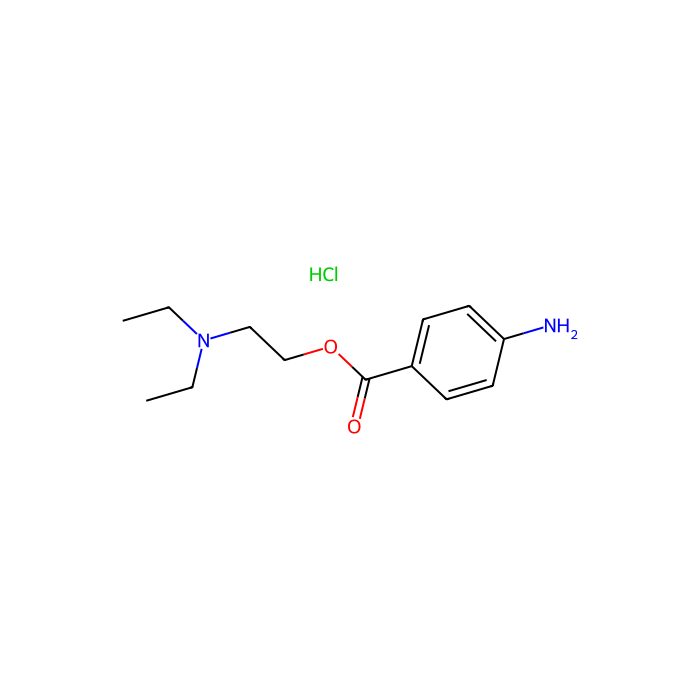
Novocaine HCl | Benzoic acid, 4-amino-, 2-(diethylamino)ethyl ester, hydrochloride (1:1)
规格或纯度
10mM in DMSO
英文名称
Procaine HCl
生化机理
普鲁卡因(Novocaine)是钠通道、NMDA 受体和 nAChR 的抑制剂,IC50 分别为 60 μM、0.296 mM 和 45.5 μM,也是 5-HT3 的抑制剂,KD为 1.7 μM。
储存条件
-80℃储存
运输条件
特低温运输
名称和识别符
EC号
200-077-2
分子类型
小分子
Isomeric SMILES
CCN(CC)CCOC(=O)C1=CC=C(C=C1)N.Cl
UN Number
分子量
272.77
Beilstein号
3917802
Reaxy-Rn
3917802
Reaxys-RN link address
https://www.reaxys.com/reaxys/secured/hopinto.do?context=S&query=IDE.XRN=3917802&ln=
技术文档
高级数据
化学和物理性质
溶解性
Solubility (25°C) In vitro DMSO: 0.01 mg/mL (0.03 mM); Water: Insoluble; Ethanol: Insoluble;
熔点
155-156°C
安全和危险性(GHS)
象形图
信号词
Danger
危险声明
H301: 吞咽会中毒
H317: 可能引起皮肤过敏反应
预防措施声明
P280: 戴防护手套/穿防护服/戴防护眼罩/戴防护面具。
P301+P310: 如误吞咽:立即呼叫急救中心/医生。
WGK Germany
3
RTECS
DG2275000
Merck Index
7757
个人防护装备
Eyeshields,Faceshields,Gloves,type P2 (EN 143) respirator cartridges
质检证书(CoA,COO,BSE/TSE 和分析图谱)
C of A & Other Certificates(BSE/TSE, COO):
输入批号以搜索分析图谱:
技术文档和文章
此产品的引用文献
溶液计算器
产品仅提供给经过验证的企业、机构和合格的专业人员用于研发。不适用于人类、动物、诊断或治疗。
Copyright © 2023至今 上海阿拉丁生化科技股份有限公司 保留所有权利。


 危险品化学品经营许可证(带存储)