
计算溶液所需的质量、体积或浓度。
为什么选择此级别
,适用于对基线干扰要求严格的色谱和分析工作流程。
储存与运输
-80℃储存。特低温运输 。请查阅批次 COA 获取详细规格。
质量文档
SDS、COA、产品数据表及规格说明书均可下载。可通过批号查询获取批次 COA。
文献证明
在色谱分析、有机合成和交叉偶联反应领域已被 0 篇同行评审文献引用。
概述
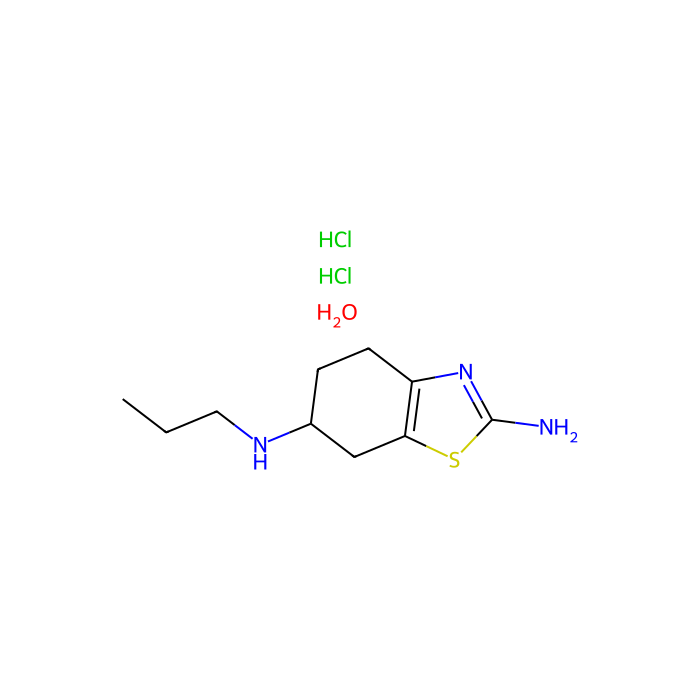
Pramipexole 2HCl Monohydrate 是一种部分/全部D2S, D2L, D3, D4受体激动剂,Ki为3.9, 2.2, 0.5, 5.1 nM。A non-ergoline dopamine agonist.
Information
Pramipexole 2HCl Monohydrateis a novel non-ergoline dopamine (DA) agonist, used to treat Parkinson's disease.
In vitro
Pramipexole, a chemically novel dopamine agonist used for the treatment of Parkinson\'s disease symptoms, possesses antioxidant activity and is neuroprotective toward substantia nigral dopamine neurons in hypoxic-ischemic and methamphetamine models. Pramipexole reduces the levels of oxygen radicals produced by methylpyridinium ion (MPP+) both when incubated with SH-SY5Y cells and when perfused into rat striatum. Pramipexole also exhibits a concentration-dependent inhibition of opening of the mitochondrial transition pore induced by calcium and phosphate or MPP+. Pramipexole decreases the levels of dopamine metabolites dose dependently, whereas striatal dopamine levels remains unchanged. Pramipexole acts in both of these models to reduce the elevated dopamine turnover and the associated elevation in hydroxyl radical production secondary to increased MAO activity that could be responsible for oxidative damage to the nigrostriatal neurons. Pramipexole (4-100 mM) significantly attenuates DA- or L-DOPA-induced cytotoxicity and apoptosis, an action which is not blocked by D3 antagonist U-99194 A or D2 antagonist raclopride. Pramipexole also protects MES 23.5 cells from hydrogen peroxide-induced cytotoxicity in a dose-dependent manner. Pramipexole can effectively inhibit the formation of melanin, an end product resulting from DA or L-DOPA oxidation in cell-free system.
In vivo
Pramipexole (0.001-1 mg/kg s.c.) reduces exploratory locomotor activity in mice. Pramipexole (1 mg/kg, p.o.) is able to significantly reduce the increased DA turnover, but by only 16%.
Cell Data
cell lines:
Concentrations:
Incubation Time:
Powder Purity:≥99%
规格
英文别名
(6S)- 4,5,6,7-tetrahydro-N6-propyl-2,6-benzothiazolediamine,hydrochloride,hydrate (1:2:1)
规格或纯度
10mM in DMSO
英文名称
Pramipexole 2HCl Monohydrate
生化机理
普拉克索 2HCl Monohydrate 是一种新型非麦角碱多巴胺(DA)激动剂,用于治疗帕金森病。
储存条件
-80℃储存
运输条件
特低温运输
作用类型
激动剂
作用机制
D2 类多巴胺受体激动剂
名称和识别符
EC号
687-708-9
分子类型
小分子
Isomeric SMILES
CCCN[C@H]1CCC2=C(C1)SC(=N2)N.O.Cl.Cl
关联CAS
PubChem CID
MeSH Entry Terms
2 Amino 6 propylaminotetrahydrobenzothiazole;2-amino-4,5,6,7-tetrahydro-6-propylaminobenzothiazole;2-amino-6-propylaminotetrahydrobenzothiazole;4,5,6,7-tetrahydro-N6-propyl-2,6-benzothiazole-diamine;6,7-tetrahydro-N6-propyl-2,6-benzothiazolediamine dihydr
分子量
302.26
技术文档
高级数据
化学和物理性质
溶解性
Solubility (25°C) In vitro DMSO: 35 mg/mL (202.06 mM); Water: Insoluble; Ethanol: 35 mg/mL
比旋光度
-67° (C=1,MeOH)
熔点
296-305°C
安全和危险性(GHS)
信号词
警告
危险声明
H302: 吞食有害
H317: 可能引起皮肤过敏反应
Merck Index
7705
质检证书(CoA,COO,BSE/TSE 和分析图谱)
C of A & Other Certificates(BSE/TSE, COO):
输入批号以搜索分析图谱:
溶液计算器
产品仅提供给经过验证的企业、机构和合格的专业人员用于研发。不适用于人类、动物、诊断或治疗。
Copyright © 2023至今 上海阿拉丁生化科技股份有限公司 保留所有权利。


 危险品化学品经营许可证(带存储)