Tg: 150°C
一般描述
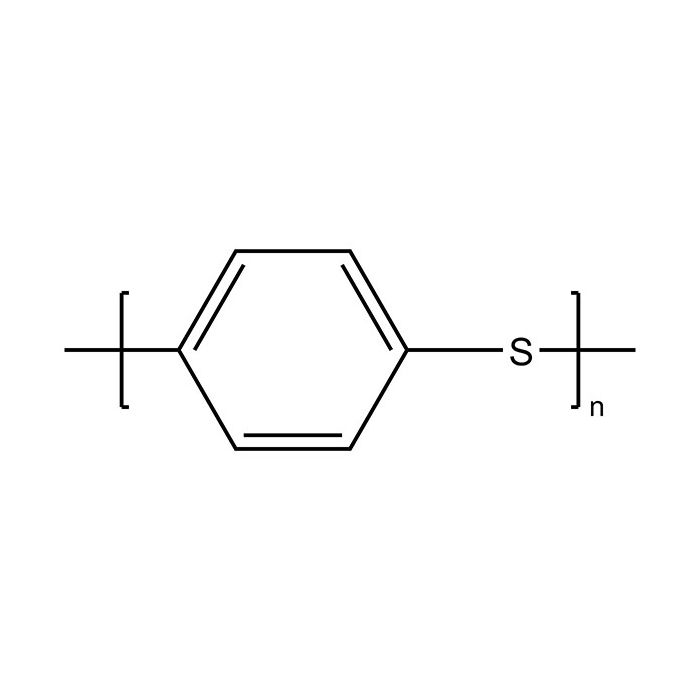
聚苯硫醚 (PPS) 是一种芳香族聚合物,可用作聚合物骨架或工程塑料。它也被称为聚苯硫醚,可以磺化形成用于电化学应用的离子交换膜。它是由 对 -二氯苯和硫酸钠在 N -甲基吡咯烷酮作溶剂中缩聚反应而得。
应用
聚苯硫醚可以磺化,与沸石形成质子交换膜,用作电解质,具有较高的热稳定性,有利于太阳能电池的制备。也可用于以纳米沸石和碳纳米管为纳米填料的有机-无机纳米复合膜的形成,可作为高性能气体分离膜。PPS 经磺化和氯甲基化后,可在分散染料、阴离子染料和阳离子染料中形成具有较高染色性能的新型 PPS 纤维。
Tg: 150°C
General description
Poly(1,4-phenylene sulfide)(PPS) is an aromatic polymer that can be used as a polymer backbone or an engineering plastic. It is also called as poly(phenylene sulfide) which can be sulfonated to form ion-exchange membranes for electrochemical applications. It is industrially produced by polycondensation of p-dichlorobenzene and sodium sulfate in N-methylpyrrolidone as a solvent.
Application
PPS can be sulfonated to form a proton exchange membrane with zeolite that can be used as an electrolyte with higher thermal stability which facilitates in the fabrication of solar cells. It can also be used in the formation of organic- inorganic nanocomposite membranes using nanozeolites and carbon nanotubes as nanofillers which can be used as high performance gas separation membranes. PPS may be sulfonated and chloromethylated to form novel PPS fiber with higher dyeing ability in dispersive, anionic and cationic dyes.

 G2631597


 危险品化学品经营许可证(带存储)