我们公司生产的红/黄/蓝/绿/紫色凝胶试剂盒(6%、8%、10%、12%、15%),是把“量子点”技术巧妙与此产品结合,孕育出彩色、简单、快速、稳定、环保的凝胶试剂盒升级产品,解决了客户配胶繁琐、看不清上样孔、不易区分不同浓度凝胶的困扰,几分钟便可配制出红/黄/蓝/绿/紫色的凝胶。
本产品适用于 Tris-甘氨酸电泳体系, 可配胶数量:125块(0.75 mm胶) 或 >90块(1.00 mm胶) 或 >60块(1.50 mm胶)。
产品特点:
1. 彩色上层胶:可制备红/黄/蓝/绿/紫色的凝胶,方便上样。
2.快速:配制好一块彩胶或多块彩胶仅需几分钟,无需计算所需溶液量,无需稀释。
3.稳定环保:凝胶无TEMED恶臭味,凝胶均匀,弹性好,不易碎,电泳蛋白质带型美观。
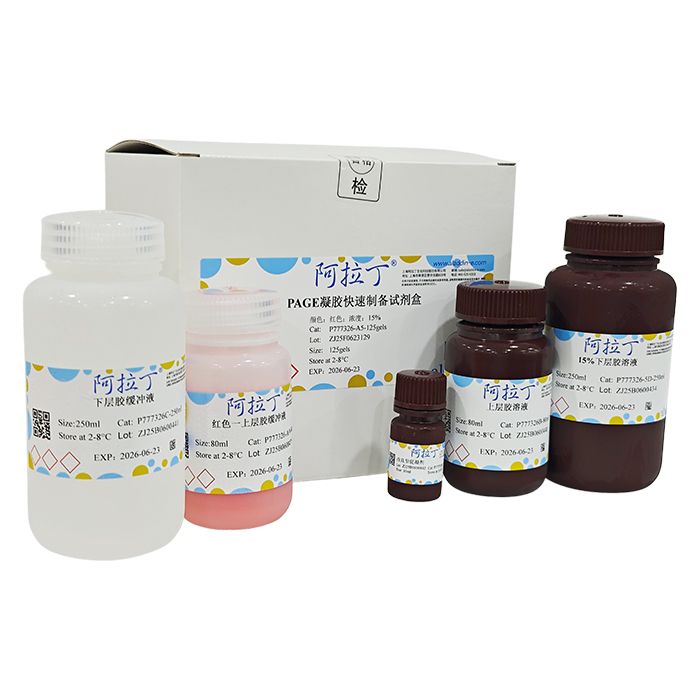
| 组分 | 试剂盒组分名称 | 规格 | 储存温度 | | A | 红/黄/蓝/绿/紫色一上层胶缓冲液 | 80mL | 2-8℃ | | B | 上层胶溶液 | 80mL | 2-8℃ | | C | 下层胶缓冲液 | 250mL | 2-8℃ | | D | 下层胶溶液 | 250mL | 2-8℃ | | E | 改良型促凝剂 | 10mL | 2-8℃
| | F | 带刻度小量杯 | 3EA | 2-8℃ |
|
使用说明:
1、下层胶配制:(以配配制一块mini胶为例0.75/1.0/1.5 mm)
a、等体积吸取下层胶溶液和下层胶缓冲液,混匀,即各吸取2/2.7/4mL。
6、对应加入40/60/80μL的促凝剂,混匀。
C、将配制好的溶液,注入制胶玻璃板中,(备注:此溶液配制为过量,留少许于小量杯中,以判断凝胶状态),加入适量水或醇覆盖于下层胶之上,待下层胶凝固后,倒去上层水或醇,用滤纸吸去多余的水或醇(备注:当水或醇和胶之间有一条折射线时说明胶已凝固,大约15分钟左右,以具体实际情况为准)。
2、上层胶的配制:
a、等体积吸取上层胶溶液和上层胶缓冲液混匀,即各吸取0.5/0.75/1mL。
6、对应加入10/15/20μL的促凝剂,混匀。
C、将配制好的溶液,注入制胶玻璃板中,插入梳子,待上层胶凝固后拔取梳子(大约15分钟左右,以具体实际情况为准),便可进行上样电泳。
备注:
1、本试剂盒上层胶对样品:有浓缩效应,促凝剂的使用量仅作参考,实际用量可根据个人实验习惯爱好和经验调整。加入较多的量的促凝剂可加速凝胶,反之亦然。凝胶速度与温度有显著的正相关性温度越高,凝胶速度越快。
2、配胶过程中有气泡的解决办法:在配胶之前,使胶溶液平衡到室温(如室温放置几分钟),可有效避免凝胶中气泡的形成。
3、由于颜料的理化性,使用前请摇匀。
4、此试剂盒也可一步法制胶,在灌完下层胶后无需液封压平胶面和等待凝胶,直接灌入上层胶即可,但此方法适合熟手,新手不建议此操作,和上面制胶方法相比仅仅节约15分钟左右。
凝胶建议使用浓度:
| 货号 | 颜色
| 上层胶浓度
| 下层胶浓度
| 分离范围 (kDa)
| 最佳范围 (kDa)
|
P777326-A1
| 红色
| 5%
| 6%胶
| 70-300
| 120-250
|
P777326-B1
| 黄色
| 5%
| 6%胶
| 70-300
| 120-250
|
P777326-C1
| 蓝色
| 5%
| 6%胶
| 70-300
| 120-250
|
P777326-D1
| 绿色
| 5%
| 6%胶
| 70-300
| 120-250
|
P777326-E1
| 紫色
| 5%
| 6%胶
| 70-300
| 120-250
|
P777326-A2
| 红色
| 5%
| 8%胶
| 50-250
| 80-200
|
P777326-B2
| 黄色
| 5%
| 8%胶
| 50-250
| 80-200
|
P777326-C2
| 蓝色
| 5%
| 8%胶
| 50-250
| 80-200
|
P777326-D2
| 绿色
| 5%
| 8%胶
| 50-250
| 80-200
|
P777326-E2
| 紫色
| 5%
| 8%胶
| 50-250
| 80-200
|
P777326-A3
| 红色
| 5%
| 10%胶
| 20-100
| 30-90
|
P777326-B3
| 黄色
| 5%
| 10%胶
| 20-100
| 30-90
|
P777326-C3
| 蓝色
| 5%
| 10%胶
| 20-100
| 30-90
|
P777326-D3
| 绿色
| 5%
| 10%胶
| 20-100
| 30-90
|
P777326-E3
| 紫色
| 5%
| 10%胶
| 20-100
| 30-90
|
P777326-A4
| 红色
| 5%
| 12%胶
| 15-60
| 15-40
|
P777326-B4
| 黄色
| 5%
| 12%胶
| 15-60
| 15-40
|
P777326-C4
| 蓝色
| 5%
| 12%胶
| 15-60
| 15-40
|
P777326-D4
| 绿色
| 5%
| 12%胶
| 15-60
| 15-40
|
P777326-E4
| 紫色
| 5%
| 12%胶
| 15-60
| 15-40
|
P777326-A5
| 红色
| 5%
| 15%胶
| 8-40
| 10-20
|
P777326-B5
| 黄色
| 5%
| 15%胶
| 8-40
| 10-20
|
P777326-C5
| 蓝色
| 5%
| 15%胶
| 8-40
| 10-20
|
P777326-D5
| 绿色
| 5%
| 15%胶
| 8-40
| 10-20
|
P777326-E5
| 紫色
| 5%
| 15%胶
| 8-40
| 10-20 |
Our company's red/yellow/blue/green/purple gel kits (6%, 8%, 10%, 12%, 15%) cleverly combine "quantum dot" technology with this product, creating a colorful, simple, fast, stable, and eco-friendly upgraded gel kit. It solves customers' troubles with cumbersome gel preparation, difficulty in seeing sample wells, and difficulty in distinguishing gels of different concentrations. A red/yellow/blue/green/purple gel can be prepared in just a few minutes.
This product is suitable for the Tris-Glycine electrophoresis system. Gel preparation capacity: 125 gels (0.75 mm gels) or >90 gels (1.00 mm gels) or >60 gels (1.50 mm gels).
Product Features:
1.Colored upper gel: Gels in red/yellow/blue/green/purple can be prepared for convenient sample loading.
2.Fast: Preparing one colored gel or multiple colored gels takes only a few minutes—no need to calculate the required solution volumes and no dilution required.
3.Stable and eco-friendly: The gel has no TEMED odor, is uniform, has good elasticity, and is not easily broken. The electrophoretic protein band pattern is美观 (aesthetic/clean).
| Component | Kit Component Name | Specification | Storage Temperature | | A | Stacking Gel Buffer (Red/Yellow/Blue/Green/Purple) | 80 mL | 2–8 ℃ | | B | Stacking Gel Solution | 80 mL | 2–8 ℃ | | C | Resolving Gel Buffer | 250 mL | 2–8 ℃ | | D | Resolving Gel Solution | 250 mL | 2–8 ℃ | | E | Modified Accelerator | 10 mL | −20 ℃ | | F | Graduated Micro Beaker | 3 EA | 2–8 ℃ |
|
Instructions for Use:
1. Preparation of the Resolving (Lower) Gel: (Example: preparing one mini gel, 0.75/1.0/1.5 mm)
a. Pipette equal volumes of the Resolving Gel Solution and the Resolving Gel Buffer, and mix well—i.e., pipette 2/2.7/4 mL of each.
b. Add 40/60/80 μL of the polymerization initiator accordingly, and mix well.
c. Pour the prepared solution into the gel-casting glass plate. (Note: The prepared solution is in excess; leave a small amount in a small cup to judge the gelation state.) Add an appropriate amount of water or alcohol to overlay the resolving gel. After the resolving gel has set, pour off the upper water or alcohol and blot away the excess water or alcohol with filter paper. (Note: When a refraction line appears between the water/alcohol and the gel, the gel has set—approximately 15 minutes, subject to actual conditions.)
2. Preparation of the Stacking (Upper) Gel:
a. Pipette equal volumes of the Stacking Gel Solution and the Stacking Gel Buffer, and mix well—i.e., pipette 0.5/0.75/1 mL of each.
b. Add 10/15/20 μL of the polymerization initiator accordingly, and mix well.
c. Pour the prepared solution into the gel-casting glass plate, insert the comb, and after the stacking gel has set, remove the comb (approximately 15 minutes, subject to actual conditions). The gel is then ready for sample loading and electrophoresis.
Precautions:
1.The stacking gel in this kit has a concentrating effect on samples. The amount of polymerization initiator used is for reference only; the actual amount can be adjusted according to personal experimental habits and experience. Adding a larger amount of initiator accelerates gelation, and vice versa. Gelation speed is significantly positively correlated with temperature—the higher the temperature, the faster the gelation.
2.To address bubbles during gel preparation: before preparing the gel, equilibrate the gel solutions to room temperature (e.g., leave at room temperature for a few minutes), which can effectively prevent bubble formation in the gel.
3.Due to the physicochemical properties of the pigments, please shake well before use.
4.This kit can also be used for one-step gel preparation: after pouring the resolving gel, there is no need to overlay liquid to level the gel surface or wait for gelation—simply pour the stacking gel directly on top. However, this method is suitable for experienced users and not recommended for beginners. Compared with the above method, it only saves about 15 minutes.
Recommended Gel Concentrations:
| Cat. No. | Color | Stacking Gel Concentration | Resolving Gel Concentration | Separation Range (kDa) | Optimal Range (kDa) | | P777326-A1 | Red | 5% | 6% | 70–300 | 120–250 | | P777326-B1 | Yellow | 5% | 6% | 70–300 | 120–250 | | P777326-C1 | Blue | 5% | 6% | 70–300 | 120–250 | | P777326-D1 | Green | 5% | 6% | 70–300 | 120–250 | | P777326-E1 | Purple | 5% | 6% | 70–300 | 120–250 | | P777326-A2 | Red | 5% | 8% | 50–250 | 80–200 | | P777326-B2 | Yellow | 5% | 8% | 50–250 | 80–200 | | P777326-C2 | Blue | 5% | 8% | 50–250 | 80–200 | | P777326-D2 | Green | 5% | 8% | 50–250 | 80–200 | | P777326-E2 | Purple | 5% | 8% | 50–250 | 80–200 | | P777326-A3 | Red | 5% | 10% | 20–100 | 30–90 | | P777326-B3 | Yellow | 5% | 10% | 20–100 | 30–90 | | P777326-C3 | Blue | 5% | 10% | 20–100 | 30–90 | | P777326-D3 | Green | 5% | 10% | 20–100 | 30–90 | | P777326-E3 | Purple | 5% | 10% | 20–100 | 30–90 | | P777326-A4 | Red | 5% | 12% | 15–60 | 15–40 | | P777326-B4 | Yellow | 5% | 12% | 15–60 | 15–40 | | P777326-C4 | Blue | 5% | 12% | 15–60 | 15–40 | | P777326-D4 | Green | 5% | 12% | 15–60 | 15–40 | | P777326-E4 | Purple | 5% | 12% | 15–60 | 15–40 | | P777326-A5 | Red | 5% | 15% | 8–40 | 10–20 | | P777326-B5 | Yellow | 5% | 15% | 8–40 | 10–20 | | P777326-C5 | Blue | 5% | 15% | 8–40 | 10–20 | | P777326-D5 | Green | 5% | 15% | 8–40 | 10–20 | | P777326-E5 | Purple | 5% | 15% | 8–40 | 10–20 |
|

 ZJ25F0623211


 危险品化学品经营许可证(带存储)