
计算溶液所需的质量、体积或浓度。
为什么选择此级别
,适用于对基线干扰要求严格的色谱和分析工作流程。
储存与运输
2-8°C储存,干燥。低温运输 。请查阅批次 COA 获取详细规格。
质量文档
SDS、COA、产品数据表及规格说明书均可下载。可通过批号查询获取批次 COA。
文献证明
在色谱分析、有机合成和交叉偶联反应领域已被 0 篇同行评审文献引用。
概述
Quinagolide hydrochloride (CV205-502 hydrochloride) is a selective and orally active dopamine D2 receptor agonist. Quinagolide hydrochloride is an inhibitor of prolactin. Quinagolide hydrochloride down-regulates AKT levels and its phosphorylation. Quinagolide hydrochloride shows antitumor effects, it can be used for the research of cancer.
In Vitro
Quinagolide hydrochloride (100 nM; 48 h) reduces non-ergot dopamine receptor 2 (DRD2) mRNA expression in ectopic lines. Quinagolide hydrochloride (100 nM; 48 h) inhibits the invasive properties of endometrial mesenchymal stromal cells (E-MSCs). Quinagolide hydrochloride (100 nM; 24 h) significantly reduces the endothelial differentiation of E-MSCs. MCE has not independently confirmed the accuracy of these methods. They are for reference only. Western Blot AnalysisCell Line: Eutopic and ectopic E-MSCs Concentration: 100 nM Incubation Time: 24 h Result: Reduced total AKT levels in ectopic E-MSCs and significantly decreased AKT phosphorylation in both eutopic and ectopic cell lines.
In Vivo
Quinagolide hydrochloride (0.03-0.6 mg/kg; s.c. once daily for 2 month) effectively inhibits tumor growth in vivo . MCE has not independently confirmed the accuracy of these methods. They are for reference only. Animal Model: Female Wistar-Furth rats bearing SMtTW tumors Dosage: 0.03-0.6 mg/kg Administration: Subcutaneous injection; 0.03-0.6 mg/kg once daily for 2 month Result: Induced normalization of plasma PRL levels in all animals, reduced the tumor size compared with the control group at a dose of 0.3 mg/kg. Showed maximal inhibitory effects on PRL secretion and tumor growth at a dose of 0.3 mg/kg.
Form:Solid
规格
别名
盐酸喹高利特
英文别名
A844947 | Quinagolide (hydrochloride) | (3S,4aS,10aR)-3-(diethylsulfamoylamino)-6-hydroxy-1-propyl-3,4,4a,5,10,10a-hexahydro-2H-benzo[g]quinoline;hydrochloride | CV205-502 hydrochloride | F85304 | HY-13736A | SDZ-205502 | DTXSID20241478 | D08457 | Quinago
英文名称
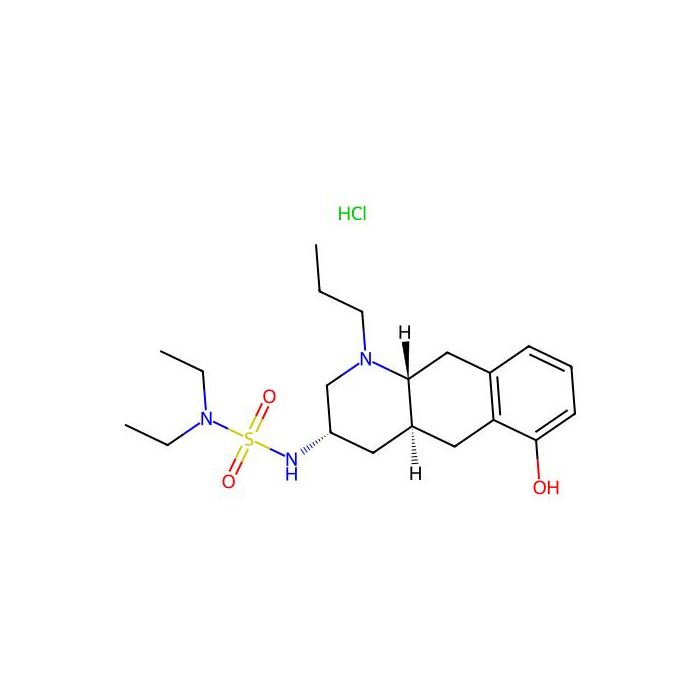
Quinagolide hydrochloride
生化机理
盐酸喹高莱(CV205-502 hydrochloride)是一种选择性口服活性多巴胺 D2 受体激动剂。盐酸喹高莱是一种催乳素抑制剂。盐酸喹高莱可下调 AKT 水平及其磷酸化。喹高莱
储存条件
2-8°C储存,干燥
运输条件
低温运输
名称和识别符
分子类型
小分子
IUPAC Name
(3S,4aS,10aR)-3-(diethylsulfamoylamino)-6-hydroxy-1-propyl-3,4,4a,5,10,10a-hexahydro-2H-benzo[g]quinoline;hydrochloride
INCHI
1S/C20H33N3O3S.ClH/c1-4-10-22-14-17(21-27(25,26)23(5-2)6-3)11-16-12-18-15(13-19(16)22)8-7-9-20(18)24;/h7-9,16-17,19,21,24H,4-6,10-14H2,1-3H3;1H/t16-,17+,19-;/m1./s1
InChi Key
DVLKVIJLALMCBQ-MSSRUXLCSA-N
Smiles
CCCN1CC(CC2C1CC3=C(C2)C(=CC=C3)O)NS(=O)(=O)N(CC)CC.Cl
Isomeric SMILES
CCCN1C[C@H](C[C@H]2[C@H]1CC3=C(C2)C(=CC=C3)O)NS(=O)(=O)N(CC)CC.Cl
关联CAS
PubChem CID
MeSH Entry Terms
CV 205-502;CV-205-502;CV205-502;N,N-diethyl-N'-(1,2,3,4,4a,5,10,10a-octahydro-6-hydroxy-1-propyl-3-benzo(g)quinolinyl)sulfamide hydrochloride, (3alpha,4aalpha,10abeta)-(+)-isomer;N,N-diethyl-N'-(1,2,3,4,4a,5,10,10a-octahydro-6-hydroxy-1-propyl-3-benzo(g)q
分子量
432.02
技术文档
高级数据
系统学分类
分类树(Taxonomy Tree)
| 界(kingdom) | 有机化合物 |
|---|---|
| 超类(Superclass) | 有机杂环化合物 |
| 类(Class) | 喹啉及其衍生物 |
| 亚类(Subclass) | 苯并喹啉 |
| 中间层级节点(Intermediate Tree Nodes) | 暂无 |
| 直接上位类(Direct Parent) | 苯并喹啉 |
| 其他上位类(Alternative Parents) | 四氢萘 芳烷基胺 1-羟基-4-未取代苯类化合物 1-羟基-2-未取代苯类化合物 硫酸二酰胺 哌啶类 三烷基胺 氮杂环化合物 有机氧化合物 有机氧化物 盐酸盐 碳氢化合物衍生物 |
| 分子骨架(Molecular Framework) | 芳香族杂多环化合物 |
| 取代基(Substituents) | 1-羟基-2-未取代苯环化合物 - 1-羟基-4-未取代苯环化合物 - 氨基酸 - 芳烷基胺 - 芳香族杂多环化合物 - 氮杂环 - 苯基化合物 - 苯并噻唑 - 烃衍生物 - 氟氯烃 - 有机硝基化合物 - 有机氧化物 - 有机氧化合物 - 有机磺酰胺 - 有机氮化合物 - 有机氧化合物 - 苯酚 - 哌嗪 - 二氨基磺酸 - 三元脂肪胺 - 三芳基胺 - 四氢吡啶 |
| 描述(Description) | 该化合物属于苯并喹啉类有机化合物。这类化合物具有苯环与喹啉环系共轭的结构。 |
| 外部描述符(External Descriptors) | 暂无 |
三维结构
交互式化学结构模型
化学和物理性质
溶解性
DMSO : 3.85 mg/mL (8.91 mM; Need ultrasonic)
分子量
432.000 g/mol
XLogP3
氢键供体数Hydrogen Bond Donor Count
3
氢键受体数Hydrogen Bond Acceptor Count
6
可旋转键计数Rotatable Bond Count
7
精确质量Exact Mass
431.201 Da
单同位素质量Monoisotopic Mass
431.201 Da
拓扑极表面积Topological Polar Surface Area
81.300 Ų
重原子数Heavy Atom Count
28
形式电荷Formal Charge
0
复杂度Complexity
576.000
同位素原子数Isotope Atom Count
0
定义的原子立体中心计数Defined Atom Stereocenter Count
3
未定义的原子立体中心计数Undefined Atom Stereocenter Count
0
定义的键立体中心计数Defined Bond Stereocenter Count
0
未定义的键立体中心计数Undefined Bond Stereocenter Count
0
所有立体化学键的总数The total count of all stereochemical bonds
0
共价键合单元计数Covalently-Bonded Unit Count
2
质检证书(CoA,COO,BSE/TSE 和分析图谱)
C of A & Other Certificates(BSE/TSE, COO):
输入批号以搜索分析图谱:
溶液计算器
常见问题
本产品应如何储存?
请于2–8 °C、干燥条件下保存。请与干燥剂一同密封保存,本品对湿气敏感。
本产品如何运输?
本产品采用湿冰冷藏运输。收货后请立即拆包,并按上述储存条件保存。
本产品的 CAS 号、分子式和分子量是多少?
本产品的 CAS 号为 94424-50-7,分子式为 C20H34ClN3O3S,分子量为 432.02 g/mol。InChIKey DVLKVIJLALMCBQ-MSSRUXLCSA-N。
如何获取批次专用COA?
每个订单都会随附分析证书(COA),您也可以从账户订单历史中下载。如需订购前的COA,请联系您的客户代表,或使用PDP上的"申请COA"按钮——我们将提供代表性批次的COA。
产品仅提供给经过验证的企业、机构和合格的专业人员用于研发。不适用于人类、动物、诊断或治疗。
Copyright © 2023至今 上海阿拉丁生化科技股份有限公司 SSE:688179 保留所有权利。


 危险品化学品经营许可证(带存储)