
计算溶液所需的质量、体积或浓度。
随机突变试剂盒
有货
BioReagent,分子生物学级,无菌 级 ,适用于对基线干扰要求严格的色谱和分析工作流程。
-20°C储存,避免反复冻融。超低温运输 。请查阅批次 COA 获取详细规格。
SDS、COA、产品数据表及规格说明书均可下载。可通过批号查询获取批次 COA。
在色谱分析、有机合成和交叉偶联反应领域已被 0 篇同行评审文献引用。
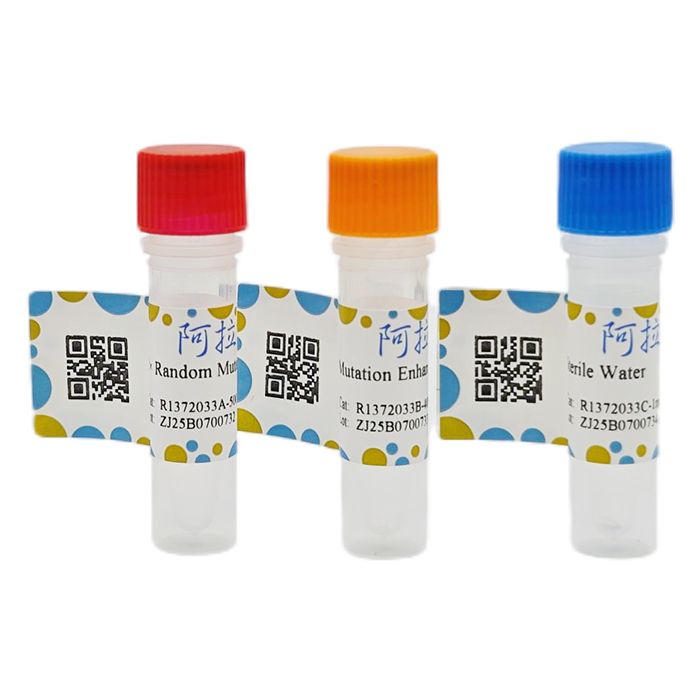
随机突变是阐述蛋白质结构和功能之间的关系、改进蛋白质性能的重要工具。随机突变试剂盒基于易错PCR(error-prone PCR)技术,利用 Taq DNA polymerase 不具有 3′→5′校对功能的特性,在特定的反应缓冲体系中,向扩增的目的基因中引入随机突变密码子。带有随机突变的扩增产物通过双酶切,连接到表达载体中构建文库,然后转化入表达宿主中,进行蛋白活性筛选。如果经一次突变反应不能获得满意的结果,可采用连续易错 PCR(sequential error-prone PCR)策略,即将一次 PCR 扩增得到的有用突变基因作为下一次 PCR 扩增的模板,连续反复地进行随机诱变,使每一次获得的突变累积而产生更有意义的突变。本试剂盒包含有优化的 2x Random System、 Enhancer 和Sterile Water 三种组分,使用时只需加入适量的 DNA 模板和合成的两条扩增引物,并用水补足体积,即可进行扩增反应,操作简便快速,大大减少了多次加样可能造成的出错和污染机会。2x Random System 含有优化浓度的 Taq DNA polymerase、dNTPs、反应缓冲液和稳定剂,可最大限度地克服常规易错 PCR 技术中,由于 Taq DNA polymerase 本身的偏爱性造成的以 GC 突变为主的缺点,获得相对均衡的突变谱。碱基突变率可通过适量添加 Enhancer、调整模板 DNA 量和改变 PCR 扩增循环数进行控制。
产品组分表
|
下表列出以 10 ng 质粒 DNA 为模板,PCR 扩增一条 1 kb DNA 片段(20 个循环)后测序检测得到的突变率结果。需要注意的是,由于不同 DNA 模板的碱基组成不同、长度不一,以及不同引物的扩增效率存在差异,所以即使在相同的 PCR 反应条件下,两组 PCR 产物所得到的突变率也可能不同。因此我们建议根据实验的具体要求,首先进行多个小体系(20 μl)扩增预实验,分别加入不同体积的 Enhancer(如 0 μl、1μl、5 μl、10 μl 等),摸索出符合目标突变率的反应条件
后,再放大扩增体系。其他影响突变率的因素见【注意事项】。
以50 µl PCR反应体系为例:
|
本试剂盒适用于扩增低于 4 kb、GC 含量在 70%以下的目标 DNA 片段。
保存条件
-20℃保存,保质期 12 个月;经常使用,可于 4℃保存,保质期 3 个月。
使用方法
1. 引物设计原则:
1)正、反向扩增引物各一条,长度约 20-45 个碱基,3’端分别与目标突变 DNA 片段的上下游结合;
2)尽量将引物的 GC 含量控制在 40-60%;
3)引物如带有克隆酶切位点,必须添加足够的保护碱基以确保酶切效率;实验证明,引物结合在目标 DNA 片段的酶切位点外侧可提高酶切效率,增加转化的克隆数量。
2. 随机突变反应:
1) PCR 反应体系:向 PCR 薄壁管中依次加入下列试剂
|
注:突变率可通过改变起始模板浓度和扩增循环数进行控制。起始模板浓度越高,突变率越低;扩增循环数越高,突变率越高。
2) 混匀后短暂离心,放入 PCR 仪。
3) PCR 循环参数的设置:
|
3. 取 1-5 μl PCR 产物电泳检测条带浓度和特异性。
4. 剩余的 PCR 产物电泳,切胶回收目标 DNA 片段。
5. 酶切、连接、转化到表达宿主菌株中进行筛选。
注意事项
1. 由于不同 DNA 模板的碱基组成不同、长度不一,以及不同引物的扩增效率存在差异,所以即使在相同的 PCR 反应条件下,两组 PCR 产物所得到的突变率也可能不同。因此我们建议根据具体实验要求,首先进行多个小体系(20 μl)扩增预实验,分别加入不同体积的 StarMut Enhancer(如 0 μl、1 μl、5 μl、10 μl 等),通过测序或活性检测等方法,摸索出符合目标突变率的反应条件后,再放大扩增体系。
2. 起始 DNA 模板的浓度对突变率有很大影响,通常可通过提高或降低 DNA 模板的浓度来调整突变率。鉴于不同型号的分光光 度计检测的 DNA 浓度存在偏差,DNA 模板最好在酶切线性化后,采用凝胶电泳方法,与已知浓度的线性化双链 DNA 或商品化的 DNA marker 进行对比,确定其浓度。
3. 突变反应产物必须进行切胶回收处理,去除 DNA 模板、PCR 产物上结合的 Taq 酶以及其他杂质。常规的乙醇沉淀、硅胶膜(珠)或玻璃奶吸附等方法,均无法去除结合的 Taq 酶,后者可能遮蔽酶切位点,影响克隆效率。
4. 建立随机突变文库通常需要 10-200 ng/μl (相当于 500 ng -10 μg/50 μl 体系)的 PCR 产物。如遇产量不足,可通过下列方法提高产量:
1) 突变率符合需求时,可放大 PCR 体系,或切胶回收 PCR 产物后,采用常规 PCR 反应条件进行扩增;
2) 突变率低于需求时,提高 PCR 扩增循环数,或切胶回收 PCR 产物后,进行第二轮随机突变反应;
3) 重新设计扩增引物;
4) 降低退火温度;
5) 确保模板质量,采用凝胶电泳方法精确定量。
5. 对于带有克隆酶切位点的 DNA 模板,必须在 PCR 反应结束后,使用 DpnI 完全消化清除甲基化的模板,再切胶回收目标DNA 片段。对于非甲基化的质粒(例如从大肠杆菌 JM110 或 SCS110 菌株中提取的质粒),可通过转化 dam+ 的大肠杆菌菌株(如 DH5α、TOP10、JM109、XL1-Blue 等),再抽提获得甲基化的质粒作为 PCR 反应模板。
6. 经过双酶切的克隆载体在插入突变 DNA 片段前,应首先通过自身连接检测,确保极低的自连背景。必要时可采用去磷酸化、切胶回收等方法把自连率降至最低,以免影响后续连接反应。
Random mutagenesis is an important tool for elucidating the relationship between protein structure and function and improving protein properties. Based on error-prone PCR technology, the Random Mutagenesis Kit leverages the property that Taq DNA polymerase lacks 3′→5′ proofreading activity to introduce random mutant codons into amplified target genes within a specific reaction buffer system. The amplified products carrying random mutations are subjected to double restriction enzyme digestion, ligated into an expression vector for library construction, and then transformed into an expression host for protein activity screening. If satisfactory results cannot be obtained from a single mutagenesis reaction, the sequential error-prone PCR strategy can be adopted. Specifically, valuable mutant genes amplified in one round of PCR serve as templates for the next round of PCR amplification, and random mutagenesis is performed repeatedly. Mutations accumulated in each round can generate more meaningful variants. This kit consists of three components: optimized 2× Random System, Enhancer and Sterile Water. For amplification reactions, users only need to add an appropriate amount of DNA template and two synthetic amplification primers, and adjust the final volume with water. The procedure is simple and efficient, which greatly reduces the risks of error and contamination caused by repeated pipetting operations. The 2× Random System contains Taq DNA polymerase, dNTPs, reaction buffer and stabilizers at optimized concentrations. It can largely overcome the drawback of conventional error-prone PCR, in which mutations are predominantly GC transitions/transversions due to the inherent bias of Taq DNA polymerase, thereby generating a relatively balanced mutation spectrum. The base mutation rate can be controlled by appropriate addition of Enhancer, adjusting the amount of template DNA, and varying the number of PCR amplification cycles.
Product Components:
|
The table below shows mutation rates determined by sequencing after PCR amplification of a 1 kb DNA fragment (20 cycles) using 10 ng plasmid DNA as the template. It should be noted that due to differences in base composition and length of various DNA templates, as well as variable amplification efficiencies of different primers, mutation rates obtained from two batches of PCR products may differ even under identical PCR reaction conditions. Therefore, we recommend performing preliminary small-scale (20 μL) amplification tests with varying volumes of Enhancer (e.g., 0 μL, 1 μL, 5 μL, 10 μL) to identify reaction conditions yielding the target mutation rate before scaling up the reaction volume. Other factors affecting mutation rates are listed in the Notes section.
Example of a 50 µL PCR reaction system:
|
This kit is suitable for amplification of target DNA fragments shorter than 4 kb with a GC content below 70%.
Storage Conditions:
Store at -20 °C for a shelf life of 12 months. For frequent use, storage at 4 °C is acceptable with a shelf life of 3 months.
Instructions for Use:
1. Primer Design Guidelines
① Prepare one forward primer and one reverse primer, approximately 20–45 bases in length. The 3′ termini bind to the upstream and downstream regions flanking the target DNA fragment for mutagenesis, respectively.
② The GC content of primers is preferably controlled within the range of 40–60%.
③ If restriction enzyme sites are incorporated into primers, sufficient protective bases must be added to guarantee digestion efficiency. Experiments have verified that positioning primer binding sites outside the restriction sites of the target DNA fragment improves digestion efficiency and increases the number of transformant colonies.
2. Random Mutagenesis Reaction
① PCR Reaction Setup: Add the following reagents sequentially into a thin-walled PCR tube
|
Note: The mutation rate can be tuned by varying the initial template concentration and the number of amplification cycles. A higher initial template concentration results in a lower mutation rate; a greater number of amplification cycles leads to a higher mutation rate.
② Mix thoroughly, perform brief centrifugation, and place the tube into a thermal cycler.
③ PCR Cycling Parameters:
|
3. Load 1–5 μL of the PCR product for agarose gel electrophoresis to examine band intensity and specificity.
4. Subject the remaining PCR product to electrophoresis, then excise the target DNA band for gel extraction.
5. Conduct restriction digestion, ligation, and transformation into expression host strains for subsequent screening.
Precautions:
1. Due to variations in base composition and length of different DNA templates, as well as differences in amplification efficiency among distinct primers, mutation rates of two batches of PCR products may differ even under identical PCR reaction conditions. Therefore, we recommend carrying out multiple preliminary small-scale (20 μL) amplification tests according to specific experimental requirements. Add different volumes of StarMut Enhancer (e.g., 0 μL, 1 μL, 5 μL, 10 μL, etc.) respectively. Identify reaction conditions that achieve the target mutation rate via sequencing, activity assay or other approaches before scaling up the reaction system.
2. The concentration of initial DNA template exerts a substantial influence on mutation rate, which can generally be modulated by increasing or decreasing the template concentration. Since deviations exist in DNA concentration measurements obtained from different spectrophotometers, it is recommended to linearize the DNA template by restriction digestion. Subsequently, quantify the template concentration by agarose gel electrophoresis through comparison with linear double-stranded DNA of known concentration or commercial DNA markers.
3. The mutagenesis PCR products must be purified by gel extraction to remove residual DNA template, Taq polymerase bound to PCR fragments and other impurities. Conventional purification methods such as ethanol precipitation, silica membrane/bead adsorption or glass milk extraction cannot eliminate bound Taq polymerase. Residual bound Taq polymerase may mask restriction sites and reduce cloning efficiency.
4. Construction of random mutagenesis libraries generally requires PCR products at a concentration of 10–200 ng/μL (equivalent to 500 ng – 10 μg in a 50 μL reaction system). If PCR yield is insufficient, the following strategies can be adopted to improve yield:
① If the obtained mutation rate meets requirements, scale up the PCR system, or amplify the gel-purified PCR product under standard PCR conditions;
② If the mutation rate is lower than expected, increase the number of PCR cycles, or perform a second round of random mutagenesis using gel-extracted PCR fragments as template;
③ Redesign amplification primers;
④ Lower the annealing temperature;
⑤ Guarantee high template quality and perform accurate quantification via gel electrophoresis.
5. For DNA templates containing cloning restriction sites, DpnI must be used to completely digest methylated template DNA upon completion of PCR, followed by gel extraction of target DNA fragments. For unmethylated plasmids (e.g., plasmids extracted from E. coli strains JM110 or SCS110), transform them into dam⁺ E. coli strains (such as DH5α, TOP10, JM109, XL1-Blue, etc.), then isolate methylated plasmids to serve as PCR templates.
6. Prior to insertion of mutated DNA fragments, double-digested cloning vectors should be subjected to self-ligation tests to ensure an extremely low self-ligation background. If necessary, dephosphorylation and gel extraction can be applied to minimize self-ligation rate and avoid interference with subsequent ligation reactions.
通过匹配包装上的批号来查找并下载产品的 COA,每批产品都进行了严格的验证,您可放心使用!
| 批号(Lot Number) | 证书类型 | 货号 |
|---|---|---|
 ZJ26F0939451 |
分析证书 | R1372033 |
| ZJ26F0838449 |
分析证书 | R1372033 |
| ZJ26F0434283 |
分析证书 | R1372033 |
| ZJ25F0724900 |
分析证书 | R1372033 |
我们的级别选择指南涵盖了目录中所有的变体的纯度、稳定剂状态和应用适用性。
查看 BioReagent 级别指南 → 查看 Suitable for molecular biology 级别指南 → 查看 Sterile 级别指南 →

 危险品化学品经营许可证(带存储)