
计算溶液所需的质量、体积或浓度。
为什么选择此级别
,适用于对基线干扰要求严格的色谱和分析工作流程。
储存与运输
-80℃储存。特低温运输 。请查阅批次 COA 获取详细规格。
质量文档
SDS、COA、产品数据表及规格说明书均可下载。可通过批号查询获取批次 COA。
文献证明
在色谱分析、有机合成和交叉偶联反应领域已被 7 篇同行评审文献引用。
概述
Ranitidine是组胺H2-受体拮抗剂,IC50为3.3±1.4 μM。A histamine H2-receptor antagonist.
Information
Ranitidine (AH19065) is ahistamine H2-receptorantagonist, used to treat stomach or intestinal ulcers.
In vitro
Ranitidine sensitizes hepatocytes to killing by cytotoxic products from activated neutrophils, whereas Famotidine lacks this ability. Ranitidine inhibits the production of tumor necrosis factor-alpha (TNF-alpha) in monocytes stimulated with lipopolysaccharide in vitro. Ranitidine reduces the Kel of morphine dose-dependently with a maximum effect of 50%, and increases the relative concentration of morphine-6-glucuronide to morphine-3-glucuronide in isolated guinea pig hepatocytes. Ranitidine gradually decreases the morphine-3-glucuronide/morphine-6-glucuronide ratio by up to 21%.
In vivo
Ranitidine results in liver injury as evidence by increased in serum alanine aminotransferase, aspartate aminotransferase, and gamma-glutamyl transferase activities within 6 hours after Ranitidine administration in rats. Ranitidine inhibits hepatic ischemia/reperfusion-induced increase in hepatic tissue levels of TNF-alpha, cytokine-induced neutrophil chemoattractant, and hepatic accumulation of neutrophils in rats. Ranitidine cotreatment enhances LPS-induced coagulation prior to liver injury, and anticoagulants reduce liver damage in LPS/RAN-treated rats. Ranitidine /LPS-treated rats results in the formation of fibrin clots in liver sinusoids, and prevention of fibrin deposition associated with reduced hepatocellular injury. Ranitidine cotreatment enhances the LPS-induced TNF increase before the onset of hepatocellular injury in rats. Ranitidine displays anxiolytic effects in the elevated plus-maze as indicated by an increase in time spent in the open arms, more open-arm scanning and more end-excursions in rats.
Cell Data
cell lines:
Concentrations:
Incubation Time:
Powder Purity:≥100%
规格
英文别名
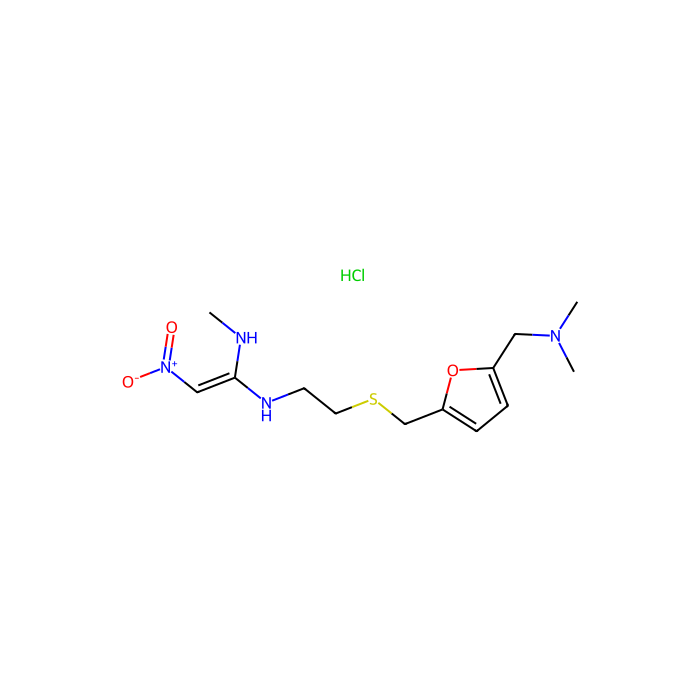
AH19065 | N'-[2-[[[5-[(dimethylamino)methyl]-2-furanyl]methyl]thio]ethyl]-N-methyl-2-nitro-1,1-ethenediamine,hydrochloride (1:1)
规格或纯度
10mM in DMSO
英文名称
Ranitidine Hydrochloride
生化机理
雷尼替丁(AH19065)是一种组胺 H2 受体拮抗剂,用于治疗胃溃疡或肠溃疡。
储存条件
-80℃储存
运输条件
特低温运输
作用类型
抑制剂
名称和识别符
EC号
266-333-0
分子类型
小分子
Isomeric SMILES
CN/C(=C\[N+](=O)[O-])/NCCSCC1=CC=C(O1)CN(C)C.Cl
分子量
350.86
Reaxy-Rn
5196014
Reaxys-RN link address
https://www.reaxys.com/reaxys/secured/hopinto.do?context=S&query=IDE.XRN=5196014&ln=
技术文档
高级数据
化学和物理性质
溶解性
Solubility (25°C) In vitro Water: 55 mg/mL (198.37 mM); DMSO: 4 mg/mL (14.42 mM);
熔点
135 °C(dec.)
安全和危险性(GHS)
信号词
Danger
危险声明
H315: 引起皮肤刺激
H319: 引起严重眼睛刺激
H335: 可能引起呼吸道刺激
H317: 可能引起皮肤过敏反应
H334: 吸入可能引起过敏或哮喘病症状或呼吸困难
预防措施声明
P261: 避免吸入灰尘/烟雾/气体/雾/蒸汽/喷雾
P305+P351+P338: 如进入眼睛:用水小心冲洗几分钟。如戴隐形眼镜并可方便地取出,取出隐形眼镜。继续冲洗。
P280: 戴防护手套/穿防护服/戴防护眼罩/戴防护面具。
P302+P352: 如皮肤沾染:用水充分清洗。
P321: 特殊处理(请参阅此标签上的...)。
P405: 密闭存放
P501: 将内容物/容器处理到。。。
P264: 处理后要彻底洗手。
P284: 如果通风不良,请佩戴呼吸防护装置。
P271: 仅在室外或通风良好的地方使用。
P304+P340: 如误吸入:将人转移到空气新鲜处,保持呼吸舒适体位。
P403+P233: 存放在通风良好的地方。保持容器密闭。
P272: 被污染的工作服不允许离开工作场所
P333+P313: 如发生皮肤刺激或皮疹:求医/就诊。
P362+P364: 脱掉沾污的衣服,清洗后方可重新使用。
P264+P265: 处理后彻底洗手[和…]。不要触摸眼睛。
P337+P317: 如果眼睛刺激持续:寻求医疗帮助。
P332+P317: 如果出现皮肤刺激:请寻求医疗帮助。
P319: 如果你感到不适,请寻求医疗帮助。
P342+P316: 如果出现呼吸道症状:立即寻求急救。
WGK Germany
2
RTECS
KM6557000
Merck Index
8110
个人防护装备
Eyeshields, Gloves, type N95 (US), type P1 (EN143) respirator filter
质检证书(CoA,COO,BSE/TSE 和分析图谱)
C of A & Other Certificates(BSE/TSE, COO):
输入批号以搜索分析图谱:
此产品的引用文献
溶液计算器
产品仅提供给经过验证的企业、机构和合格的专业人员用于研发。不适用于人类、动物、诊断或治疗。
Copyright © 2023至今 上海阿拉丁生化科技股份有限公司 保留所有权利。


 危险品化学品经营许可证(带存储)