Streptavidin is used as a tetrameric protein used to visualize biotin conjugated molecules in ELISA. Due to the strong affinity of biotin and biotinylated molecules has made streptavidin one of the most important components in diagnostics and laboratory kits. Streptavidin is widely used in molecular biology through its unique high affinity for the biotin.
规格
产品名称
LumiDye™ Violet 421标记的链霉亲和素
别名
重组链霉亲和素 | 链霉亲和素
英文别名
SA V1 | SA V2 | strepavidin | Streptavidin V1 | Streptavidin V2 | Streptavidin
Liquid in PBS pH 7.4, containing 50% glycerol, 1% BSA and 0.05% Proclin300.
防腐剂
0.05% ProClin300
浓度
1.0 mg/mL
储存条件
避光,-20°C储存,避免反复冻融
运输条件
超低温运输
稳定性与储存
Store at -20°C. Protect from light. Avoid freeze/thaw cycles.
图片
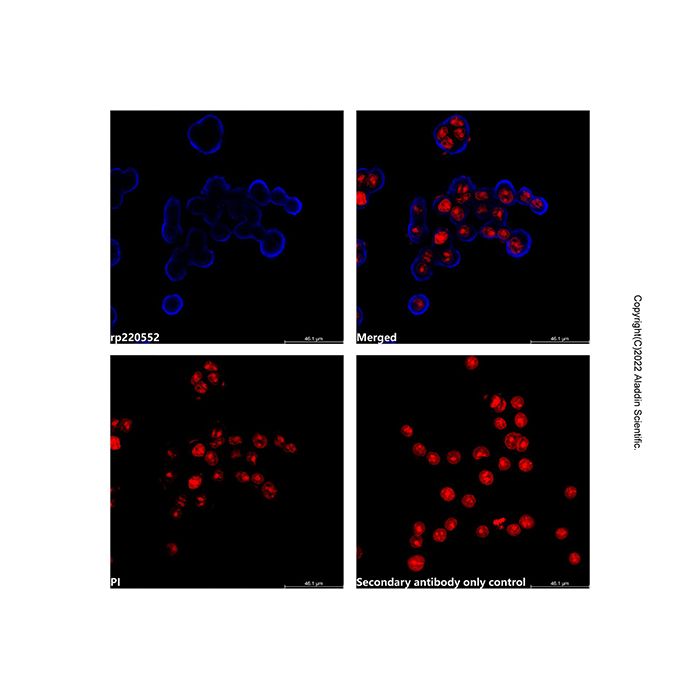
Recombinant Streptavidin Protein (LumiDye™ Violet 421) (rp220552) – IF/ICC IF analysis of EpCAM (blue) in HT-29 cells. The cells were fixed with 4% Paraformaldehyde Fix Solution (P395744) for 15 minutes, and blocked with 2% BSA for 1 hour at room temperature. Cells were stained with biotinylated Oportuzumab (anti-EpCAM) (Ab190146) at 1/1000 dilution in blocking buffer overnight at 4°C, and then incubated with Recombinant Streptavidin Protein (LumiDye™ Violet 421) (rp220552) at a dilution of 1/1000 for 1 hour at room temperature in the dark (blue). PBS instead of the primary antibody was used as the secondary antibody only control. Cells were counterstained with PI (red). Images were taken on the confocal laser scanning microscope.
Recombinant Streptavidin Protein (LumiDye™ Violet 421) (rp220552) - Flow Cytometry Flow cytometry analysis of EpCAM expression by HT-29 cells (red) compared to an isotype control (blue). Cells were stained with biotinylated Oportuzumab (anti-EpCAM) (Ab190146) at 0.1μg/test for 1 hour at 4°C. Then incubated with Recombinant Streptavidin Protein (LumiDye™ Violet 421) (rp220552) at 0.1μg/test for 30 minutes at 4°C in the dark. Blue - Human IgG (Biotin) (Ab180314). Black - Unlabelled control, cells without incubation with primary antibody.
应用
应用名称
稀释比例
IF/ICC
1-10μg/mL
Flow Cytometry
0.5-10μg/mL Since applications vary, you should determine the optimum working dilution for the product that is appropriate for your specific need.

 ZJ25F0623086


 危险品化学品经营许可证(带存储)