Aladdin offers recombinant protein A conjugated to our LumiDye™ AF Dyes (Table 1).
Table 1. Spectral characteristics of protein A conjugates.
Cat.No.
Conjugate
λmax (nm)
Em (nm
rp303252
FITC
498
517
rp303253
AF488
490
525
rp303254
AF555
553
568
rp303256
AF594
590
618
rp303258
AF647
650
668
Aladdin recombinant protein A is a modification of the protein structure based on natural Staphylococcus aureus protein A. It consists of four Fc binding domain fragments linked together, with a molecular weight of 27KD. Compared with natural protein A, it removes the binding site with the immunoglobulin Fab region, enhances its binding ability with the Fc region, and improves the stability and alkali resistance of the protein. Recombinant protein A can separate and purify antibodies of different subtypes of mammals or genetic engineering recombinant proteins containing Fc fragments of antibodies from ascites, serum, cell culture supernatant or cell extracts.
Recombinant Protein A was conjugated with LumiDye™ AF594 under optimal conditions and subsequently purified to remove unconjugated free dyes. This conjugate can be used for immunoglobulin detection in Flow Cytometry and IF and for assay development. Red Fluorescence. Excitation/Emission wavelength= 590 nm/618 nm.
Protein A | Staphylococcal Protein A | Staphylococcal Protein A Recombinant | Immunoglobulin G-binding protein A | gG-binding protein A | Immunoglobulin G binding protein A | SPA | rat-PA | Protein A, AF594 Conjugate | Protein A – AF594
规格或纯度
适用于免疫荧光(IF),BioReagent,无叠氮钠,1.0 mg/mL
生化机理
Plays a role in the inhibition of the host innate and adaptive immune responses. Possesses five immunoglobulin-binding domains that capture both the fragment crystallizable region (Fc region) and the Fab region (part of Ig that identifies antigen) of immunoglobulins. In turn, Staphylococcus aureus is protected from phagocytic killing via inhibition of Ig Fc region. In addition, the host elicited B-cell response is prevented due to a decrease of antibody-secreting cell proliferation that enter the bone marrow, thereby decreasing long-term antibody production. Inhibits osteogenesis by preventing osteoblast proliferation and expression of alkaline phosphatase, type I collagen, osteopontin and osteocalcin. Acts directly as a pro-inflammatory factor in the lung through its ability to bind and activate tumor necrosis factor alpha receptor 1/TNFRSF1A (By similarity).
表达系统
E. coli
种属
金黄色葡萄球菌(Staphylococcus aureus)
蛋白标签
No tag
无载体
No
无动物源
No
偶联
AF594
Excitation(nm)
Yellow-Green Laser(594nm)
Emission(nm)
618nm
Ex/Em(nm)
Ex:590nm;Em:618nm
来源
重组表达
CAS编号和信息
91932-65-9
分子类型
蛋白质
产品线
生物产品
储存与运输
物理形态
液体
储存缓冲液
Liquid in PBS pH 7.4, containing 50% glycerol, 1% BSA and 0.05% Proclin300.
防腐剂
0.05% Proclin300
浓度
1.0 mg/mL
储存条件
避光,-20°C储存,避免反复冻融
运输条件
超低温运输
稳定性与储存
Store at-20°C for one year. Avoid repeated freeze/thaw cycles. Protect from light.
图片
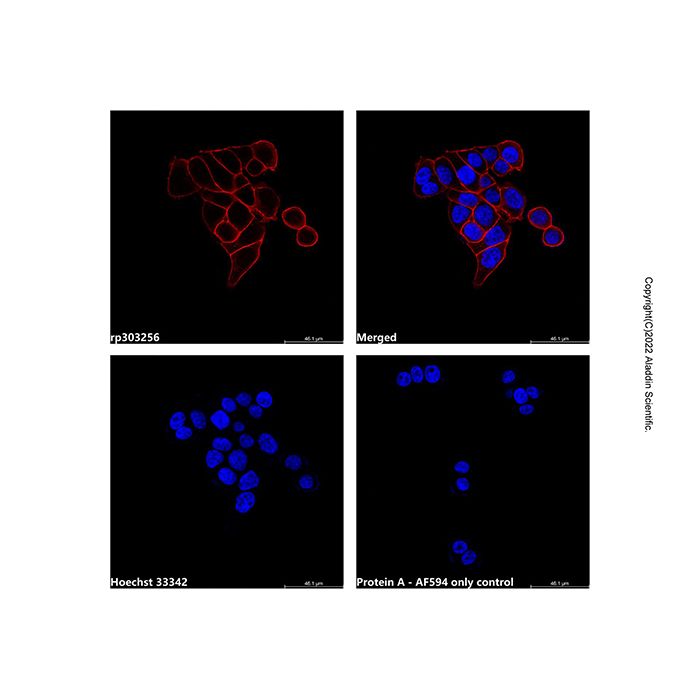
Recombinant Protein A, AF594 conjugate (rp303256) – IF/ICC
IF analysis of EpCAM (red) in HT-29 cells. The cells were fixed with 4% Paraformaldehyde Fix Solution (P395744) for 15 minutes, and blocked with 5% BSA for 1 hour at room temperature. Cells were stained with Citatuzumab (anti-EpCAM) (Ab209902; Isotype type: Human IgG1) at 1/1000 dilution in blocking buffer overnight at 4°C, and then incubated with Recombinant Protein A, AF594 conjugate (rp303256) at 1/500 dilution for 1 hour at room temperature in the dark (red). PBS instead of the primary antibody was used as the secondary antibody only control. Cells were counterstained with Hoechst 33342 (B113845) (blue) at 1/1000 dilution for 5 minutes. Images were taken on the confocal laser scanning microscope.
.
Recombinant Protein A, AF594 conjugate (rp303256) - Flow Cytometry
Flow Cytometry analysis of HT-29 cells labelling EpCAM (red) with Citatuzumab (anti-EpCAM) (Ab209902; Isotype type: Human IgG1). Recombinant Protein A, AF594 conjugate (rp303256) at a dilution of 1/1000 was used as the secondary antibody. Blue - Isotype control, Human IgG (Ab170213). Black - Unlabelled control, cells without incubation with primary antibody.

 ZJ26F0434908


 危险品化学品经营许可证(带存储)