产品介绍
土壤过氧化物酶 (S-POD) 是土壤中的一种氧化还原酶,主要来源于土壤微生物,能够催化过氧化氢氧化酚类、胺类化合物和烃类氧化产物,可消除过氧化氢、酚类和醛类等物质的毒害作用,其活性可表征土壤呼吸强度和微生物活动状况,并且在腐殖质的形成过程中具有重要作用。本试剂盒提供了一种简单易用的比色法,用于分析土壤样本中的过氧化物酶活性,其原理是土壤过氧化物酶可催化H₂O₂氧化特定底物生成紫色没食子素,在430 nm有特征光吸收,通过吸光值变化即可表征土壤过氧化物酶的活性。
本试剂盒可采用分光光度检测法,具有检测灵敏度高、线性范围宽、样品用量少等特点。在样品体积为0.04 g时,可检测范围为 0.01‑0.2 mg/mL 酶活样本。适用于新鲜土样或风干土壤物样本测定。
组分货号 | 组分名称 | 物理外观 | 50T | 100T | 储存 | 单次测试使用量 |
S1515793A | 检测缓冲液 | 液体 | 10.0 mL | 20.0 mL | 2-8 ℃. | 100.0 μL |
S1515793B | 试剂一 | 粉末 | 275.0 mg | 275.0 mg*2 | 2-8 ℃. 避光 | 按需 |
S1515793C | 试剂二 | 液体 | 2.0 mL | 4.0 mL | 2-8 ℃. 避光 | 按需 |
S1515793D | 标准品 | 液体 | 5.0 mL | 10.0 mL | 2-8 ℃. 避光 | 按需 |
自备材料:
酶标仪 、台式离心机 、水浴锅/恒温培养箱 、可调节式移液枪及枪头、 0.5 mol/L HCl溶液 、96孔板、1.5 mL EP管 、30 -50目筛 、冰和蒸馏水。
使用方法
1.试剂的准备
1) 试剂一:临用前加入11 mL蒸馏水 ,溶解后作为工作液一备用, 用不完可2-8 ℃可保存2周,尽快使用以免影响后续实验。
2) 试剂二:取一定量的试剂二(根据要检测的样品个数计算),用等体积的检测缓冲液稀释2倍后作为工作液二备用。
3) 标准品 :本试剂盒提供了吸光度等效于0.2 mg/mL紫色没食子素溶液的重铬酸钾溶液(5 mmol/L),可直接进行后续标准品测定。
2. 准备样品:
1) 取新鲜土样或风干土壤 ,先粗研磨 ,过40目筛网 ,待测备用 (可适当调整待测样本量 ,具体比例也可以参考文献)。
3. 标准曲线的测定
1) 标准品处理 :将标准品用0.5 mol/L HCI溶液稀释至0.1 、0.08 、 0.06 、 0.04 、0.02 、0.01、0 mg/mL ,参照下表进行稀释。
序号 | 稀释前浓度 (mg/mL) | 标准品体积 (µL) | 0.5 mol/L HCl体积 (µL) | 稀释后浓度 (mg/mL) |
1 | 0.2 | 500 | - | 0.2 |
2 | 0.2 | 800 | 800 | 0.1 |
3 | 0.1 | 800 | 200 | 0.08 |
4 | 0.1 | 300 | 200 | 0.06 |
5 | 0.08 | 500 | 500 | 0.04 |
6 | 0.04 | 500 | 500 | 0.02 |
7 | 0.02 | 500 | 500 | 0.01 |
8 | - | - | 500 | 0 |
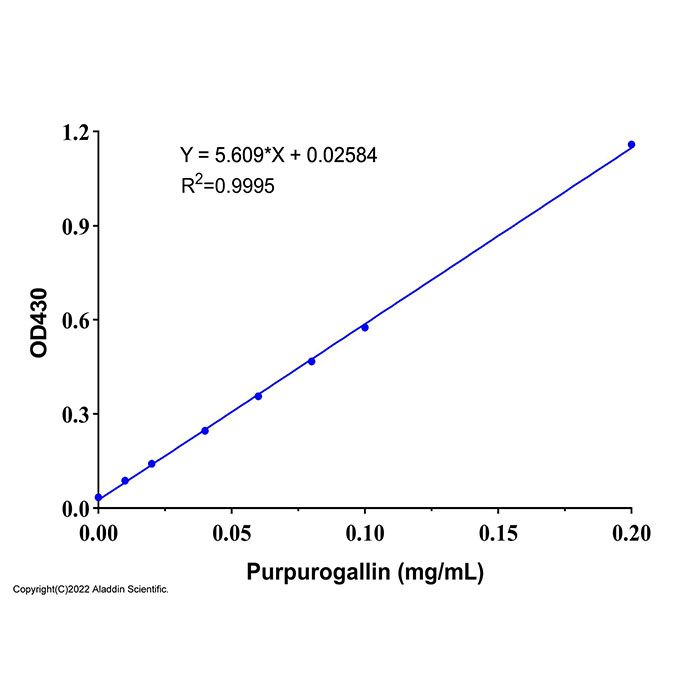
2)标准曲线的建立:以 0 mg/mL 的标准品为空白管,取 200 μL 稀释好的标准品(0.2、0.1、0.08、0.06、0.04、0.02、0.01 mg/mL) 分别加入96孔板中,在 430 nm 处测定吸光值 A,分别记为 A标准 、A空白 , ΔA标准 = A标准-A空白,标准曲线只需做 1-2 次。
4. 样本测定: (在 1.5 mLEP 管中依次加入以下试剂)
1) 酶标仪开机预热 30 min 以上,调节波长 430 nm。
2) 加样:按照下表设置样本测定管、样本对照管、溶液应按照顺序依次加入。
试剂名称 | 对照孔 | 测定孔 |
土样 (g) | 0.04 | 0.04 |
检测缓冲液 (µL) | 100 | 100 |
工作液一 (µL) | 200 | 200 |
工作液二 (µL) | - | 40 |
蒸馏水 (µL) | 40 | - |
充分振荡混匀,30℃反应1 h,4℃,5000 g 离心 10 min 后,取 200 μL上清液于96孔板中,430 nm 处测定吸光值 A,分别记为A测定 、 A对照 ,ΔA测定 = A 测定 - A 对照 。(每个测定管需设一个对照管)。 |
5. S-POD 活性计算
1) 标准曲线的建立: 根据标准管的浓度(X,mg/mL)和吸光度 A 标准 (Y,Δ A标准 ),建立标准曲线。根据标准曲线,将 (Y,Δ A 测定) 带入公式计算样本的浓度 (X,mg/mL)。
2) S-POD 活性计算:
单位的定义:每天每 g土样中产生 1 mg 紫色没食子素定义为一个酶活性单位。
S-POD活性 (U/g 土样)=X×Vₜ÷W÷T=8.16×X÷W
注:
T:反应时间,1 h=1/24d;
Vₜ:反应液总体积,0.34 mL;
W:样本质量,g;
注意事项:
1.当样本 Δ A 测定 > 1.2 时,可降低样本质量后进行测定;当样本 Δ A 测定 < 0.01 时,可提高样本质量或延长反应时间后进行测定,注意同步修改计算公式。
2. 若样本量过多,建议分批次进行测定;反应后的上清置于冰上待测,尽量在 10 min 内测完,防止测定结果受氧化影响。
3. 本试剂盒应在有效期内使用, 试剂一 、二注意避光保存, 并请严格按照说明书进行存储。
4. 不同批次号、不同厂家之间的组分不要混用;否则,可能导致结果异常。
5. 勤换吸头,避免各组分之间的交叉污染。
6. 本产品仅供科学研究使用。请勿用于临床、诊断、食品、化妆品检测等用途。
7. 为了您的安全和健康,请穿实验服并戴一次性手套操作。
实验示例:
1、称取2管 0.04 g 室内绿萝土,按照测定步骤操作,用 96孔板测得 ΔA测定 = A测定 - A对照 = 1.1027-0.4524=0.6503,
带入标曲 Y= 7.843×X+ 0.0394 ,R²= 0.998 ,计算 X=0.078,则S-POD 活性(U/g 土样)=8.16×X÷W=15.89 U/g 土样。
Product Introduction
Soil peroxidase (S‑POD) is a redox enzyme in soil, mainly derived from soil microorganisms. It catalyzes the oxidation of phenols, amines and hydrocarbon oxidation products by hydrogen peroxide, and can eliminate the toxic effects of hydrogen peroxide, phenols, aldehydes and other substances. Its activity can characterize soil respiration intensity and microbial activity, and plays an important role in humus formation. This kit provides an easy-to-use colorimetric method for assaying peroxidase activity in soil samples. The principle is that soil peroxidase catalyzes H₂O₂ to oxidize a specific substrate to form purple purpurogallin, which exhibits characteristic light absorption at 430 nm. The activity of soil peroxidase can be determined according to the change in absorbance.
This kit adopts spectrophotometric detection and features high detection sensitivity, wide linear range and low sample consumption. With a sample mass of 0.04 g, the detectable range for enzyme activity samples is 0.01-0.2 mg/mL. It is suitable for the determination of fresh soil samples or air-dried soil samples.
Component No. | Component Name | Appearance | 50T | 100T | Storage | Quantity Per Test |
S1515793A | Assay Buffer | Liquid | 10.0 mL | 20.0 mL | 2-8 ℃. | 100.0 μL |
S1515793B | Reagent 1 | Powder | 275.0 mg | 275.0 mg*2 | 2-8 ℃.Store in the dark. | As needed |
S1515793C | Reagent 2 | Liquid | 2.0 mL | 4.0 mL | 2-8 ℃.Store in the dark. | As needed |
S1515793D | Standard | Liquid | 5.0 mL | 10.0 mL | 2-8 ℃.Store in the dark. | As needed |
Materials to be Supplied by User
Microplate reader, benchtop centrifuge, water bath/constant temperature incubator, adjustable pipettes and pipette tips, 0.5 mol/L HCl solution, 96-well plate, 1.5 mL EP tubes, 30-50 mesh sieve, ice and distilled water.
Operating Procedure
1. Reagent Preparation
1) Reagent 1: Add 11 mL of distilled water before use. After dissolution, the solution is ready as Working Solution 1. Any unused portion can be stored at 2-8 °C for 2 weeks. Use promptly to avoid interference with subsequent experiments. .
2) Reagent 2: Pipette an appropriate amount of Reagent 2 (calculated based on the number of samples to be tested), dilute with an equal volume of assay buffer to prepare Working Solution 2 for later use.
3) Standard: This kit provides potassium dichromate solution (5 mmol/L) whose absorbance is equivalent to 0.2 mg/mL purpurogallin solution, which can be directly used for subsequent standard measurement.
2. Sample Preparation :
1) Take fresh or air-dried soil samples, perform coarse grinding, and sieve through a 40-mesh sieve for testing (the sample mass may be adjusted appropriately; refer to literature for specific ratios).
3. Standard Curve Determination
1) Standard treatment: Dilute the standard with 0.5 mol/L HCl solution to concentrations of 0.1, 0.08, 0.06, 0.04, 0.02, 0.01 and 0 mg/mL. Perform dilution according to the table below.
No. | Concentration before dilution (mg/mL) | Volume of standard (µL) | Volume of 0.5 mol/L HCl (µL) | Concentration after dilution (mg/mL) |
1 | 0.2 | 500 | - | 0.2 |
2 | 0.2 | 800 | 800 | 0.1 |
3 | 0.1 | 800 | 200 | 0.08 |
4 | 0.1 | 300 | 200 | 0.06 |
5 | 0.08 | 500 | 500 | 0.04 |
6 | 0.04 | 500 | 500 | 0.02 |
7 | 0.02 | 500 | 500 | 0.01 |
8 | - | - | 500 | 0 |
2) Establishment of Standard Curve : Use the 0 mg/mL standard as the blank tube. Pipette 200 μL of diluted standards (0.2, 0.1, 0.08, 0.06, 0.04, 0.02, 0.01 mg/mL) into the 96-well plate separately. Measure absorbance A at 430 nm, recorded as Aₛₜₐₙdₐᵣd and Abₗₐₙₖ, Δ Aₛₜₐₙdₐᵣd= Aₛₜₐₙdₐᵣd − Abₗₐₙₖ . The standard curve only needs to be prepared 1-2 times.
4. Sample Determination: (Add the following reagents sequentially into a 1.5 mL EP tube)
1) Power on the microplate reader and preheat for more than 30 min, set the wavelength to 430 nm.
2) Sample loading: Set up sample assay tubes and sample control tubes as shown in the table below. Add solutions in the specified order.
Reagent Name | Control Well | Assay Well |
Soil sample (g) | 0.04 | 0.04 |
Assay buffer (µL) | 100 | 100 |
Working Solution 1 (µL) | 200 | 200 |
Working Solution 2 (µL) | - | 40 |
Distilled Water (µL) | 40 | - |
Vortex thoroughly to mix. Incubate at 30 °C for 1 h. Centrifuge at 5000 g, 4 °C for 10 min. Transfer 200 μL supernatant into a 96-well plate and measure absorbance A at 430 nm, recorded as Aassay and Acontrol. ΔAassay = Aassay − Acontrol. (One control tube is required for each assay tube). |
5. Calculation of S-POD Activity
1) Establishment of standard curve: Construct the standard curve using standard concentration (X, mg/mL) and absorbance Δ Aₛₜₐₙdₐᵣd (Y). Substitute ΔA assay (Y) into the standard curve equation to calculate the sample concentration (X, mg/mL).
2) Calculation of S-POD activity:
Unit definition: One enzyme activity unit is defined as the production of 1 mg purpurogallin per gram of soil per day.
S-POD activity (U/g soil) =X×Vₜ÷W÷T=8.16×X÷W
Notes:
T:Reaction time , 1h=1/24d.
Vₜ:Total volume of reaction mixture , 0.34 mL.
W: Sample weight, g.
Precautions
1. If ΔAassay > 1.2, reduce the sample weight before measurement. If ΔAassay < 0.01, increase the sample weight or extend the reaction time; remember to modify the calculation formula accordingly.
2. If there are a large number of samples, batch testing is recommended. Keep the post-reaction supernatant on ice before measurement and complete detection within 10 min to avoid oxidation interference on results.
3. Use this kit within its expiry date. Store Reagent 1 and Reagent 2 away from light; strictly follow storage instructions.
4. Do not mix components from different lot numbers or different manufacturers, otherwise abnormal results may occur.
5. Replace pipette tips frequently to prevent cross-contamination between reagents.
6. This product is for research use only. Not for clinical, diagnostic, food or cosmetic testing applications.
7. Wear lab coat and disposable gloves during operation for personal safety and health.
Experimental Example
1. Weigh two aliquots of 0.040 g indoor pothos soil and follow the assay procedure. Measure ΔA assay using a 96-well plate: ΔA assay = A assay- Acontrol =1.1027-0.4524 = 0.6503 Substitute into the standard curve equation Y=7.843×X+0.0394, R² = 0.998. Solve for X= 0.078
S-POD activity (U/g soil) = 8.16 × X ÷ W = 15.89 U/g soil



 危险品化学品经营许可证(带存储)