
计算溶液所需的质量、体积或浓度。
为什么选择此级别
,适用于对基线干扰要求严格的色谱和分析工作流程。
储存与运输
-80℃储存。特低温运输 。请查阅批次 COA 获取详细规格。
质量文档
SDS、COA、产品数据表及规格说明书均可下载。可通过批号查询获取批次 COA。
文献证明
在色谱分析、有机合成和交叉偶联反应领域已被 8 篇同行评审文献引用。
概述
Information
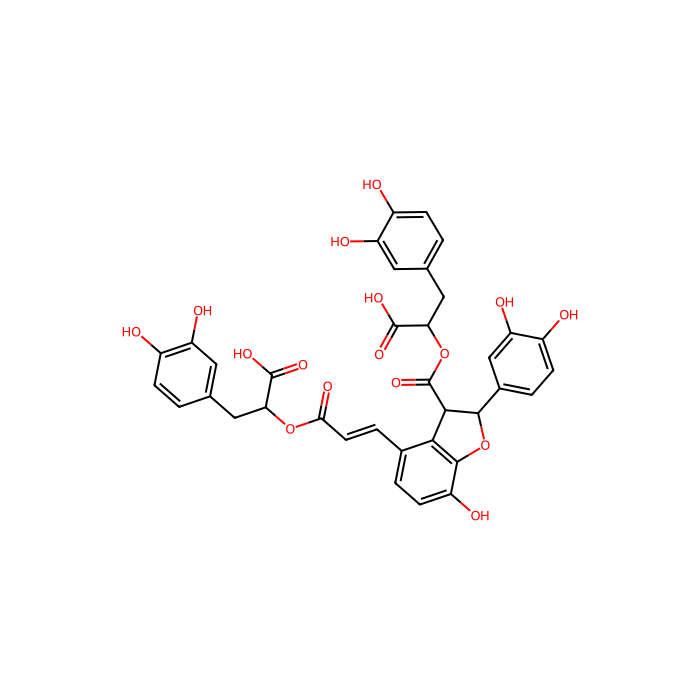
Salvianolic acid B Salvianolic acid B (Sal B, Lithospermate B, Lithospermic acid B), an antioxidant and free radical scavenging compound, is the most abundant bioactive compound extracted from the root of Salvia miltiorrhiza Bunge.
In vitro
Salvianolic acid B, also known as satanic acid B or lithospermic acid B, is a new generation of the natural antioxidants. It can influence Ca2+ aggregation and endothelial cell NO release of hypoxia/ reoxygenation-induced cell. When acid B concentration is 2.5, 5, and 10\u2009mg/l, cell viability and superoxide dismutase (SOD) activity are enhanced, and the formation of malondialdehyde (MDA) in human umbilical vein endothelial cells (ECV304) is inhibited. SalB inhibits HG-induced oxidative stress and reduces the generation of ROS and 8-hydroxy-2-deoxyguanosine (8-OHDG) and mitochondrial depolarization and apoptosis in a dose-dependent manner. It can downregulate the expression of Bax and AIF nuclear translocation and cytochrome c release mediated by HG, but upregulate the expression of Bcl-2 induced by HG. Besides, SalB attenuates HG-induced caspase of the enzyme 3, 9 and minimize PARP cleavage of Schwann cells (SCs). SalB inhibits angiotensin II or H2O2 and TNF-α-induced gelatinolytic activity in human aortic smooth muscle cells (HASMCs) in a concentration-dependent manner. Salvianolic acid B can inhibit platelet aggregation and adhesion. Salvianolic acid B can promote cardiac angiogenesis effect. SalB can enhance cell activity and reduce the number of sub-G1 and apoptotic nuclei of ischemic cell model in order to show its antiapoptotic effects. Salvianolic acid B inhibits ischemia and hypoxia of myocardial injury. Salvianolic acid B inhibits the synthesis of type I collagen of non-TGF-1 stimulated human hepatic stellate cell line (LX-2). SalB activates mammalian sirtuins 1 (SIRT1), an NAD-dependent class III histone deacetylase (HDAC) that plays important roles in several physiological processes, including gene transcription, senescence, energy metabolism, oxidative stress and inflammation. (HG:High glucose)
In vivo
Salvianolic acid B can significantly reduce the myocardial infarct size and blood lactate dehydrogenase level of model rat with acute myocardial infarction, improve cardiac function and myocardial tissue structure, thus inhibiting ischemia and hypoxia of myocardial injury. salvianolic acid B can improve blood hemorheology, reduce oxidative damage, improve the vascular endothelial cell function, and prevent the development of coronary artery disease. Salvianolic acid B could selectively inhibit the activity of MMP-9 in a rat model of myocardial infarction. Salvianolic acid B can also effectively increase the thickness of the left ventricular wall in the myocardial infarction rats to improve the contraction of the heart, and reduce cardiac fibrosis. SalB treatment ameliorates ethanol-induced hepatic inflammation by decreasing the levels of hepatotoxic cytokines such as tumor necrosis factor-α (TNF-α) and interleukin-6 (IL-6). SalB has beneficial effects against hepatic fibrosis in animal models and has been shown to possess cardioprotective and neuroprotective activity via anti-oxidative and anti-inflammatory actions.
Cell Data
cell lines:
Concentrations:8 μM
Incubation Time:3 h
Powder Purity:≥98%
规格
英文别名
Sal B, Lithospermate B, Lithospermic acid B | 3-Benzofurancarboxylic acid, 4-[(1E)-3-[(1R)-1-carboxy-2-(3,4-dihydroxyphenyl)ethoxy]-3-oxo-1-propen-1-yl]-2-(3,4-dihydroxyphenyl)-2,3-dihydro-7-hydroxy-, 3-[(1R)-1-carboxy-
规格或纯度
10mM in DMSO
英文名称
Salvianolic acid B
生化机理
丹酚酸 B(Sal B、Lithospermate B、Lithospermic acid B)是一种抗氧化和清除自由基的化合物,是从丹参根中提取的最丰富的生物活性化合物。
储存条件
-80℃储存
运输条件
特低温运输
名称和识别符
分子类型
小分子
Isomeric SMILES
C1=CC(=C(C=C1C[C@H](C(=O)O)OC(=O)/C=C/C2=C3[C@@H]([C@H](OC3=C(C=C2)O)C4=CC(=C(C=C4)O)O)C(=O)O[C@H](CC5=CC(=C(C=C5)O)O)C(=O)O)O)O
PubChem CID
分子量
718.61
技术文档
高级数据
化学和物理性质
比旋光度
108° (C=1,MeOH)
沸点
1020.3°C/760mmHg
熔点
169 °C
安全和危险性(GHS)
信号词
Warning
危险声明
H315: 引起皮肤刺激
H319: 引起严重眼睛刺激
H335: 可能引起呼吸道刺激
H302: 吞食有害
预防措施声明
P261: 避免吸入灰尘/烟雾/气体/雾/蒸汽/喷雾
P305+P351+P338: 如进入眼睛:用水小心冲洗几分钟。如戴隐形眼镜并可方便地取出,取出隐形眼镜。继续冲洗。
WGK Germany
3
质检证书(CoA,COO,BSE/TSE 和分析图谱)
C of A & Other Certificates(BSE/TSE, COO):
输入批号以搜索分析图谱:
此产品的引用文献
溶液计算器
产品仅提供给经过验证的企业、机构和合格的专业人员用于研发。不适用于人类、动物、诊断或治疗。
Copyright © 2023至今 上海阿拉丁生化科技股份有限公司 保留所有权利。


 危险品化学品经营许可证(带存储)