T7 Quick High Yield RNA Transcription Kit 是一种使用T7 RNA聚合酶,以带有T7启动子的DNA为模板,通过体外转录大量合成RNA的试剂盒,适用于长链和短链转录本。本品提供的T7 Enzyme Mix中已经预混了RNase抑制剂与无机焦磷酸酶,而DNase I, RNase-free用于转录反应结束后清除模板DNA。使用本品以1μg线性化双链DNA模板可以转录获得至少150μg以上的RNA。通过转录合成的RNA可用于多种下游应用,如体外翻译、RNA结构和功能研究、RNase保护、探针杂交、RNA干扰等。
转录方案

图1.非共转录T7启动子RNA转录方案
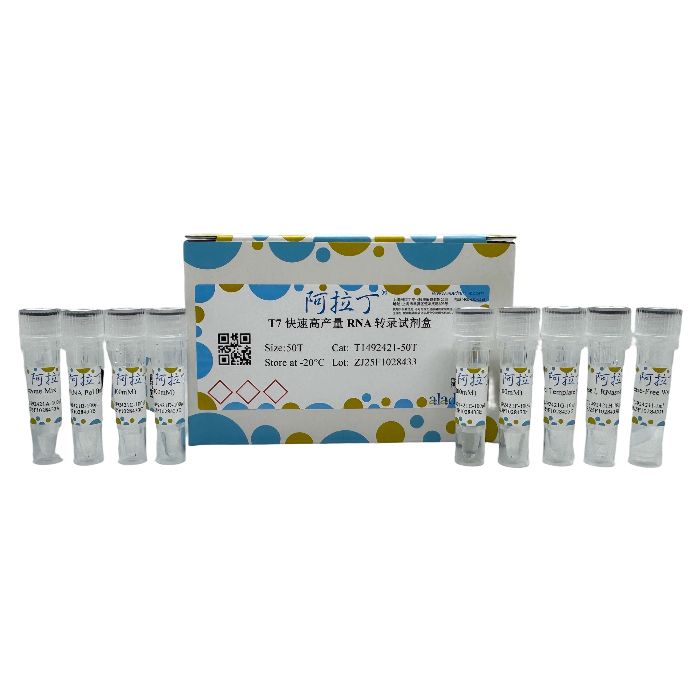
产品组分及储存条件
项目号
| Component
| 50T
| Storage
|
T1492421A
| T7 Enzyme Mix
| 100 μl
| -20℃
|
T1492421B
| 10× T7 RNA Pol Buffer
| 100 μl
| -20℃
|
T1492421C
| ATP (100mM)
| 100 μl
| -20℃
|
T1492421D
| UTP (100mM)
| 100 μl
| -20℃
|
T1492421E
| GTP (100mM)
| 100 μl
| -20℃
|
T1492421F
| CTP (100mM)
| 100 μl
| -20℃
|
T1492421G
| Control Template (0.5 μg/μl)
| 10 μl
| -20℃
|
T1492421H
| DNase I, RNase-free (1 U/μl)
| 100 μl
| -20℃
|
T1492421I
| Nuclease-Free Water
| 1 ml
| -20℃ |
|
使用方法
1. DNA 模板制备
带有T7启动子的线性化质粒或PCR扩增产物都可以作为体外转录模板,模板可以用TE缓冲液或Nuclease-Free Water溶解。T7启动子序列:TAATACGACTCACTATAN*
注:N*为 RNA 转录的第一个碱基,一般为G,若进行共转录由帽子类似物决定。
(1)质粒模板
将目的DNA插入含有T7启动子的质粒载体中,然后用限制酶进行处理,待完全线性化后进行纯化。
注1:由于终止子不能保证转录100%终止,环状质粒会转录出不同长度的RNA产物。为了得到特定长度的RNA,质粒必须完全线性化。
注2:质粒线性化所选限制酶的酶切位点需要紧邻编码链下游,且在编码链中无识别位点。选择的限制酶要能形成5'突出末端或者平滑末端。
注3:为了避免蛋白及盐离子等对转录体系的影响,线性化质粒建议纯化后再作为模板进行体外转录。
注4:质粒DNA抽提过程中引入的RNase A残留会显著影响转录RNA的质量,建议使用A260/A280为1.8~2.0的高纯度RNase-free模板。
(2)PCR产物模
带 T7 启动子的PCR产物可以作为体外转录模板。首先将T7启动子序列加在编码链上游引物的5'端,然后在高保真酶的作用下扩增含T7 启动子的DNA模板,随后进行转录。PCR产物可以不经纯化直接作为模板, 但纯化后RNA收率会更高。
注1:PCR产物作为模板,必须电泳确认产物的特异性及浓度,建议20μl反应体系投入2~5μl PCR产物。
注2:为了得到更多高品质的RNA,推荐PCR产物纯化之后再作为模板进行体外转录。
2.体外转录
(1)根据所需产物类型选择下面三个反应体系进行反应溶液加样。
①标准体外转录体系
在冰上配制如下反应体系:
试剂
| 体积
| 终浓度
| 10× T7 RNA Pol Buffer
| 2 μl
| 1×
| T7 Enzyme Mix
| 2 μl
| - | Template DNA
| 1 μg
| 50 ng/μl
| ATP/CTP/GTP/UTP (100 mM each)ᵃ’ᵇ
| 2 μl each
| 10 mM each
| Nuclease-Free Water
| up to 20 μl
| - |
|
a.建议先加入 Nuclease-Free Water, 然后再加入 ATP/CTP/GTP/UTP。
b.可以用同样摩尔浓度的修饰NTP替代相应的未修饰NTP。修饰UTP可参考使用 N¹-Methyl-Pseudo-UTP(100mM)(货号:N464730)和Pseudo-UTP(100mM)(货 号:P463387)。
②加帽RNA共转录体系
在冰上配制如下反应体系:
试剂
| 体积
| 终浓度
| 10× T7 RNA Pol Buffer
| 2 μl
| 1×
| T7 Enzyme Mix
| 2 μl
| - | Template DNA
| 1 μg
| 50 ng/μl
| ATP/CTP/GTP/UTP (100 mM each)
| 2 μl each
| 10 mM each
| Cap1 Analogue (100 mM)ᶜ
| 1.6 μl
| 8 mM
| Nuclease-Free Water
| up to 20 μl
| - |
|
.帽子类似物与每种 NTP 的摩尔浓度之比应为 4 : 5,该摩尔比适用于 CleanCap 系列帽子类似物。帽子类似物可参考使用 Cap1 analogue AG。 若使用其它结构的帽子类似物,请根据帽子类似物的说明书设定帽子类似物与GTP的合理比例,可根据加帽效率调整比例,但两者终浓度之和控制在10 mM 为宜。
③非放射性标记RNA体外转录体系
试剂
| 体积
| 终浓度
| 10× T7 RNA Pol Buffer
| 2 μl
| 1×
| T7 Enzyme Mix
| 2 μl
| - | Template DNA
| 1 μg
| 50 ng/μl
| ATP/CTP/GTP (100 mM each)
| 2 μl each
| 10 mM each
| UTP (100 mM)
| 1.5 μl
| 7.5 mM
| 修饰UTP (50 mM)ᵈ
| 1 μl
| 2.5 mM
| Nuclease-Free Water
| up to 20 μl
| - |
|
d.本体系适用生物素修饰UTP、荧光素修饰UTP、地高辛修饰UTP或者氨基烯丙基修饰UTP,使用修饰UTP转录产量会比未修饰UTP转录产量偏低。
注1:不同模板序列的转录效率差异较大,初次实验可先按照建议加入量进行,然后再摸索优化最适体系, 模板量可在 0.5 μg~2 μg 的范围进行调整。
(2)充分混匀并瞬离后,37℃温育2 h。若转录产物长度<100 nt,可延长反应时间至3~16 h。
(3)反应结束后,向产物中按照每μg Template DNA加入2 μl DNase I, RNase-free 的比例,37℃孵育15 min以去除 DNA 模板。
(4)转录后的RNA推荐用磁珠或者柱纯化,也可以采用酚/氯仿或者氯化锂纯化。纯化后的RNA可以进行下游实验或者储存于-80℃备用。
3. 对照模板转录(T包装不含)
对照模板是一个含有T7启动子的线性DNA片段,转录产物大小约4000 nt。在推荐的标准体外转录反应体系中,1 μg对照模板DNA 在37℃下反应2 h至少可获得150 μg以上的RNA。
4. 产物纯化
转录后的 RNA 可以选用磁珠法进行纯化,也可以采用柱纯化、酚/氯仿纯化法或氯化锂沉淀法等,以去除蛋白、游离的核苷酸。纯化后的 RNA 经电泳检测后可进行下游实验或存储于-80℃。
(1) 磁珠纯化法
按照磁珠说明书进行纯化操作。
(2) 柱纯化法
纯化前加入 80 μl Nuclease-Free Water 将产物稀释至 100 μl,再按纯化柱说明书进行纯化操作。
(3) 酚 / 氯仿纯化法
①向20 μl反应混合物中,加入115 μl Nuclease-Free Water 和15 μl 3M 乙酸钠(pH5.2),混合均匀。
②加入等体积(150 μl)的酚/氯仿(1:1)混合液抽提一次,室温以最大转速(≥12000 rpm)离心5 min,将上层水相溶液转移至新的RNase-free EP管中。
注:转移上清时请勿吸到中间层。
③再加入等体积的氯仿抽提 2 次,收集上清,并转移至新的 RNase-free EP 管中。
④加入2倍体积的无水乙醇沉淀 RNA。混合均匀后置于-20℃至少 30 min,以最大转速(≥12000 rpm),4℃离心15 min,收集沉淀。
⑤加入500 μl冰预冷的70%乙醇洗涤RNA沉淀,以最大转速(≥12000 rpm), 4℃离心5 min,收集沉淀。
⑥用20 μl Nuclease-Free Water 溶解RNA 沉淀。纯化后的RNA溶液于-80℃保存。
(4) 氯化锂沉淀法
采用氯化锂沉淀法,RNA长度至少满足100 nt以上,且浓度不能低于100 ng/μl。
①向20 μl反应混合物中,加入30 μl Nuclease-Free Water 和30 μl 7.5 M氯化锂。
②混合均匀后,置于-20℃至少30 min,以最大转速(≥12000 rpm),4℃ 离心15 min,收集沉淀。
③加入500 μl冰预冷的70%乙醇洗涤RNA沉淀,以最大转速(≥12000 rpm), 4℃离心5 min ,收集沉淀。
④用20 μl Nuclease-Free Water 溶解RNA 沉淀。纯化后的RNA溶液于-80℃保存。
5. RNA 定量
(1) 紫外吸收法:游离的NTP等会严重影响定量的准确性,采用此方法前请先进行RNA纯化。
(2) 染料法:可使用RNA特异荧光染料或相关试剂盒进行RNA定量,可以对纯化或者未纯化的反应产物中的RNA进行定量。
6. RNA 检测
(1) 凝胶电泳法
为了评估转录本的长度及质量,转录产物应选择合适的非变性或变性琼脂糖或聚丙烯酰胺凝胶上进行电泳检测。变性电泳下可减少RNA的二级结构形成,通常RNA以正确大小的单个条带迁移。
转录本长度
| 推荐使用电泳凝胶
| >500 nt
| 1%琼脂糖凝胶
| 100~500 nt
| 2%琼脂糖凝胶或4~5%尿素变性聚丙烯酰胺凝胶
| 50~100 nt
| 10%~15%尿素变性聚丙烯酰胺凝胶
| <50 nt
| 20%尿素变性聚丙烯酰胺凝胶 |
|
注1:电泳缓冲液和凝胶均需现配现用,使用尿素变性聚丙烯酰胺凝胶电泳时推荐用0.5× TBE(货号:T397904)电泳缓冲液电泳。
注2:转录完成的RNA可用Nuclease-Free Water稀释后电泳,电泳上样量推荐 0.05~1 μg。
注3:加完RNA Loading Buffer后的样品可于65℃处理5~10 min以减少RNA二级结构形成。
注4:可使用Safe Red核酸染料 (货号:S397951) 观察RNA电泳条带,聚丙烯凝胶酰胺凝胶推荐用泡染法观察条带。
(2) 毛细管电泳法
毛细管电泳法可数字化的精确评估RNA样本的完整性、纯度或降解程度。与凝胶法相比,此法所需RNA样本量低,灵敏度高。
常见问题
问题描述
| 原因
| 解决方法
| 转录产物产量低
| 模板中可能有抑制反应的组分或模板纯度较差或模板浓度不正确
| 若对照组产量正常,请重新纯化模板并确定模板浓度及其特异性。 若对照组产量低,请咨询本公司技术支持。
| 短片段转录产物产量低
| 转录起始片段短可能会抑制反应
| 转录产物 100 nt 时,建议延长反应时间或者增加模板量至 2 μg。
| RNA 产物片段小于预期
| 模板序列中可能包含类似于 T7 RNA 聚合酶的终止序列
| 建议降低反应温度至 30℃可能会增加全长转录本的比例,但是产量会下降。
|
| 可能模板中 GC 含量高或形成二级结构
| 建议提高反应温度至 42℃或使用单链结合蛋白提高产量和长度。
| RNA 产物片段大于预期
| 质粒模板 DNA 可能酶切不完全
| 建议质粒模板DNA继续进行酶切或者重新优化质粒模板DNA制备酶切反应体系。
|
| RNA 可能存在更强的二级结构而未完全变性
| 增加变性剂的浓度或加完 RNA Loading Buffer 后样品变性温度可提高至 70℃。
| 电泳拖尾
| 实验过程可能污染 RNase
| 建议单独的转录反应操作区域、专用的 RNA 试剂及移液器;实验过程中佩戴口罩和手套,并经常更换手套;使用 RNase-free RNA 耗材;试剂不使用时请盖好盖子;反应过程中保证试管紧密封闭。
|
| 模板可能有 RNase 污染
| 模板存在 RNase 污染也可能造成 RNA 产物片段小于预期,建议重新纯化模板 DNA 后用 Nuclease-Free Water 或 DEPC 处理水溶解。 |
|
The T7 Quick High Yield RNA Transcription Kit is a kit that uses T7 RNA polymerase to synthesize large amounts of RNA in vitro, with DNA containing the T7 promoter as the template. It is suitable for both long and short transcripts. The T7 Enzyme Mix provided in this product is pre-mixed with RNase inhibitor and inorganic pyrophosphatase, while DNase I, RNase-free is used to remove template DNA after the transcription reaction. Using this product with 1μg of linearized double-stranded DNA template can yield at least 150μg of RNA. The RNA synthesized by transcription can be used in various downstream applications, such as in vitro translation, RNA structure and function research, RNase protection, probe hybridization, and RNA interference.
Product Components and Storage Conditions
| SKU | Component
| 50T
| Storage
|
T1492421A
| T7 Enzyme Mix
| 100 μl
| -20℃
| T1492421
B
| 10× T7 RNA Pol Buffer
| 100 μl
| -20℃
|
T1492421C
| ATP (100mM)
| 100 μl
| -20℃
|
T1492421D
| UTP (100mM)
| 100 μl
| -20℃
|
T1492421E
| GTP (100mM)
| 100 μl
| -20℃
|
T1492421F
| CTP (100mM)
| 100 μl
| -20℃
|
T1492421G
| Control Template (0.5 μg/μl)
| 10 μl
| -20℃
|
T1492421H
| DNase I, RNase-free (1 U/μl)
| 100 μl
| -20℃
| T1492421I
| Nuclease-Free Water
| 1 ml
| -20℃ |
|
Transcription Protocol

Figure 1. RNA Transcription Protocol for Non-Cotranscriptional T7 Promoter
Usage Instructions
1. DNA Template Preparation
Linearized plasmids containing the T7 promoter or PCR amplification products can both be used as templates for in vitro transcription. The template can be dissolved in TE buffer or Nuclease-Free Water. T7 promoter sequence: TAATACGACTCACTATAN*
Note: N* is the first base of RNA transcription, which is generally G. If cotranscription is performed, it is determined by the cap analog.
(1) Plasmid Template
Insert the target DNA into a plasmid vector containing the T7 promoter, then treat it with restriction enzymes. After complete linearization, purify the plasmid.
Note 1: Since terminators cannot ensure 100% termination of transcription, circular plasmids will transcribe RNA products of different lengths. To obtain RNA of a specific length, the plasmid must be completely linearized.
Note 2: The restriction site of the restriction enzyme selected for plasmid linearization needs to be adjacent to the downstream of the coding strand and must not have a recognition site within the coding strand. The selected restriction enzyme should be capable of generating 5' overhangs or blunt ends.
Note 3: To avoid the impact of proteins, salts, and other substances on the transcription system, it is recommended to purify the linearized plasmid before using it as a template for in vitro transcription.
Note 4: Residual RNase A introduced during plasmid DNA extraction will significantly affect the quality of transcribed RNA. It is recommended to use high-purity RNase-free templates with an A260/A280 ratio of 1.8–2.0.
(2) PCR Product Template
PCR products carrying the T7 promoter can be used as templates for in vitro transcription. First, add the T7 promoter sequence to the 5' end of the upstream primer of the coding strand. Then, amplify the DNA template containing the T7 promoter under the action of a high-fidelity enzyme, followed by transcription. PCR products can be directly used as templates without purification, but the RNA yield will be higher after purification.
Note 1: When using PCR products as templates, it is necessary to confirm the specificity and concentration of the products by electrophoresis. It is recommended to add 2–5 μl of PCR products to a 20 μl reaction system.
Note 2: To obtain more high-quality RNA, it is recommended to purify the PCR products before using them as templates for in vitro transcription.
2. In Vitro Transcription
(1) Select one of the three reaction systems below for reaction solution sampling according to the type of product required.
① Standard In Vitro Transcription System
Prepare the following reaction system on ice:
Reagent
| Volume
| Final Concentration
| 10× T7 RNA Pol Buffer
| 2 μl
| 1×
| T7 Enzyme Mix
| 2 μl
| - | Template DNA
| 1 μg
| 50 ng/μl
| ATP/CTP/GTP/UTP (100 mM each)ᵃ’ᵇ
| 2 μl each
| 10 mM each
| Nuclease-Free Water
| up to 20 μl
| - |
|
a. It is recommended to add Nuclease-Free Water first, followed by ATP/CTP/GTP/UTP.
b. Modified NTPs with the same molar concentration can be used to replace the corresponding unmodified NTPs. For modified UTPs, reference can be made to the use of N¹-Methyl-Pseudo-UTP (100 mM) (Catalog No.: N464730) and Pseudo-UTP (100 mM) (Catalog No.: P463387).
② Capped RNA Cotranscription System
Prepare the following reaction system on ice:
Reagent
| Volume
| Final Concentration
| 10× T7 RNA Pol Buffer
| 2 μl
| 1×
| T7 Enzyme Mix
| 2 μl
| - | Template DNA
| 1 μg
| 50 ng/μl
| ATP/CTP/GTP/UTP (100 mM each)
| 2 μl each
| 10 mM each
| Cap1 Analogue (100 mM)ᶜ
| 1.6 μl
| 8 mM
| Nuclease-Free Water
| up to 20 μl
| - |
|
c. The molar concentration ratio of the cap analog to each NTP should be 4:5. This molar ratio is applicable to the CleanCap series of cap analogs. For the cap analog, reference can be made to the use of Cap1 analogue AG. If cap analogs with other structures are used, please set a reasonable ratio between the cap analog and GTP according to the cap analog's instruction manual. The ratio can be adjusted based on the capping efficiency, but it is advisable to control the sum of their final concentrations at 10 mM.
③ Non-Radioactive Labeled RNA In Vitro Transcription System
Reagent
| Volume
| Final Concentration
| 10× T7 RNA Pol Buffer
| 2 μl
| 1×
| T7 Enzyme Mix
| 2 μl
| - | Template DNA
| 1 μg
| 50 ng/μl
| ATP/CTP/GTP (100 mM each)
| 2 μl each
| 10 mM each
| UTP (100 mM)
| 1.5 μl
| 7.5 mM
| Modified UTP (50 mM)ᵈ
| 1 μl
| 2.5 mM
| Nuclease-Free Water
| up to 20 μl
| - |
|
d. This system is suitable for biotin-modified UTP, fluorescein-modified UTP, digoxin-modified UTP, or aminoallyl-modified UTP. The transcription yield using modified UTP will be lower than that using unmodified UTP.
Note 1: The transcription efficiency varies significantly among different template sequences. For initial experiments, follow the recommended addition amount first, then optimize the optimal system through exploration. The template amount can be adjusted within the range of 0.5 μg to 2 μg.
(2) After thorough mixing and brief centrifugation, incubate at 37°C for 2 hours. If the length of the transcription product is < 100 nt, the reaction time can be extended to 3–16 hours.
(3) After the reaction is completed, add DNase I, RNase-free to the product at a ratio of 2 μl per μg of Template DNA, and incubate at 37°C for 15 minutes to remove the DNA template.
(4) It is recommended to purify the transcribed RNA using magnetic beads or columns; phenol/chloroform or lithium chloride purification can also be used. The purified RNA can be used for downstream experiments or stored at -80°C for future use.
3. Control Template Transcription (Not Included in T Package)
The control template is a linear DNA fragment containing the T7 promoter, and the transcription product is approximately 4000 nt in size. In the recommended standard in vitro transcription reaction system, 1 μg of control template DNA can yield at least 150 μg of RNA when reacted at 37°C for 2 hours.
4. Product Purification
After transcription, the RNA can be purified using magnetic bead-based purification, column purification, phenol/chloroform purification, or lithium chloride precipitation to remove proteins and free nucleotides. The purified RNA can be used for downstream experiments after electrophoresis detection or stored at -80°C.
(1) Magnetic Bead Purification Method
Perform the purification operation according to the magnetic bead instruction manual.
(2) Column Purification Method
Before purification, add 80 μl of Nuclease-Free Water to dilute the product to 100 μl, then perform the purification operation according to the purification column instruction manual.
(3) Phenol/Chloroform Purification Method
① To 20 μl of the reaction mixture, add 115 μl of Nuclease-Free Water and 15 μl of 3M sodium acetate (pH 5.2), and mix thoroughly.
② Add an equal volume (150 μl) of phenol/chloroform (1:1) mixture for extraction once. Centrifuge at room temperature at maximum speed (≥12000 rpm) for 5 minutes, then transfer the upper aqueous phase to a new RNase-free EP tube.
Note: Do not aspirate the middle layer when transferring the supernatant.
③ Add an equal volume of chloroform for extraction twice more. Collect the supernatant and transfer it to a new RNase-free EP tube.
④ Add 2 volumes of absolute ethanol to precipitate the RNA. After mixing thoroughly, place it at -20°C for at least 30 minutes. Centrifuge at 4°C at maximum speed (≥12000 rpm) for 15 minutes, then collect the precipitate.
⑤ Add 500 μl of ice-precooled 70% ethanol to wash the RNA precipitate. Centrifuge at 4°C at maximum speed (≥12000 rpm) for 5 minutes, then collect the precipitate.
⑥ Dissolve the RNA precipitate with 20 μl of Nuclease-Free Water. Store the purified RNA solution at -80°C.
(4) Lithium Chloride Precipitation Method
For the lithium chloride precipitation method, the RNA must have a length of at least 100 nt and a concentration of no less than 100 ng/μl.
① To 20 μl of the reaction mixture, add 30 μl of Nuclease-Free Water and 30 μl of 7.5 M lithium chloride.
② After mixing thoroughly, place it at -20°C for at least 30 minutes. Centrifuge at 4°C at maximum speed (≥12000 rpm) for 15 minutes, then collect the precipitate.
③ Add 500 μl of ice-precooled 70% ethanol to wash the RNA precipitate. Centrifuge at 4°C at maximum speed (≥12000 rpm) for 5 minutes, then collect the precipitate.
④ Dissolve the RNA precipitate with 20 μl of Nuclease-Free Water. Store the purified RNA solution at -80°C.
5. RNA Quantification
(1) UV Absorption Method: Free NTPs and other substances will seriously affect the accuracy of quantification. Please purify the RNA first before using this method.
(2) Dye-Based Method: RNA-specific fluorescent dyes or related kits can be used for RNA quantification. This method allows quantification of RNA in both purified and unpurified reaction products.
6. RNA Detection
(1) Gel Electrophoresis Method
To evaluate the length and quality of transcripts, the transcription products should be subjected to electrophoresis detection using an appropriate non-denaturing or denaturing agarose or polyacrylamide gel. Denaturing electrophoresis can reduce the formation of RNA secondary structures, and usually, RNA migrates as a single band of the correct size.
Transcript Length
| Recommended Electrophoretic Gels
| >500 nt
| 1% Agarose Gel
| 100~500 nt
| 2% Agarose Gel or 4–5% Urea-Denaturing Polyacrylamide Gel
| 50~100 nt
| 10%–15% Urea-Denaturing Polyacrylamide Gel
| <50 nt
| 20% Urea-Denaturing Polyacrylamide Gel |
|
Note 1: Both the electrophoresis buffer and gel should be prepared and used immediately. When performing urea-denaturing polyacrylamide gel electrophoresis, it is recommended to use 0.5× TBE (Catalog No.: T397904) as the electrophoresis buffer.
Note 2: The transcribed RNA can be diluted with Nuclease-Free Water before electrophoresis, and the recommended loading volume for electrophoresis is 0.05–1 μg.
Note 3: After adding the RNA Loading Buffer to the sample, the sample can be treated at 65°C for 5–10 minutes to reduce the formation of RNA secondary structures.
Note 4: Safe Red nucleic acid dye (Catalog No.: S397951) can be used to visualize RNA electrophoresis bands. For polyacrylamide gels, the soaking method is recommended for band visualization.
(2) Capillary Electrophoresis Method
Capillary electrophoresis can digitally and accurately evaluate the integrity, purity, or degradation degree of RNA samples. Compared with the gel method, this method requires a smaller amount of RNA sample and has higher sensitivity.
Common Questions
Problem Description
| Reason
| Example sentence
| Low yield of transcription products
| There may be components in the template that inhibit the reaction, or the template purity is poor, or the template concentration is incorrect.
| If the yield of the control group is normal, please repurify the template and confirm the template concentration as well as its specificity. If the yield of the control group is low, please consult the technical support of our company.
| Low yield of short-fragment transcription products
| A short transcription initiation fragment may inhibit the reaction.
| When the transcription product is 100 nt, it is recommended to extend the reaction time or increase the amount of template to 2 μg.
| The RNA product fragments are smaller than expected
| The template sequence may contain a termination sequence similar to that of T7 RNA polymerase.
| It is recommended that lowering the reaction temperature to 30°C may increase the proportion of full-length transcripts, but the yield will decrease.
|
| The template may have a high GC content or form secondary structures.
| It is recommended to increase the reaction temperature to 42°C or use single-stranded binding proteins to improve the yield and length (of the transcription products).
| The RNA product fragments are larger than expected
| The plasmid template DNA may be incompletely digested by restriction enzymes.
| It is recommended to continue the restriction enzyme digestion of the plasmid template DNA or re-optimize the enzyme digestion reaction system for plasmid template DNA preparation.
|
| The RNA may have stronger secondary structures and thus not be completely denatured.
| Increase the concentration of the denaturant, or raise the sample denaturation temperature to 70°C after adding the RNA Loading Buffer.
| Electrophoretic tailing
| RNase contamination may occur during the experimental process.
| It is recommended to have a dedicated operating area for transcription reactions, as well as specialized RNA reagents and pipettes; wear a mask and gloves during the experiment, and replace gloves frequently; use RNase-free RNA consumables; keep the reagent lids closed when the reagents are not in use; ensure that the test tubes are tightly sealed during the reaction process.
|
| The template may be contaminated with RNase.
| RNase contamination in the template may also result in RNA product fragments being smaller than expected. It is recommended to repurify the template DNA and then dissolve it in Nuclease-Free Water or DEPC-treated water. |
|

 ZJ25F1028433


 危险品化学品经营许可证(带存储)