超氧化物歧化酶(Superoxide Dismutase, SOD)是生物体内核心的抗氧化防御酶,专一催化超氧阴离子自由基发生歧化反应,是机体氧化 - 抗氧化平衡状态的关键标志物,广泛应用于氧化应激、衰老、炎症、药物筛选等研究领域。早期 SOD 活性检测以 NBT 法、羟胺法、细胞色素 C 法为主,但存在产物水溶性差、易与反应体系中其他组分发生非特异反应、灵敏度不足等缺陷。WST-8 法是基于水溶性四氮唑盐开发的新一代比色检测方法,凭借稳定性、灵敏度与操作便捷性,已成为当前 T-SOD 检测的主流技术方案。
WST-8可以和黄嘌呤氧化酶(Xanthine Oxidase, XO)催化产生的超氧化物阴离子反应产生水溶性的甲臜染料(formazan dye),由于SOD能催化超氧化物阴离子发生歧化作用,所以该反应步骤可以被SOD所抑制,因此SOD的活性与甲臜染料的生成量成负相关,从而通过对WST-8产物的比色分析即可计算SOD的酶活力。

图1. 基于黄嘌呤氧化酶偶联反应体系和WST-8的SOD酶活力检测原理图
产品组分
T1509010 | 组分 | 物理外观 | 50 T | 100 T | 储存条件 | 单次测试使用量 | T1509010A | 提取液 | 液体 | 25 mL | 50 mL | 2-8℃. | 按需 | T1509010B | SOD检测缓冲液 | 液体 | 10 mL | 20 mL | 2-8℃. | 按需 | T1509010C | 检测试剂 A | 液体 | 100 μL | 200 μL | -20℃.避光 | 2 μL | T1509010D | 检测试剂 B | 液体 | 100 μL | 200 μL | -20℃.避光 | 2 μL | T1509010E | 底物 | 液体 | 100 μL | 200 μL | 2-8℃.避光 | 2 μL | T1509010F | 酶溶液 | 液体 | 100 μL | 200 μL | -20℃.避光 | 2 μL |
|
使用方法
1.样品的准备:
(1) 细胞样品的准备:对于贴壁细胞,吸净细胞培养液,用4℃或冰浴预冷的PBS或生理盐水洗涤一遍,按照每1×10⁶个细胞加入100-200微升的比例加入提取液,适当吹打以充分裂解细胞;对于悬浮细胞,600g离心5分钟收集细胞,用4℃或冰浴预冷的PBS或生理盐水洗涤一遍,按照每1×10⁶个细胞加入100-200微升的比例加入SOD样品制备液,适当吹打,以充分裂解细胞。4℃约12,000 g离心3-5分钟,取上清作为待测样品。
(2) 组织样品的准备:动物用生理盐水(0.9% NaCl,含有0.16 mg/ml肝素钠)灌流清除血液后获取组织样品。取适量的组织样品,按照每10 mg组织加入100微升SOD样品制备液的比例在4℃或冰浴进行匀浆(可以使用玻璃匀浆器或各类常见电动匀浆器)。4℃约12,000 g离心3-5分钟,取上清作为待测样品。
(3) 血浆或红细胞样品的准备:用抗凝管收集血液,颠倒混匀。4℃ 600g离心10分钟,移取上清至另一新的1 mL离心管中,适量生理盐水稀释后即可作为血浆样本进行检测。红细胞样品可以参考步骤(1)悬浮细胞样品的制备方法,或其它不含Triton X-100等去垢剂的样品制备方法。
(4)上述样品准备完毕后可以用阿拉丁生产的BCA蛋白浓度测定试剂盒测定蛋白浓度。通常10-20微克蛋白的细胞或组织匀浆液样品中的SOD平均活力约1个活力单位左右(不同细胞和组织的差异会比较大,该活力范围仅作为初步的参考)。每种样品准备20-100微克蛋白量通常已经足够用于后续检测。
(5)根据蛋白浓度和预计的蛋白使用量,用本试剂盒提供的SOD检测缓冲液适当稀释样品。准备好的样品如果当天测定,可以冰浴保存;如果当天不能完成测定,可以-70℃冻存,但建议尽量当天完成测定。
2.试剂盒的准备工作:
(1) WST-8工作液的配制:按照每个反应140 μL的体积配制适量的WST-8工作液。均匀混合134 μL SOD检测缓冲液、2 μL 检测试剂A、2 μL 检测试剂B和2 μL酶溶液,即可配制成140 μL WST-8工作液。根据待检测样品(包括标准品)的数量,配制适量的WST-8工作液。具体配制方法可以参考下表。配制好的WST-8工作液4℃或冰浴保存,建议尽量现配现用。注意:由于酶溶液的用量较少且易沉降,必须注意在使用前先轻轻离心一下,然后适当混匀后再使用。
待测样品数量 | 1 | 10 | 20 | 50 | SOD检测缓冲液 (μL) | 134 | 1340 | 2680 | 6700 | 检测试剂A (μL) | 2 | 20 | 40 | 100 | 检测试剂B (μL) | 2 | 20 | 40 | 100 | 酶溶液 (μL) | 2 | 20 | 40 | 100 | WST-8工作液 (μL) | 140 | 1400 | 2800 | 7000 |
|
(2) 反应启动液的配制:取底物按照每2μL底物加入18 μL SOD检测缓冲液的比例进行稀释,混匀后即为反应启动工作液。根据待检测样品(包括标准品)的数量,配制适量的反应启动工作液。配制好的反应启动工作液4℃或冰浴保存,建议尽量现配现用。
(3) (可选做)SOD标准品准备:需自备SOD标准品,用本试剂盒提供的提取液(当样品用试剂盒提供的提取液制备时)或SOD检测缓冲液(当样品为血液等无需处理的样品时)将SOD标准品稀释至如下系列浓度:200 U/mL,100 U/mL,50 U/mL,20 U/mL,10 U/mL,5 U/mL,2 U/mL。在随后的检测中可以各取20微升,参考样品进行检测。
说明:为避免稀释后SOD酶活性的下降,SOD标准品宜现稀释现使用;本试剂盒对于SOD的检测并不需要SOD作为标准品,但可以使用SOD标准品作为阳性对照或作为对SOD活性定量的参考。
3. 样品测定
(1) 参考下表使用96孔板设置样品孔和各种空白对照孔。并按下表依次加入待测样品和其它各种溶液。加入反应启动工作液后充分混匀。注意:加入反应启动工作液后反应即会开始,可以在低温操作或用排枪操作以减小各孔间因加入反应启动工作液的时间先后差异而导致的误差。
| 样品/标准品 | 空白对照1 | 空白对照2 | 空白对照3 | 待测样品 | 40 μL | / | / | 40 μL | SOD检测缓冲液 | / | 40 μL | 40 μL | 40 μL | WST-8工作液 | 140 μL | 140 μL | 140 μL | 140 μL | 反应启动液 | 20 μL | 20 μL | / | / |
|
注:如果样品有颜色或含有抗氧化物质,则需设置空白对照3;如果样品没有颜色并且也不含有抗氧化物则没有必要设置空白对照3。
(2) 37℃孵育30分钟。
(3) 在450 nm测定吸光度。
4. 样品中总SOD活力的计算
(1) 参考如下计算公式计算抑制百分率:
抑制百分率=[(A空白对照1-A空白对照2)-(A样品-A空白对照3)] / (A空白对照1-A空白对照2)×100%
如果样品没有颜色并且也不含有抗氧化物,则A空白对照2=A空白对照3,此时可以把计算公式简化为如下形式(简化时可以不设置空白对照3):
抑制百分率=(A空白对照1-A样品) / (A空白对照1-A空白对照2) × 100%
注:如果计算出来的抑制百分率小于30%或大于70%,则通常需要把该样品重新测定。尽量使样品的抑制百分率在30-70%范围内。如果测定出来的抑制百分率偏高,则需适当稀释样品;如果测定出来的抑制百分率偏低,则需重新准备浓度较高的待测样品。
(2) SOD酶活力单位的定义
在上述黄嘌呤氧化酶偶联反应体系中抑制百分率为50%时,反应体系中的SOD酶活力定义为一个酶活力单位(unit)。注意:SOD的活力单位的定义方式有很多种,不同的活力单位需根据其定义的不同进行适当换算。
(3) SOD酶活力的计算
待测样品中SOD酶活力单位=检测体系中SOD酶活力单位=抑制百分率 / (1-抑制百分率) units。例如,当抑制百分率为50%时,待测样品中SOD酶活力单位=50% / (1-50%) units=1 unit;当抑制百分率为60%时,待测样品中SOD酶活力单位=60% / (1-60%) units=1.5 units。
(4) 如果样品为细胞或组织的匀浆液,可以根据样品的蛋白浓度和稀释倍数,将SOD活力单位换算为U/g或U/mg蛋白。如果样品为红细胞抽提液,可以根据血红蛋白含量,可换算为U/克血红蛋白或U/毫克血红蛋白。
注意事项
1. 一个试剂盒如果不能在3次内使用完毕,其中放在-20℃的试剂需要在首次使用时适当分装,以避免反复冻融导致的检测效果下降。
2. 标准品稀释时所用的稀释液应尽量与样品一致。
3. 抗氧化物会对本试剂盒的检测产生干扰,会使测定出来的吸光度显著升高。此时尽管样品没有颜色,如果设置了使用说明中的空白对照3,就可以消除样品中的抗氧化物的干扰。
4. 本产品仅限于专业人员的科学研究用,不得用于临床诊断或治疗,不得用于食品或药品,不得存放于普通住宅内。
5. 为了您的安全和健康,请穿实验服并戴一次性手套操作。
结果展示
本试剂盒对SOD标准品的检测效果

图2:本试剂盒对SOD标准品的检测效果。图1纵坐标ΔOD450为孵育30分钟后,空白对照1与SOD标准品孔的吸光度差值。
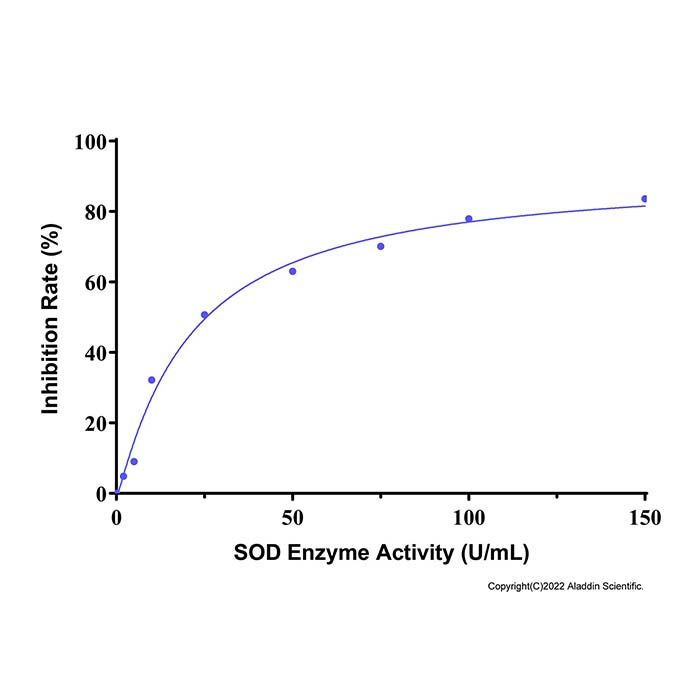
图3:本试剂盒对SOD标准品的检测效果,SOD酶活力和ΔOD450及抑制百分率呈非线性关系。
Superoxide Dismutase (SOD) is a core antioxidant defense enzyme in living organisms. It specifically catalyzes the dismutation of superoxide anion free radicals, and serves as a key biomarker of the body’s oxidation-antioxidant balance. SOD is widely applied in research fields including oxidative stress, aging, inflammation, and drug screening.
Early SOD activity detection methods were mainly the NBT method, hydroxylamine method and cytochrome C method, which have limitations such as poor water solubility of reaction products, proneness to non-specific reactions with other components in the system, and insufficient sensitivity. The WST-8 method is a new-generation colorimetric assay developed based on water-soluble tetrazolium salts. Owing to its excellent stability, high sensitivity and operational convenience, it has become the mainstream technical solution for total SOD (T-SOD) detection at present.
WST-8 reacts with superoxide anions generated via xanthine oxidase (XO) catalysis to produce water-soluble formazan dye. Since SOD catalyzes the dismutation of superoxide anions, this reaction process can be inhibited by SOD. Therefore, SOD activity is negatively correlated with the yield of formazan dye, and SOD enzyme activity can be calculated through colorimetric analysis of the WST-8 reaction product.
Figure 1. Schematic diagram of SOD enzyme activity assay based on xanthine oxidase-coupled reaction system and WST-8
Product Components
| T1509010 | Component | Appearance | 50 T | 100 T | Storage conditions | Usage volume per test | | T1509010A | Extraction buffer | Liquid | 25 mL | 50 mL | 2-8℃. | As need | | T1509010B | SOD assay buffer
| Liquid | 10 mL | 20 mL | 2-8℃ | As need | | T1509010C | Assay Reagent A | Liquid | 100 μL | 200 μL | -20℃. Store in the dark | 2 μL | | T1509010D | Assay Reagent B | Liquid | 100 μL | 200 μL | -20℃. Store in the dark | 2 μL | | T1509010E | Substrate | Liquid | 100 μL | 200 μL | 2-8℃. Store in the dark | 2 μL | | T1509010F | Enzyme Solution | Liquid | 100 μL | 200 μL | -20℃. Store in the dark | 2 μL |
|
Usage Instructions
1. Sample Preparation
(1) Cell sample preparation
For adherent cells: Aspirate the cell culture medium completely, wash the cells once with pre-chilled PBS or normal saline at 4°C / in an ice bath. Add extraction buffer at a ratio of 100-200 μL per 1×10⁶ cells, and pipette repeatedly to achieve full cell lysis.
For suspension cells: Collect cells by centrifugation at 600 g for 5 minutes, wash once with pre-chilled PBS or normal saline at 4°C / in an ice bath. Add SOD sample preparation solution at a ratio of 100–200 μL per 1×10⁶ cells, and pipette appropriately for complete lysis.
Centrifuge the lysate at approximately 12,000 g for 3-5 minutes at 4°C, and collect the supernatant as the test sample.
(2) Tissue sample preparation
Harvest tissue samples from animals after perfusion with normal saline (0.9% NaCl containing 0.16 mg/mL heparin sodium) to remove residual blood. Take an appropriate amount of tissue, and perform homogenization at 4°C / in an ice bath at a ratio of 100 μL SOD sample preparation solution per 10 mg tissue (a glass homogenizer or common electric homogenizers are applicable). Centrifuge at approximately 12,000 g for 3-5 minutes at 4°C, and collect the supernatant as the test sample.
(3) Plasma or red blood cell sample preparation
Collect whole blood in an anticoagulant tube and mix by gentle inversion. Centrifuge at 600 g for 10 minutes at 4°C, transfer the supernatant to a new 1 mL centrifuge tube, and dilute with an appropriate volume of normal saline to obtain plasma samples for detection.
For red blood cell samples, refer to the suspension cell preparation procedure in step (1), or adopt other sample preparation methods free of detergents such as Triton X-100.
(4) After sample preparation, protein concentration can be determined using the BCA Protein Concentration Assay Kit (Aladdin). Typically, the average SOD activity of cell or tissue homogenate samples containing 10-20 μg total protein is approximately 1 activity unit (values vary greatly across different cell lines and tissues; this range is for preliminary reference only). A total protein amount of 20-100 μg per sample is generally sufficient for subsequent detection.
(5) Dilute the sample appropriately with the SOD assay buffer provided in the kit, according to the measured protein concentration and planned sample input. Prepared samples can be stored in an ice bath if assayed on the same day. If the assay cannot be completed on the same day, samples can be stored frozen at -70°C; on-day detection is still strongly recommended.
2. Kit Reagent Preparation
(1) Preparation of WST-8 working solution
Prepare WST-8 working solution at a volume of 140 μL per reaction. Mix 134 μL SOD assay buffer, 2 μL Assay Reagent A , 2 μL Assay Reagent B and 2 μL enzyme solution thoroughly to make 140 μL WST-8 working solution. Scale up the total volume according to the number of test samples (including standards). Refer to the table below for detailed formulation.Store the prepared WST-8 working solution at 4°C / in an ice bath, and prepare it fresh immediately before use whenever possible.Note: Since the enzyme solution is used in small volumes and tends to settle, briefly centrifuge the tube gently and mix thoroughly before use.
Number of test samples | 1 | 10 | 20 | 50 | SOD assay buffer (μL) | 134 | 1340 | 2680 | 6700 | Assay Reagent A (μL) | 2 | 20 | 40 | 100 | Assay Reagent B (μL) | 2 | 20 | 40 | 100 | Enzyme solution (μL) | 2 | 20 | 40 | 100 | Total WST-8 working solution (μL) | 140 | 1400 | 2800 | 7000 |
|
(2) Preparation of Reaction initiation working solution
Dilute the substrate with SOD assay buffer at a ratio of 2 μL substrate to 18 μL SOD assay buffer, and mix thoroughly to obtain the reaction initiation working solution. Prepare an appropriate volume according to the number of test samples (including standards).Store the prepared reaction initiation working solution at 4°C / in an ice bath, and prepare it fresh immediately before use whenever possible.
(3) (Optional) SOD standard preparation
SOD standards shall be prepared by the user. Dilute SOD standard stock to the following concentration gradient with the provided extraction buffer (for samples prepared with extraction buffer) or SOD assay buffer (for unprocessed samples such as blood): 200 U/mL, 100 U/mL, 50 U/mL, 20 U/mL, 10 U/mL, 5 U/mL, 2 U/mL.
For detection, take 20 μL of each standard concentration and follow the same assay procedure as test samples.
Note: To prevent activity loss of diluted SOD, standards should be diluted freshly before use. SOD standards are not required for SOD quantification with this kit, but can serve as positive controls or references for activity calibration.
3. Sample Assay
(1) Set up sample wells and blank control wells on a 96-well plate according to the table below. Add the test sample and other reagents sequentially in the indicated order. Mix thoroughly immediately after adding the reaction initiation working solution.
Note: The reaction starts upon addition of the enzyme working solution. Operate at low temperature or use a multichannel pipette to minimize well-to-well errors caused by time differences in reagent addition.
| Sample / Standard | Blank 1 | Blank 2 | Blank 3 | Test sample | 40 μL | / | / | 40 μL | SOD assay buffer | / | 40 μL | 40 μL | 40 μL | WST-8 working solution | 140 μL | 140 μL | 140 μL | 140 μL | Reaction initiation working solution | 20 μL | 20 μL | / | / |
|
Note: Set Blank 3 if the sample is colored or contains endogenous antioxidants. Blank 3 is unnecessary for colorless samples free of antioxidants.
(2) Incubate the plate at 37°C for 30 minutes.
(3) Measure absorbance at 450 nm.
4. Calculation of Total SOD Activity in Samples
(1) Calculate the inhibition percentage using the formula below:
Inhibition (%)=( A Blank 1 - A Blank 2 )-( A Sample - A Blank 3 )/(A Blank 1 - A Blank 2 )×100%
For colorless samples without antioxidants, A Blank 2 = A Blank 3 , and the formula can be simplified as follows (Blank Control 3 can be omitted):
Inhibition(%)=( A Blank 1 - A Sample )/( A Blank 1 - A Blank 2 )×100%
Note: Re-assay is generally required if the inhibition percentage is below 30% or above 70%. It is recommended to keep sample inhibition within the 30-70% range. Dilute the sample further if inhibition is too high; prepare a more concentrated sample if inhibition is too low
(2) Definition of SOD activity unit
In this xanthine oxidase-coupled reaction system, one SOD activity unit (U) is defined as the amount of SOD that yields 50% inhibition in the reaction system.
Note: Multiple definitions of SOD activity units exist; conversion between different units shall be performed according to their respective definitions.
(3) Calculation of SOD enzyme activity
SOD activity in test sample (U)=SOD activity in reaction system (U)=Inhibition (%)/(1-Inhibition (%))
For example:
At 50% inhibition: SOD activity = 50% / (1 − 50%) = 1 U
At 60% inhibition: SOD activity = 60% / (1 − 60%) = 1.5 U
(4) For cell or tissue homogenate samples, convert SOD activity to U/g tissue or U/mg protein based on sample protein concentration and dilution factor. For red blood cell lysate samples, convert activity to U per gram hemoglobin or U per milligram hemoglobin based on hemoglobin content.
Precautions
(1)If the kit will not be used up within 3 uses, aliquot reagents stored at -20°C upon first use to avoid performance degradation caused by repeated freeze-thaw cycles.
(2)The diluent for standard dilution should be consistent with the sample matrix as much as possible.
(3)Endogenous antioxidants will interfere with detection and cause significantly elevated absorbance readings. In this case, even for colorless samples, setting Blank Control 3 as described can eliminate antioxidant interference.
(4)This product is for scientific research use by professional personnel only. It shall not be used for clinical diagnosis or treatment, nor added to food or drugs. Do not store in residential environments.
(5)For personal safety, wear a laboratory coat and disposable gloves during all operations.
Results Presentation
Detection performance of this kit for SOD standards
Figure 1: Detection performance of this kit for SOD standard. The vertical axis ΔOD450 in Figure 1 refers to the absorbance difference between blank control 1 and SOD standard wells after 30 min incubation.

Figure 2: Detection performance of this kit for SOD standard. The SOD enzyme activity shows a nonlinear correlation with ΔOD450 and inhibition percentage.

 J2617015


 危险品化学品经营许可证(带存储)