茶多酚(Tea Polyphenols,TP)是茶叶中多酚类物质的总称,包括黄烷醇类、花色苷类、黄酮类、黄酮醇类和酚酸类等,是一类儿茶素为主体的黄酮化合物,儿茶素占60~80%,具有C6-C3-C6碳骨架结构,是一种重要的天然抗氧化物质,能够清除自由基。类物质茶多酚又称茶鞣或茶单宁,是形成茶叶色香味的主要成份之一,也是茶叶中有保健功能的主要成份之一,研究表明茶多酚等活性物质具解毒和抗辐射作用,能有效地阻止放射性物质侵入骨髓,并可使锶90和钴60迅速排出体外。 该试剂盒检测原理是利用福林酚氧化茶多酚中的酚羟基-OH,使其显蓝色,用分光光度计或酶标仪测定765nm(或600nm)处吸光度,在一定范围内吸光度与颜色深浅的变化成正比,与标准曲线比较,进而计算出茶多酚的含量,主要用于测定植物组织样品中茶多酚含量,尤其适用于茶叶。该试剂盒仅用于科研领域,不适用于临床诊断或其他用途。
组份表:
| 组分货号 | 组分名称 | 物理外观 | 100T | 储存 | 单次测试使用量 | | T1522010A | 福林酚试剂 | 黄色液体 | 1.5 mL | 2-8℃.避光 | 每次反应需使用125 µL | | T1522010B | 茶多酚标准(1 mg/mL) | 红棕色液体 | 1 mL | 2-8℃.避光 | 按需求使用 | | T1522010C | TP显色液 | 无色透明液体 | 12 mL | 2-8℃. | 每次反应需使用100 µL |
备注:配制福林酚工作液:按照福林酚试剂:蒸馏水=1:9的比例,现配现用,不宜长期保存。 |
所需的仪器和用品:
1. 茶叶、绿茶等待测样本、蒸馏水、甲醇。
2. 研钵、200目细胞筛、水浴锅或电炉。
3. 离心机、离心管或试管、96孔板、酶标仪。
操作步骤 (仅供参考):
1. 准备样品:
(1) 固体样品:称取1g植物样品,充分研磨成粉末,称取0.2g加入10mL离心管中,再向其中加入在70℃水浴中预热的70%甲醇水溶液5mL,盖紧并使样品湿润,立即放入70℃水浴中浸提10min(每隔5min晃动1次),浸提后冷却至室温,3500r/min离心10min,转移上清液至10mL容量瓶,向样品残渣再加入5mL 70%甲醇水溶液浸提一次,重复上述操作;合并上清液并定容至10mL,摇匀,即为茶多酚提取液;4℃避光保存,用于茶多酚的检测。
(2) 绿茶、血浆、血清和尿液等液体样品:绿茶样品可直接用该试剂盒测定;血浆、血清按照常规方法制备后可直接用本试剂盒测定。
2. 配制系列茶多酚标准:用蒸馏水和茶多酚标准(1mg/mL),按下表进行操作,依次稀释。
加入物(μL) | 1 | 2 | 3 | 4 | 5 | 6 | 7 | 茶多酚标准(1mg/mL) | 5 | 10 | 20 | 40 | 60 | 80 | 100 | 蒸馏水 | 995 | 990 | 980 | 960 | 940 | 920 | 900 | 相当于茶多酚含量(μg/mL) | 5 | 10 | 20 | 40 | 60 | 80 | 100 |
|
3. 配制福林酚工作液:按照福林酚试剂:蒸馏水=1:9的比例,现配现用,不宜长期保存。
4. TP加样:取96孔板,按照下表设置空白孔、对照孔、测定孔,溶液应按照顺序依次加入,并注意避免产生气泡;如果样品中的TP浓度过高,可以减少样品用量或适当稀释后再进行测定,样品的检测最好能设置2平行孔,求平均值。
加入物(μL) | 空白孔 | 标准孔 | 测定孔 | 蒸馏水 | 25 | - | - | 系列茶多酚标准(1~7号) | - | 25 | - | 待测样品 | - | - | 25 | 福林酚工作液 | 125 | 125 | 125 | 摇匀,反应5~8min。加入100μL TP显色液,摇匀,室温下放置60min。 |
|
5. TP测定:以空白孔调零,酶标仪测定765nm(或600nm)处各标准孔、测定孔的吸光度。
结果计算:
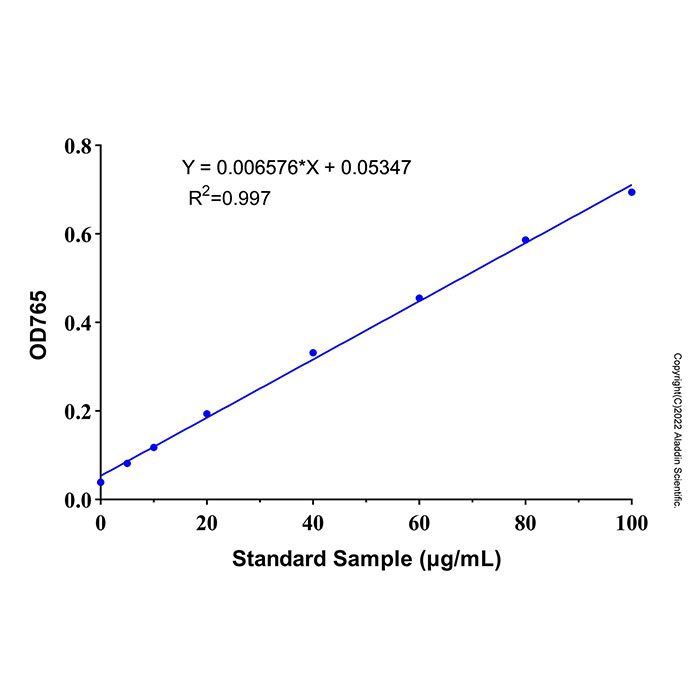
以系列茶多酚标准浓度(1~7号) (5、10、20、40、60、80、100μg/mL)为横坐标,以对应的吸光度为纵坐标,绘制标准曲线,求得回归方程;以测定管吸光度代入回归方程求得提取液中TP含量。
1. 固体样品TP含量(μg/g)=(C×VT×N)/W
式中:C=根据标准曲线求得提取液中茶多酚含量(μg/mL)
VT=提取液的总体积(mL)=10mL
W=固体样品的质量(g)=0.2g
N=提取液的稀释倍数
2. 液体样本TP含量(μg/mL)=C×N
式中:C=根据标准曲线求得提取液中茶多酚含量(μg/mL)
N=提取液的稀释倍数
注意事项:
1. 茶多酚提取液宜4℃避光保存,且保存时间在24h以内。
2. 福林酚有一定的腐蚀性,请小心操作。
3. 样品中茶多酚浓度过高,颜色反应将特别深,超出仪器的检测范围,应用蒸馏水适当稀释重新检测。
4. 该试剂盒测定标准品时,肉眼可见,浓度小于10μg/mL时呈浅蓝色,20~60μg/mL时呈蓝色,大于80μg/mL时呈深蓝色。
附录:
参考标准曲线如下

注意:由于检测仪器和操作手法等条件的不同,参考值范围会有波动,该值仅供参考。
Tea Polyphenols (TP) are a general term for the polyphenolic substances found in tea, including flavanols, anthocyanins, flavonoids, flavonols, and phenolic acids. They are a class of flavonoid compounds primarily composed of catechins, which account for 60-80% of the total. These compounds feature a C6-C3-C6 carbon skeleton structure and are important natural antioxidants capable of scavenging free radicals. Also known as tea tannin, tea polyphenols are one of the main components contributing to the color, aroma, and flavor of tea, as well as a key component responsible for its health benefits. Research indicates that active substances such as tea polyphenols possess detoxifying and anti-radiation effects, effectively preventing radioactive substances from penetrating the bone marrow and facilitating the rapid excretion of Strontium-90 and Cobalt-60 from the body.
This kit is developed in reference to the national standard GB/T 8313. Its detection principle utilizes the Folin-Ciocalteu reagent to oxidize the phenolic hydroxyl groups (-OH) in tea polyphenols, producing a blue coloration. The absorbance is measured at 765 nm (or 600 nm) using a spectrophotometer or a microplate reader. Within a certain range, the absorbance value is proportional to the intensity of the color development. By comparing with a standard curve, the tea polyphenol content is calculated. This kit is primarily intended for measuring tea polyphenol content in plant tissue samples, and is particularly suitable for tea leaves. This product is intended for research use only and is not for use in diagnostic procedures or other purposes.

 ZJ26F0838766


 危险品化学品经营许可证(带存储)