产品介绍
机体中存在多种抗氧化物,包括抗氧化大分子、抗氧化小分子和酶等,可以清除体内产生的各种活性氧,以阻止活性氧诱导的氧化应激的产生。一个体系内的各种抗氧化大分子、抗氧化小分子和酶的总的水平即体现了该体系内的总抗氧化能力。因此测定血浆、血清、尿液、唾液等各种体液,细胞或组织等裂解液中的总抗氧化能力具有非常重要的生物学意义。FRAP法测定总抗氧化能力的原理是在酸性条件下抗氧化物质可以还原 Fe³⁺ -TPTZ 产生蓝色的 Fe²⁺ -TPTZ,在 593 nm 处测定吸光度可以计算出样本中的总抗氧化能力。本试剂盒适用于检测血清(浆)、唾液、尿液、动植物组织、细胞(或细胞上清)中的总抗氧化能力。
| T1529318 | 组分 | 物理外观 | 100 T | 储存 | 单次测试使用量 |
| T1529318A | 缓冲液 | 液体 | 20 mL | 2-8℃ | 150 μL |
| T1529318B | TPTZ溶液 | 液体 | 2 mL | 2-8℃. 避光保存 | 15 μL |
| T1529318C | 底物液 | 液体 | 2 mL | 2-8℃. 避光保存 | 15 μL |
| T1529318D | FeSO₄·7H₂O 标准品 | 固体 | 200 mg | 2-8℃ | 按需 |
| T1529318E | Trolox | 固体 | 1 mg | 2-8℃. 避光保存 | 按需 |
所需自备物品
仪器:酶标仪(590-600 nm)
试剂:双蒸水、DMSO、生理盐水(0.9% NaCl)或 PBS(0.01 M,pH 7.4)。
使用方法
1. 试剂准备
1.1 试剂盒中的试剂平衡至室温。
1.2 FRAP工作液的配制。按缓冲液:TPTZ溶液:底物液为10: 1: 1的体积比混匀,现配现用,2小时内用完。
1.3 100 mmol/L硫酸亚铁溶液的配制:用电子天平精确称取 FeSO₄·7H₂O 标准品27.8 mg,加双蒸水1 mL溶解混匀即可。该试剂必须现用现配,硫酸亚铁溶液容易氧化产生三价铁盐,使溶液的颜色从初的淡绿色逐渐转变为浅黄色。如果发现溶液的颜色已经呈现明显的黄色,弃之,重新配制。
1.4 Trolox 阳性对照:在1mg Trolox中加入2.66 mL DMSO,避光颠倒或涡旋,使其溶解,终浓度为1.5mM。溶解后建议分装成小管,-20°C避光可保存3个月。
1.5 不同浓度标准品的稀释(先将100 mmol/L硫酸亚铁用双蒸水稀释至10mmol/L,再稀释至以下的浓度):
| 编号 | 1 | 2 | 3 | 4 | 5 | 6 | 7 |
| 标准品浓度 (mmol/L) | 0.15 | 0.3 | 0.6 | 0.9 | 1.2 | 1.8 | 2.5 |
| 10 mmol/L 标准品 (μL) | 3 | 6 | 12 | 18 | 24 | 36 | 50 |
| 双蒸水 (μL) | 197 | 194 | 188 | 182 | 176 | 164 | 150 |
2. 样本准备
2.1 血清(浆)、唾液、尿液、细胞上清等液体样本: 血液样本采集后需及时分离血清或血浆,避免溶血。唾液、尿液、细胞上清等直接取样进行测定。血浆建议肝素或柠檬酸钠抗凝,不宜采用 EDTA。
2.2 动(植)物组织样本: 按照每0.01 g组织加入0.1 mL的生理盐水或者 PBS比例,冰水浴条件下机械匀浆,以充分破碎细胞并释放其中的抗氧化物, 4℃,12000× g,离心 5 分钟,取上清测定。
2.3 细胞样本:收集不少于100万细胞(建议细胞刮处理,不宜使用胰酶和 EDTA 消化),加100 μL 冰冷的 PBS (0.01mol/L,pH7.0-7.4),匀浆或超声以充分破碎细胞并释放其中的抗氧化物,4℃,12000× g ,离心 5 分钟,取上清测定。
注:如需测定蛋白浓度,推荐使用阿拉丁BCA蛋白定量试剂盒 (B665595)。
3. 样本的稀释
3.1 在正式检测前,建议选择2-3个预期差异大的样本稀释成不同浓度进行预实验,根据预实验的结果,结合本试剂盒的线性范围:0.04-2.5 mmol/L,选择合适的稀释倍数。
3.2 样本如需要稀释,稀释液可使用生理盐水(0.9% NaCl) 或 PBS (0.01 M,pH 7.4)。
4. 样品测定
4.1 酶标仪预热30 min 以上,调节波长到593 nm。
4.2 按下表设置反应体系加样。设置阳性对照孔和不加样品的空白对照孔。
| 空白孔 | 标准品孔 | 测定样品孔 | 阳性对照孔 |
| 蒸馏水 (μL) | 5 |
|
|
|
| 标准品 (μL) |
| 5 |
|
|
| 样品 (μL) |
|
| 5 |
|
| 1.5 mM Trolox (μL) |
|
|
| 5 |
| FRAP 工作液 (μL) | 180 | 180 | 180 | 180 |
4.3 混匀,37°C 孵育3-5 min,在酶标仪593 nm处测定各孔OD值。空白孔的OD值记为A空白,标准品孔的OD值记为A标准,测定样品孔的OD值记为A测定。计算:ΔA测定= A测定 - A空白 ,Δ A标准 = A标准 - A空白。
5. 结果计算
5.1 标准曲线的绘制
以标准品浓度为x轴,Δ A标准 为 y 轴,绘制标准曲线,得到标准方程,将 ΔA测定 代入方程得到测定样品孔总抗氧化能力 T-AOCₛₐₘₚₗₑ (mmol/L)。
5.2 总抗氧化能力计算(本试剂盒总抗氧化能力用对应FeSO4标准溶液的浓度来表示)
5.2.1 血清(浆)等液体样本:总抗氧化能力 (mmol/L) = T-AOCₛₐₘₚₗₑ × f;
5.2.2 组织样本:
(1) 以组织湿重进行计算: 总抗氧化能力 (mmol/kg wet weight) = T-AOCₛₐₘₚₗₑ × f ÷ (m/V);
(2) 按蛋白浓度计算:总抗氧化能力 (μmol/mg 蛋白) = T-AOCₛₐₘₚₗₑ × f ÷ Cₚᵣ
5.2.3 细胞样本:
(1) 以细胞数量进行计算: 总抗氧化能力 (μmol/10⁶ cells ) = T-AOCₛₐₘₚₗₑ × f ÷ (N/V)
(2) 按蛋白浓度计算:总抗氧化能力 (μmol/mg蛋白) = T-AOCₛₐₘₚₗₑ × f ÷ Cₚᵣ
注:
f:样本加入检测体系前的稀释倍数;
m:组织湿重质量(g);
V:样本提取液加入量(mL);
Cₚᵣ:样本蛋白质浓度,mg/mL;
N: 用于裂解的细胞样本数量/10⁶ 。
注意事项:
1. 在酸性条件下呈蓝色或近蓝色的试剂对测定结果会产生干扰,需要尽量避免。
2. 如样本中含有高浓度的铁盐或亚铁盐,都会干扰测定,由于在酸性条件可以抑制样品中内源性物质的干扰。血清(浆)中铁离子或者亚铁离子的总浓度总是低于 10μmol/L,所以不会干扰到 FRAP 法测定。样本中含有少量的金属离子螯合剂也不会影响到测定。
3. 样本中不能添加 DTT、巯基乙醇等影响氧化还原反应的物质,也不宜添加 Tween、Triton 和 NP-40 等去垢剂。
4. 样本测定 OD 值如比较接近标曲的 0 孔,为样本总抗氧化能力偏低,可考虑增加样本浓度测定或用本公司另一款总抗氧化能力 (T-AOC) 检测试剂盒(ABTS法)(T1373443)测定。
5. 样本如不能及时检测,建议-80℃冻存,在一个月内所测数据没有显著变化。
6. 本试剂盒仅用于科研,不得用于临床诊断或治疗,不得用于食品及药品。
结果展示
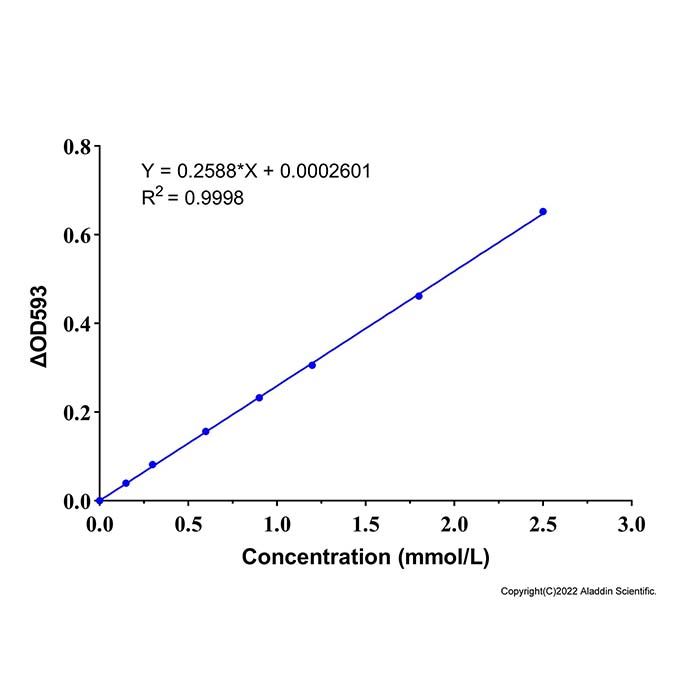
典型标准曲线:

Product Description
The body contains a variety of antioxidants, including antioxidant macromolecules, small‑molecule antioxidants, and enzymes, which can scavenge various reactive oxygen species (ROS) generated in vivo to prevent oxidative stress induced by ROS. The total level of all these antioxidant macromolecules, small‑molecule antioxidants, and enzymes in a system reflects the total antioxidant capacity of that system. Therefore, measuring the total antioxidant capacity in various biological fluids such as plasma, serum, urine, and saliva, as well as in cell or tissue lysates, is of great biological significance. The FRAP (Ferric Reducing Ability of Plasma) assay is based on the principle that, under acidic conditions, antioxidants reduce Fe³⁺‑TPTZ to produce blue‑colored Fe²⁺‑TPTZ. The total antioxidant capacity of the sample can be calculated by measuring the absorbance at 593 nm. This kit is suitable for detecting total antioxidant capacity in serum, plasma, saliva, urine, animal and plant tissues, cells (or cell culture supernatants).
| T1529318 | Components | Appearance | 100T | Storage | Quantity Per Test |
| T1529318A | Buffer Solution | Liquid | 20 mL | 2-8℃ | 150 μL |
| T1529318B | TPTZ Solution | Liquid | 2 mL | 2-8℃. Store in the dark | 15 μL |
| T1529318C | Substrate Solution | Liquid | 2 mL | 2-8℃. Store in the dark | 15 μL |
| T1529318D | FeSO₄·7H₂O Standard | Solid | 200 mg | 2-8℃ | As needed |
| T1529318E | Trolox | Solid | 1 mg | 2-8℃. Store in the dark | As needed |
Materials Required (Not Provided)
Instrument: Microplate reader (590–600 nm)
Reagents: Double-distilled water, DMSO, normal saline (0.9% NaCl), or PBS (0.01 M, pH 7.4).
Protocol
1. Reagent Preparation
1.1 Equilibrate all reagents in the kit to room temperature.
1.2 Preparation of FRAP Working Solution. Mix Buffer Solution, TPTZ Solution, and Substrate Solution at a volume ratio of 10:1:1. Prepare fresh immediately before use and use within 2 hours.
1.3 Preparation of 100 mmol/L ferrous sulfate solution: Accurately weigh 27.8 mg of FeSO₄·7H₂O Standard using an analytical balance, dissolve in 1 mL of double‑distilled water, and mix well. This solution must be prepared fresh immediately before use. Ferrous sulfate solution is prone to oxidation to ferric salts, causing the color to gradually change from pale green to light yellow. If the solution turns distinctly yellow, discard it and prepare a fresh one.
1.4 Trolox Positive Control: Add 2.66 mL of DMSO to 1 mg of Trolox. Protect from light and mix by inversion or vortexing until dissolved. The final concentration is 1.5 mM. Store at –20 °C protected from light for up to 3 months.
1.5 Dilution of standards to different concentrations (first dilute the 100 mmol/L ferrous sulfate to 10 mmol/L with double‑distilled water, then further dilute to the following concentrations):
| No. | 1 | 2 | 3 | 4 | 5 | 6 | 7 |
| Standard concentration (mmol/L) | 0.15 | 0.3 | 0.6 | 0.9 | 1.2 | 1.8 | 2.5 |
| 10 mmol/L standard (μL) | 3 | 6 | 12 | 18 | 24 | 36 | 50 |
| Double‑distilled water (μL) | 197 | 194 | 188 | 182 | 176 | 164 | 150 |
2. Sample Preparation
2.1 Liquid samples such as serum, plasma, saliva, urine, and cell culture supernatant: Separate serum or plasma promptly after blood collection to avoid hemolysis. Saliva, urine, and cell culture supernatant can be directly sampled for measurement. For plasma, heparin or sodium citrate is recommended as anticoagulant; EDTA should not be used.
2.2 Animal or plant tissue samples: Add 0.1 mL of normal saline (0.9% NaCl) or PBS per 0.01 g of tissue, and homogenize mechanically in an ice‑water bath to thoroughly disrupt cells and release antioxidants. Centrifuge at 12,000 × g and 4 °C for 5 minutes, and collect the supernatant for measurement.
2.3 Cell samples: Collect no less than 1 × 10⁶ cells (a cell scraper is recommended; trypsin and EDTA digestion should be avoided). Add 100 μL of ice‑cold PBS (0.01 mol/L, pH 7.0–7.4), and homogenize or sonicate to thoroughly disrupt cells and release antioxidants. Centrifuge at 12,000 × g and 4 °C for 5 minutes, and collect the supernatant for measurement.
Note: If protein concentration determination is required, Aladdin’s BCA Protein Assay Kit (B665595) is recommended.
3. Sample Dilution
3.1 Before formal testing, it is recommended to perform a preliminary experiment by diluting 2–3 samples with expected large differences into several concentrations. Based on the preliminary results and the linear range of this kit (0.04–2.5 mmol/L), select an appropriate dilution factor.
3.2 If sample dilution is required, use normal saline (0.9% NaCl) or PBS (0.01 M, pH 7.4) as diluent.
4. Sample Assay
4.1 Preheat the microplate reader for at least 30 minutes and set the wavelength to 593 nm.
4.2 Set up the reaction system according to the table below. Prepare a positive control well and a blank control well without sample.
| Blank well | Standard well | Sample well | Positive control well |
| Distilled water (μL) | 5 |
|
|
|
| Standard (μL) |
| 5 |
|
|
| Sample (μL) |
|
| 5 |
|
| 1.5 mM Trolox |
|
|
| 5 |
| FRAP Working Solution (μL) | 180 | 180 | 180 | 180 |
4.3 Mix well, incubate at 37 °C for 3–5 minutes, and measure the OD of each well at 593 nm using a microplate reader. Record the OD value of the blank well as Abₗₐₙₖ, the OD value of standard well as Aₛₜₐₙdₐᵣd, and the OD value of sample well as Aₛₐₘₚₗₑ. Calculate: ΔAₛₐₘₚₗₑ = Aₛₐₘₚₗₑ – Abₗₐₙₖ , ΔAₛₜₐₙdₐᵣd = Aₛₜₐₙdₐᵣd – Abₗₐₙₖ.
5. Calculation of Results
5.1 Preparation of the standard curve: Plot the standard curve using the standard concentrations as the x‑axis and the corresponding ΔAₛₜₐₙdₐᵣd values as the y‑axis. Obtain the linear regression equation, and then substitute ΔAₛₐₘₚₗₑ into the equation to obtain the total antioxidant capacity (T‑AOCₛₐₘₚₗₑ ) of the sample well (in mmol/L).
5.2 Calculation of total antioxidant capacity (expressed as the equivalent concentration of FeSO₄ standard solution):
5.2.1 For liquid samples such as serum/plasma: Total antioxidant capacity (mmol/L) = T‑AOCₛₐₘₚₗₑ × f
5.2.2 For tissue samples:
(1) Based on tissue wet weight: Total antioxidant capacity (mmol/kg wet weight) = T‑AOCₛₐₘₚₗₑ × f ÷ (m / V)
(2) Based on protein concentration: Total antioxidant capacity (μmol/mg protein) = T‑AOCₛₐₘₚₗₑ × f ÷ Cₚᵣ
5.2.3 For cell samples:
(1) Based on cell number: Total antioxidant capacity (μmol/10⁶ cells) = T‑AOCₛₐₘₚₗₑ × f ÷ (N / V)
(2) Based on protein concentration: Total antioxidant capacity (μmol/mg protein) = T‑AOCₛₐₘₚₗₑ × f ÷ Cₚᵣ
Notes:
f: dilution factor of the sample before addition to the assay system;
m: wet weight of the tissue (g);
V: volume of sample extraction solution added (mL);
Cₚᵣ : protein concentration of the sample (mg/mL);
N: number of cells used for lysis (in units of 10⁶).
Precautions
1. Reagents that appear blue or nearly blue under acidic conditions may interfere with the assay and should be avoided as much as possible.
2. High concentrations of ferric or ferrous salts in samples may interfere with the determination. However, acidic conditions suppress interference from endogenous substances. The total concentration of iron or ferrous ions in serum/plasma is always below 10 μmol/L, which does not affect the FRAP assay. Small amounts of metal chelators in the sample also do not interfere.
3. Do not add reducing agents such as DTT or β‑mercaptoethanol that affect redox reactions, nor detergents such as Tween, Triton, or NP‑40.
4. If the sample OD value is close to that of the zero standard (suggesting low antioxidant capacity), consider increasing the sample concentration or using our other Total Antioxidant Capacity (T-AOC) Assay Kit (ABTS) (T1373443).
5. If samples cannot be assayed promptly, it is recommended to store them at –80 °C; no significant change in data is observed within one month.
6. This kit is for research use only. Not for clinical diagnosis or treatment, and not for use in food or pharmaceutical products.
Results Presentation
Typical standard curve:



 危险品化学品经营许可证(带存储)