
计算溶液所需的质量、体积或浓度。
为什么选择此级别
,适用于对基线干扰要求严格的色谱和分析工作流程。
储存与运输
-80℃储存。特低温运输 。请查阅批次 COA 获取详细规格。
质量文档
SDS、COA、产品数据表及规格说明书均可下载。可通过批号查询获取批次 COA。
文献证明
在色谱分析、有机合成和交叉偶联反应领域已被 14 篇同行评审文献引用。
概述
Information
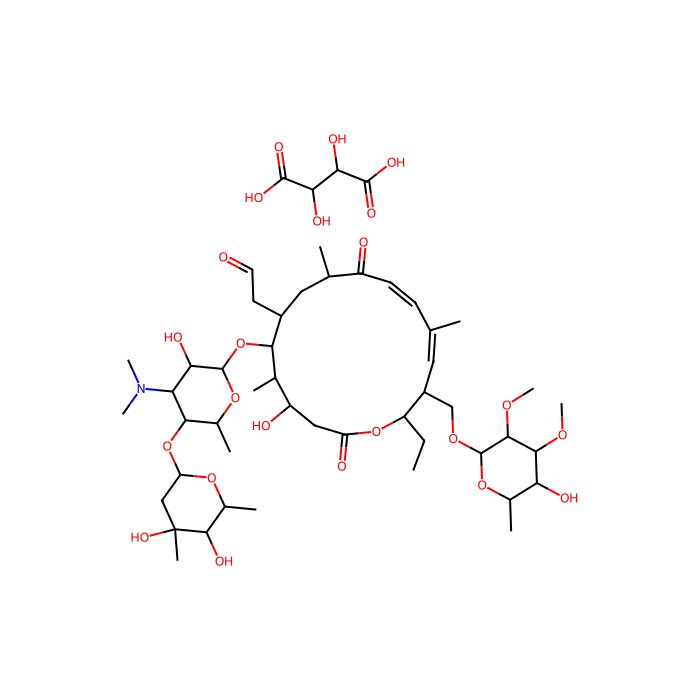
Tylosin tartrate is a macrolide antibiotic approved for the control of mycoplasmosis in poultry.
In vitro
Tylosin tartrate (25 mg/L) significantly inhibits methane production relative to unamended controls, thus indicating that Tylosin tartrate at concentrations commonly found in swine lagoons can negatively impact anaerobic metabolism. Tylosin disappearance follows a biphasic pattern, where rapid initial loss is followed by a slow removal phase. The 90% disappearance times for tylosin, relomycin (tylosin D), and desmycosin (tylosin B) in anaerobically incubated slurries are 30 to 130 hours, and aerating the slurries reduced the 90% disappearance times to between 12 and 26 hours. Tylosin tartrate is stable for at least one month when stored in Milli-Q water at pH 5.7 to 6.7 at 22 ℃.
In vivo
Tylosin increases splenocyte proliferation and splenocyte conditioned medium (CM) proliferative activity above control levels from whole splenocyte cultures in chickens. Tylosin also increases antitumor activity of splenocytes in chickens. Tylosin tartrate (50 mg/kg) administered orally twice daily for 10 days, beginning 14 days after intranasal infection, significantly reduces the incidence and severity of macroscopical pneumonic lung lesions in neonatal piglets. After tylosin tartrate administered intravenously (i.v.) at 10 mg/kg in camels, serum tylosin concentrations in the water-deprived camels are significantly higher, rate of drug elimination is slower, the volume of distribution is significantly smaller, and total body clearance is significantly slower than in the normal camels. On the other hand, serum tylosin concentrations are lower in the water deprived camels and the mean absorption time is significantly shorter in camels treat with tylosin tartrate (20 mg/kg i.m.).
Cell Data
cell lines:
Concentrations:
Incubation Time:
Powder Purity:≥96%
规格
规格或纯度
10mM in DMSO
英文名称
Tylosin tartrate
生化机理
酒石酸泰乐菌素是一种大环内酯类抗生素,已被批准用于控制家禽的支原体病。
储存条件
-80℃储存
运输条件
特低温运输
名称和识别符
EC号
616-119-1
分子类型
小分子
Isomeric SMILES
CC[C@@H]1[C@H](/C=C(/C=C/C(=O)[C@@H](C[C@@H]([C@@H]([C@H]([C@@H](CC(=O)O1)O)C)O[C@H]2[C@@H]([C@H]([C@@H]([C@H](O2)C)O[C@H]3C[C@@]([C@H]([C@@H](O3)C)O)(C)O)N(C)C)O)CC=O)C)\C)CO[C@H]4[C@@H]([C@@H]([C@@H]([C@H](O4)C)O)OC)OC.[C@@H]([C@H](C(=O)O)O)(C(=O)O)O
技术文档
高级数据
安全和危险性(GHS)
信号词
危险
危险声明
H317: 可能引起皮肤过敏反应
H334: 吸入可能引起过敏或哮喘病症状或呼吸困难
个人防护装备
dust mask type N95 (US), Eyeshields, Faceshields, Gloves
质检证书(CoA,COO,BSE/TSE 和分析图谱)
C of A & Other Certificates(BSE/TSE, COO):
输入批号以搜索分析图谱:
此产品的引用文献
溶液计算器
产品仅提供给经过验证的企业、机构和合格的专业人员用于研发。不适用于人类、动物、诊断或治疗。
Copyright © 2023至今 上海阿拉丁生化科技股份有限公司 保留所有权利。


 危险品化学品经营许可证(带存储)