
计算溶液所需的质量、体积或浓度。
为什么选择此级别
,适用于对基线干扰要求严格的色谱和分析工作流程。
储存与运输
干燥,-80℃储存。特低温运输 。请查阅批次 COA 获取详细规格。
质量文档
SDS、COA、产品数据表及规格说明书均可下载。可通过批号查询获取批次 COA。
文献证明
在色谱分析、有机合成和交叉偶联反应领域已被 0 篇同行评审文献引用。
概述
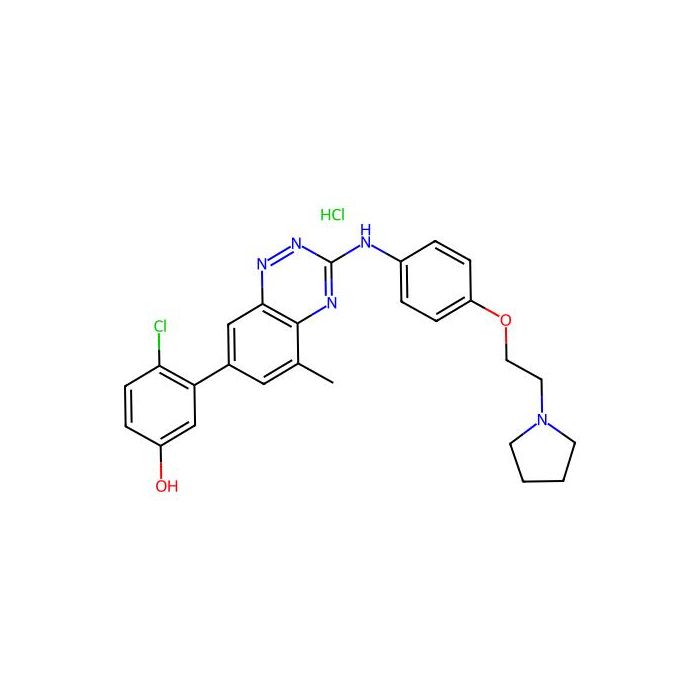
TG 100572 Hydrochloride is a multi-targeted kinase inhibitor which inhibits receptor tyrosine kinases and Src kinases ; has IC 50 s of 2, 7, 2, 16, 13, 5, 0.5, 6, 0.1, 0.4, 1, 0.2 nM for VEGFR1, VEGFR2, FGFR1 , FGFR2 , PDGFRβ , Fgr, Fyn, Hck, Lck, Lyn, Src , Yes, respectively.
In Vitro
TG 100572 shows sub-nanomolar activity against the Src family as well as RTK such as VEGFR1 and R2, FGFR1 and R2, and PDGFRβ. TG 100572 inhibits vascular endothelial cell proliferation (ED 50 =610±71 nM) and blocks VEGF-induced phosphorylation of extracellular signal-regulated kinase. TG 100572 induces apoptosis in rapidly proliferating, but not quiescent, endothelial cell cultures. TG 100572 is shown to inhibit hRMVEC cell proliferation, with an IC 50 of 610±72 nM. This suggests that TG 100572 has the therapeutic potential to inhibit VEGF function in ocular endothelial cells, a contributing factor to pathological angiogenesis in diseases such as AMD and PDR. MCE has not independently confirmed the accuracy of these methods. They are for reference only.
In Vivo
Systemic delivery of TG 100572 in a murine model of laser-induced choroidal neovascularization (CNV) causes significant suppression of CNV, but with an associated weight loss suggestive of systemic toxicity . A concentration of 23.4 μM (C max ) of TG 100572 is reached in 30 min (T max )=0.5 h) in the choroid and the sclera. However, the levels of TG 100572 in the retina are relatively low. The half-life of TG 100572 in ocular tissues is very short; hence, the compound is administered topically minimum t.i.d. to maintain appropriate drug levels in the eye. The maximum concentration one can achieve in formulations using TG 100572 is 0.7% w/v. MCE has not independently confirmed the accuracy of these methods. They are for reference only.
IC50& Target:VEGFR1 2 nM (IC 50 ) VEGFR2 7 nM (IC 50 ) FGFR1 2 nM (IC 50 ) FGFR2 16 nM (IC 50 ) PDGFRβ 13 nM (IC 50 )
规格
别名
TG 100572 盐酸盐
规格或纯度
10mM in DMSO
英文名称
TG 100572 Hydrochloride
生化机理
TG 100572 盐酸盐是一种多靶点激酶抑制剂,可抑制受体酪氨酸激酶和 Src 激酶;对 VEGFR1、VEGFR2、FGFR1、FGFR2、PDGFRβ、Fgr、Fyn、Hck、Lck、Lyn 的 IC 50 s 分别为 2、7、2、16、13、5、0.5、6、0.1、0.4、1、0.2 nM、
储存条件
干燥,-80℃储存
运输条件
特低温运输
名称和识别符
分子类型
小分子
Isomeric SMILES
CC1=CC(=CC2=C1N=C(N=N2)NC3=CC=C(C=C3)OCCN4CCCC4)C5=C(C=CC(=C5)O)Cl.Cl
PubChem CID
分子量
512.43
技术文档
高级数据
质检证书(CoA,COO,BSE/TSE 和分析图谱)
C of A & Other Certificates(BSE/TSE, COO):
输入批号以搜索分析图谱:
溶液计算器
常见问题
本产品应如何储存?
请于?80 °C、干燥条件下保存。请与干燥剂一同密封保存,本品对湿气敏感。
本产品如何运输?
本产品采用干冰配冷袋冷冻运输。收货后请立即拆包,并按上述储存条件保存;处理干冰时请戴隔热手套并保持通风。
本产品的 CAS 号、分子式和分子量是多少?
本产品的 CAS 号为 867331-64-4,分子式为 C26H27Cl2N5O2,分子量为 512.43 g/mol。
如何获取批次专用COA?
每个订单都会随附分析证书(COA),您也可以从账户订单历史中下载。如需订购前的COA,请联系您的客户代表,或使用PDP上的"申请COA"按钮——我们将提供代表性批次的COA。
产品仅提供给经过验证的企业、机构和合格的专业人员用于研发。不适用于人类、动物、诊断或治疗。
Copyright © 2023至今 上海阿拉丁生化科技股份有限公司 保留所有权利。


 危险品化学品经营许可证(带存储)