
计算溶液所需的质量、体积或浓度。
| 活性类型 | 活性值-log(M) | 作用机制 | 期刊 | 参考文献(PubMed IDs) |
|---|
EnzymoPure™,for DNA and RNA applications,分子生物学级,无DNA酶和RNA酶,重组 级 ,适用于对基线干扰要求严格的色谱和分析工作流程。
-20°C储存,避免反复冻融。超低温运输 。请查阅批次 COA 获取详细规格。
SDS、COA、产品数据表及规格说明书均可下载。可通过批号查询获取批次 COA。
在色谱分析、有机合成和交叉偶联反应领域已被 1 篇同行评审文献引用。
本公司生产的 Uracil-DNA Glycosylase (E. coli),也称 E. coli Uracil-DNA Glycosylase (UDG) 或 E. coli Uracil N-Glycosylase (UNG),即大肠杆菌 UDG 或 UNG,可催化含尿嘧啶的 DNA 链中的尿嘧啶 (dU) 碱基和脱氧核糖之间的 N - 糖苷键发生水解,从而释放游离尿嘧啶。Uracil-DNA Glycosylase (UDG) 可以水解含有 dU 的单链或双链 DNA,但不能水解 RNA 或含有 dU 的长度不超过 6 个碱基 DNA 寡聚体。UDG 主要应用于消除 PCR 扩增过程中带来的产物污染问题。其防止污染的原理为:在 PCR 反应中加入适量的 dUTP,以 dUTP 替代 dTTP 掺入 DNA 中,形成含 dU 碱基的 PCR 扩增产物;后续进行 PCR 反应时,使用 UDG 酶选择性切割可能被污染而带入的之前 PCR 扩增产生的含有 dU 的单链或双链 DNA,从而避免之前的 PCR 扩增产物可能的污染对于本次 PCR 扩增带来的负面影响。
| 来源 (Source) | 大肠杆菌重组表达 |
|---|---|
| 外观 (Appearance) | 无菌液体 |
| 保存液 (Storage Buffer) | 10mM Tris-HCl (pH 7.4),50mM KCl,0.1mM EDTA,1mM DTT,0.1mg/ml BSA,50% (v/v) glycerol |
| 酶浓度 (Enzyme Concentration) | 5U/μL |
| 纯度 (Purity) | 不含 UDG 酶活力之外的内切或外切脱氧核糖核酸酶、RNase 和磷酸酶活性。 |
| 活性定义 (Activity Definition) | One unit is defined as the amount of enzyme that catalyzes the release of 60 pmol of uracil per minute from double-stranded, uracilcontaining DNA. Activity is measured by release of [3H]-uracil in a 50 µl reaction containing 0.2 µg DNA (104–105 cpm/µg) in 30 minutes at 37℃. |
组分和说明
| U292571 | Component | 1KU | 5×1KU | Storage |
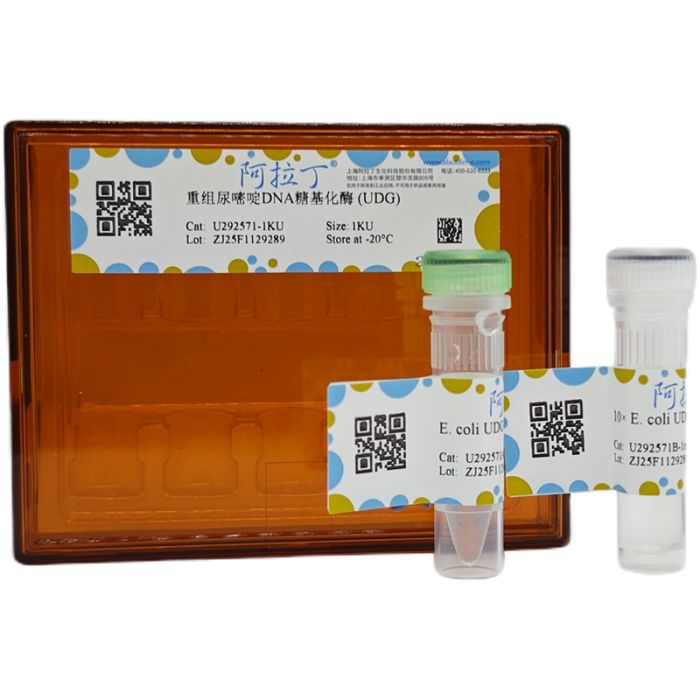
| U292571A | E. coli UDG (5U/µl) | 200µl | 5×200µl | -20℃. Avoid freeze/thaw cycle. |
| U292571B | 10× E. coli UDG Buffer | 1ml | 5×1mL | -20℃. Avoid freeze/thaw cycle. |
产品应用
防止 PCR 产物的交叉污染;单核苷酸多态性检测 (single nucleotide polymorphism detection,GMPD);位点特异性突变;蛋白质与 DNA 相互作用研究;SNP 基因分型;PCR 产物的克隆;制备含有单链突出末端的 PCR 产物或 cDNA。
产品优势
Uracil-DNA Glycosylase (UDG) 可以水解含有 dU 的单链或双链 DNA,还用于消除 PCR 扩增过程中带来的产物污染问题
使用说明
1. PCR 反应体系的设置:参考下表设置 PCR 反应体系,或者参考所使用的 PCR 扩增体系设置 PCR 体系,并加入 E. coli UDG 酶至终浓度为 0.01U/μl。通常仅加入 PCR buffer 即可,无需加入10× E. coli UDG Buffer (E. coli UDG单独使用时专用Buffer)。
| Reagent | Volume | Volume | Final Concentration |
|---|---|---|---|
| Nuclease-Free Water | (18.325-x)μl | (36.65-y)μl | - |
| 10× PCR Buffer (with Mg²⁺) | 2.5μl | 5μl | 1X (1.5mM Mg²⁺) |
| dNTP/dUTP (2.5mM each/5mM) | 2μl | 4μl | 0.2mM each/0.4mM |
| Primer mix (10μM each) | 2μl | 4μl | 0.8μM |
| Template | xμl | yμl | 10pg-1μg |
| Taq DNA Polymerase (5U/μl) | 0.125μl | 0.25μl | - |
| E. coli UDG (5U/µl) | 0.05μl | 0.1μl | - |
| Total volume | 25μl | 50μl | - |
注 1:根据实验需要,dNTP/dUTP (可购买 D745378 dNTP/dUTP Mixture (2.5mM each/5mM)) 的终浓度可在 0.2-0.6mM 之间调整。镁离子的最终终浓度可在 1.0-4.0mM 之间调整。
注 2:对于 25μl 的 PCR 反应体系,E. coli UDG (5U/µl) 的使用量一般为 0.25-0.5U。
注 3:模板和引物的用量请参考 A156186 Taq DNA Polymerase 使用说明或相应的 PCR 体系的产品说明书。
注 4:10× PCR Buffer (with Mg²⁺) 不随货提供,需用户自行配制。组分:100 mM Tris-HCl (pH 8.8 at 25℃), 500 mM KCl, 15mM MgCl₂, 0.8% (v/v) Nonidet P40。
2. 参考上述反应体系,加入 E. coli UDG 后混匀,37℃孵育 10min (本步骤可以有效去除可能的之前含 dUTP 的 PCR 扩增产物的污染),后续就可以立即进入 PCR 扩增程序 (须确保退火温度不低于 55℃)。根据我们的实际测试结果发现,在退火温度不低于 55℃的情况下,使用本产品的情况下不会影响 PCR 扩增的产物量。
附: E. coli UDG单独使用参考方案
1、反应体系配制(冰上操作)
在无菌的 PCR 管或离心管中,按顺序加入以下组分,建立 20-50 μL 的反应体系。注意:UDG 酶和 Buffer 在使用前应于冰上解冻并轻柔混匀,避免剧烈涡旋导致酶失活。
| s试剂 | 体积 / 用量 | 终浓度 / 说明 |
| 10× E. coli UDG Buffer | 2-5 μL | 1× |
| DNA 底物(含 dU) | 可变 | 根据实验需求(如 0.1-1 μg) |
| E.coli UDG(5U/μl) | 可变 | 通常 0.1-1 U |
| 无核酸酶水 | 补足至终体积 | - |
2、37℃ 孵育
将反应管置于 37℃孵育 10-30 分钟。这是 UDG 酶切除降解含尿嘧啶 DNA 的核心步骤。具体时间可根据底物中 dU 的含量和 DNA 长度进行优化,部分协议建议可延长至 30-60 分钟以获得更彻底的处理。
3、 反应终止:热失活(可选,但通常不彻底)
如需终止反应,可将反应管置于 95℃加热 10 分钟。这能使 UDG 丧失超过 95% 的活性。
注意事项
(1) E. coli UDG 酶在大多数 PCR 反应缓冲液体系中均有活性,但对于自行使用的 PCR 或 RT-PCR 体系,首次使用时建议先测试一下是否和所使用的体系兼容。通常取含 dUTP 的 PCR 扩增产物,加入适量 UDG,观察能否有效降解含 dUTP 的 PCR 扩增产物。
(2) dNTP/dUTP 推荐选购阿拉丁的D745378 dNTP/dUTP Mixture (2.5mM each/5mM)。
(3) 由 E. coli UDG 酶消化产生的 DNA 链的无碱基位点可通过加热,碱处理或核酸内切核酸酶处理而除去。通常 PCR 反应过程中的加热步骤可以确保 UDG 酶消化的位点被完全剪切开。
(4) E. coli UDG 酶在比较宽泛的 pH 范围内具有活性,其最适 pH 值为 8.0,E. coli UDG 酶活不需要二价阳离子,并被高离子强度 (> 200 mM) 所抑制。
(5) E. coli UDG 酶可以在 PCR 反应前清除不慎污染的含 dUTP 的 PCR 产物,从而避免由于污染导致的 PCR 假阳性结果。
(6) E. coli UDG 在加热变性后可能由于重折叠而在较低温度下表现出残留活性。因此,建议在退火步骤中使用 55℃或更高的温度进行后续 PCR。
(7) E. coli UDG 可以用于 DNA 或 cDNA 的常规 PCR 或 qPCR 扩增体系,但通常不建议用于 RT-PCR 体系。因为在反转录条件下,通常 E. coli UDG 会保持活性,并可能消化新合成的 cDNA。
(8) E. coli UDG 酶经 95℃加热 10min 处理后,仍会保持少量活性,如果希望用于 RT-PCR 体系,需要反转录和 PCR 分开进行,在反转录时不使用 dUTP,在反转录后加入 E. coli UDG 酶处理,然后进行常规的 PCR 或 qPCR,或者建议加入 UDG 抑制剂 (如来自枯草芽孢杆菌噬菌体 PBS2 的 Ugi 蛋白或噬菌体 phi29 的 p56 蛋白) 进一步抑制 E. coli UDG 的酶活性。
(9) 本产品仅限于专业人员的科学研究用,不得用于临床诊断或治疗,不得用于食品或药品,不得存放于普通住宅内。
(10) 为了您的安全和健康,请穿实验服并戴一次性手套操作。
The Uracil-DNA Glycosylase (E. coli) produced by our company, also known as E. coli Uracil-DNA Glycosylase (UDG) or E. coli Uracil N-Glycosylase (UNG) (i.e., E. coli UDG or UNG), can catalyze the hydrolysis of the N-glycosidic bond between the uracil (dU) base and deoxyribose in the DNA strand containing uracil, thereby releasing free uracil. Uracil-DNA Glycosylase (UDG) can hydrolyze single-stranded or double-stranded DNA containing dU, but cannot hydrolyze RNA or DNA oligomers containing dU with a length of no more than 6 bases. UDG is mainly used to eliminate product contamination caused during PCR amplification. The principle of preventing contamination is as follows: an appropriate amount of dUTP is added to the PCR reaction, and dUTP is used to replace dTTP for incorporation into DNA to form PCR amplification products containing dU bases; during subsequent PCR reactions, UDG enzyme is used to selectively cleave the single-stranded or double-stranded DNA containing dU from previous PCR amplifications that may be introduced by contamination, thereby avoiding the negative impact of potential contamination from previous PCR amplification products on the current PCR amplification.
| Source | Recombinant expression in E. coli |
|---|---|
| Appearance | Sterile liquid |
| Storage Buffer | 10mM Tris-HCl (pH 7.4), 50mM KCl, 0.1mM EDTA, 1mM DTT, 0.1mg/ml BSA, 50% (v/v) glycerol |
| Enzyme Concentration | 5U/μL |
| Purity | Free of endonuclease, exonuclease, RNase, and phosphatase activities other than UDG enzyme activity. |
| Activity Definition | One unit is defined as the amount of enzyme that catalyzes the release of 60 pmol of uracil per minute from double-stranded, uracil-containing DNA. Activity is measured by the release of [³H]-uracil in a 50 µl reaction containing 0.2 µg DNA (10⁴–10⁵ cpm/µg) for 30 minutes at 37℃. |
Components and Description
| U292571 | Component | 1KU | 5×1KU | Storage |
| U292571A | E. coli UDG (5U/µl) | 200µl | 5×200µl | -20℃. Avoid freeze/thaw cycle. |
| U292571B | 10× E. coli UDG Buffer | 1ml | 5×1mL | -20℃. Avoid freeze/thaw cycle. |
Product Applications
Prevention of cross-contamination of PCR products; single nucleotide polymorphism detection (GMPD); site-directed mutagenesis; research on protein-DNA interactions; SNP genotyping; cloning of PCR products; preparation of PCR products or cDNA with single-stranded overhanging ends.
Product Advantages
Uracil-DNA Glycosylase (UDG) can hydrolyze single-stranded or double-stranded DNA containing dU and is also used to eliminate product contamination caused during PCR amplification.
Instructions for Use
1. Setup of PCR reaction system:Set up the PCR reaction system with reference to the table below, or with reference to the PCR amplification system used, and add E. coli UDG enzyme to a final concentration of 0.01U/μl. Usually, only PCR buffer needs to be added, and there is no need to add 10× E. coli UDG Buffer.
| Reagent | Volume | Volume | Final Concentration |
|---|---|---|---|
| Nuclease-Free Water | (18.325-x)μl | (36.65-y)μl | - |
| 10× PCR Buffer (with Mg²⁺) | 2.5μl | 5μl | 1X (1.5mM Mg²⁺) |
| dNTP/dUTP (2.5mM each/5mM) | 2μl | 4μl | 0.2mM each/0.4mM |
| Primer mix (10μM each) | 2μl | 4μl | 0.8μM |
| Template | xμl | yμl | 10pg-1μg |
| Taq DNA Polymerase (5U/μl) | 0.125μl | 0.25μl | - |
| E. coli UDG (5U/µl) | 0.05μl | 0.1μl | - |
| Total volume | 25μl | 50μl | - |
Note 1: According to experimental needs, the final concentration of dNTP/dUTP (D745378 dNTP/dUTP Mixture (2.5mM each/5mM) is available for purchase) can be adjusted between 0.2-0.6mM. The final concentration of magnesium ions can be adjusted between 1.0-4.0mM.
Note 2: For a 25μl PCR reaction system, the dosage of E. coli UDG (5U/µl) is generally 0.25-0.5U.
Note 3: For the dosages of template and primers, please refer to the instruction manual of A156186 Taq DNA Polymerase or the product instruction manual of the corresponding PCR system.
Note 4: 10× PCR Buffer (with Mg²⁺) is not supplied and should be prepared by user. Components: 100 mM Tris-HCl (pH 8.8 at 25℃), 500 mM KCl, 15mM MgCl₂, 0.8% (v/v) Nonidet P40.
2. With reference to the above reaction system, add E. coli UDG, mix well, and incubate at 37℃ for 10 minutes (this step can effectively remove potential contamination from previous PCR amplification products containing dUTP). Then, you can immediately proceed to the PCR amplification program (ensure that the annealing temperature is not lower than 55℃). According to our actual test results, when the annealing temperature is not lower than 55℃, the use of this product will not affect the yield of PCR amplification products.
Appendix: Reference Protocol for Standalone Use of E. coli UDG
1. Reaction Setup (Operate on ice)
Prepare a 20–50 μL reaction system by adding the following components in order into a sterile PCR tube or microcentrifuge tube. Note: Thaw UDG and Buffer on ice before use and mix gently. Avoid vigorous vortexing which may cause enzyme inactivation.
| eagent | Volume / Amount | Final Concentration / Note |
| 10× E. coli UDG Buffer | 2–5 μL | 1× |
| DNA Substrate (containing dU) | Variable | According to experimental requirements (e.g., 0.1–1 μg) |
| E. coli UDG (5 U/μL) | Variable | Typically 0.1–1 U |
| Nuclease-Free Water | Bring to final volume | — |
2. Incubation at 37 °C
Place the reaction tube at 37 °C and incubate for 10–30 minutes. This is the core step for UDG to excise and degrade uracil-containing DNA. The incubation duration can be optimized based on the dU content and DNA length of the substrate. Some protocols recommend extending the incubation time to 30–60 minutes for more thorough treatment.
3. Reaction Termination: Heat Inactivation (Optional, usually incomplete)
If reaction termination is required, heat the reaction tube at 95 °C for 10 minutes. This can eliminate more than 95% of UDG activity.
Precautions
(1) E. coli UDG enzyme is active in most PCR reaction buffer systems. However, for self-used PCR or RT-PCR systems, it is recommended to test the compatibility with the used system for the first time. Usually, take the PCR amplification product containing dUTP, add an appropriate amount of UDG, and observe whether the PCR amplification product containing dUTP can be effectively degraded.
(2) For dNTP/dUTP, it is recommended to purchase D745378 dNTP/dUTP Mixture (2.5mM each/5mM) from Aladdin.
(3) The abasic sites of the DNA strand generated by E. coli UDG enzyme digestion can be removed by heating, alkali treatment, or endonuclease treatment. Usually, the heating step during the PCR reaction can ensure that the sites digested by UDG enzyme are completely cleaved.
(4) E. coli UDG enzyme is active in a relatively wide pH range, with an optimal pH value of 8.0. The activity of E. coli UDG does not require divalent cations and is inhibited by high ionic strength (> 200 mM).
(5) E. coli UDG enzyme can remove accidentally contaminated PCR products containing dUTP before the PCR reaction, thereby avoiding false positive PCR results caused by contamination.
(6) E. coli UDG may exhibit residual activity at lower temperatures due to refolding after heat denaturation. Therefore, it is recommended to use a temperature of 55℃ or higher for subsequent PCR in the annealing step.
(7) E. coli UDG can be used in conventional PCR or qPCR amplification systems for DNA or cDNA, but it is generally not recommended for RT-PCR systems. Because under reverse transcription conditions, E. coli UDG usually remains active and may digest the newly synthesized cDNA.
(8) After treatment at 95℃ for 10 minutes, E. coli UDG enzyme still retains a small amount of activity. If it is desired to use it in an RT-PCR system, reverse transcription and PCR need to be performed separately: do not use dUTP during reverse transcription, add E. coli UDG enzyme for treatment after reverse transcription, and then perform conventional PCR or qPCR; alternatively, it is recommended to add a UDG inhibitor (such as Ugi protein from Bacillus subtilis phage PBS2 or p56 protein from phage phi29) to further inhibit the enzyme activity of E. coli UDG.
(9) This product is only for scientific research by professionals, and shall not be used for clinical diagnosis or treatment, nor for food or drugs. It shall not be stored in ordinary residences.
(10) For your safety and health, please wear a lab coat and disposable gloves during operation.
通过匹配包装上的批号来查找并下载产品的 COA,每批产品都进行了严格的验证,您可放心使用!
| 批号(Lot Number) | 证书类型 | 货号 |
|---|---|---|
 ZJ26F1039867 |
分析证书 | U292571 |
| ZJ25F1129289 |
分析证书 | U292571 |
| ZJ25F1129288 |
分析证书 | U292571 |
我们的级别选择指南涵盖了目录中所有的变体的纯度、稳定剂状态和应用适用性。
查看 Recombinant 级别指南 → 查看 DNase, RNase free 级别指南 → 查看 Suitable for molecular biology 级别指南 → 查看 EnzymoPure™ 级别指南 → 查看 for DNA and RNA applications 级别指南 →

 危险品化学品经营许可证(带存储)