维生素 C(Vitamin C)又称 L-抗坏血酸,是高等灵长类动物与其他少数生物的必需营养素,在生物体内维生素 C 是一种抗氧化剂,为酸性己糖衍生物,是烯醇式己糖酸内酯,保护身体免于自由基的威胁,同时也是一种辅酶,其广泛的食物来源为各类新鲜蔬果。Vc 有 L-型和D-型两种异构体,只有 L-型的才具有生理功能,还原型和氧化型都有生理活性。
维生素 C 检测试剂盒(磷钼酸,比色法)检测原理是在强酸和偏磷酸根离子存在条件下,钼酸铵能与还原型维生素 C 反应生成蓝色化合物,在一定浓度范围吸光度值与浓度呈线性关系, 以分光光度计 760nm 处检测吸光度,获得Vitamin C 含量.
产品组分
组分货号 | 组分名称 | 物理外观 | 50 T | 储存 | 单次测试使用量 |
V1515890A | VC 标准品 | 粉剂 | 2×5 mg | RT.避光 | 5 mg |
V1515890B | 组织匀浆液 A | 液体 | 100 mL | RT | 按需 |
V1515890C | 组织匀浆液 B | 液体 | 12 mL | RT | 按需 |
V1515890D | MPA | 粉剂 | 0.2 g | RT.避光 | 按需 |
V1515890E | 酸性缓冲液 A | 液体 | 12 mL | RT | 按需 |
V1515890F | 酸性缓冲液 B | 液体 | 25 mL | RT | 40μL |
V1515890G | 钼酸铵 | 粉剂 | 1.25 g | RT.避光 | 按需 |
使用方法
1. 配制组织匀浆液
按组织匀浆液 A:组织匀浆液 B:蒸馏水=8:1:91 的比例混匀即得。
2. 准备样品
取待测材料如青菜、水果、松针等,清洗擦干,准确称量1g,加入研磨器内,再加入少量组织匀浆液,研磨碎,留取上清,再次用组织匀浆液研磨, 最后一并倒入10mL离心管,4000 r/min 离心5 min,取上清并补充组织匀浆液至10 mL, 充分混匀,即为待测液。如果样品维生素C浓度较低,可适当提高研磨时组织的质量。
3. 配制 MPA 工作液
称取 0.1 g MPA 粉末,充分溶解于 5 mL 酸性缓冲液 A 中,也可根据使用情况称取一定量的 MPA 按比例溶解即可,4℃保存 3~4 天有效。
4. 配制钼酸铵工作液
取钼酸铵粉末 0.25 g,充分溶解于 10mL 蒸馏水中,也可根据使用情况称取一定量的钼酸铵加水按比例溶解即可,4℃避光保存。注意:钼酸铵溶于水会逐渐变化成乳白色浊液,则不能使用。
5. 配制系列 Vitamin C 标准
将 5 mg Vitamin C 标准用 1 mL 组织匀浆液溶解即得 Vitamin C 标准(5 mg/mL),再用组织匀浆液稀释成 Vitamin C 标准(400 μg/mL) ,取干净离心管或试管,按下表进行操作,依次稀释。Vitamin C 标准(5 mg/ml)放置-20℃, 短期保存。
VC 标准品(400 μg/mL)加入体积(μL) | 50 | 125 | 250 | 500 | 750 | 1000 |
组织匀浆液 | 950 | 875 | 750 | 500 | 250 | 0 |
VC 浓度(μg/mL) | 20 | 50 | 100 | 200 | 300 | 400 |
6. 加样
按照下表设置空白孔、标准孔、测定孔,溶液应按顺序依次加入,并注意避免产生气泡。如果样品中的 Vitamin C 含量过高,可以减少样品用量或适当稀释后再进行测定,样品的检测最好能设置 2 平行孔,求平均值。
加入物(μL) | 空白孔 | 标准孔 | 测定孔 |
组织匀浆液 | 400 | 0 | 0 |
系列 Vitamin C 标准 | 0 | 400 | 0 |
待测液 | 0 | 0 | 400 |
组织匀浆液 | 800 | 800 | 800 |
MPA 工作液 | 200 | 200 | 200 |
酸性缓冲液 B | 400 | 400 | 400 |
钼酸铵工作液 | 800 | 800 | 800 |
7. Vitamin C 测定
立即混匀,30℃水浴 20 min,以空白调零,测定 760 nm处系列标准孔、测定孔的吸光度。
8. 计算
以系列标准 Vitamin C 为横坐标,以对应的吸光度为纵坐标,绘制标准曲线,求得回归方程,以测定孔的吸光度代入回归方程求得样品维生素 C 含量。
100 g 样品中维生素 C 含量(mg) =(C×V)×100/(W×1000)×D=(C×V) /(W×10)×D
C:待测样品的吸光度值在标准曲线上查出的维生素C的浓度(μg/mL)
V:待测液的总体积(mL)=10
W:样品质量(g)=1
1000: μg换算成mg
D:待测样品的稀释倍数
注意事项:
1. Vitamin C 标准避免反复冻融,以免失效或效率下降,最好现配现用。
2. 组织匀浆液 A 保存温度过低时易产生结晶,可用温水浴溶解后再使用。
3. 钼酸铵工作液室温保存时间过长或者过期会出现白色粘稠物,不可使用,应换新的产品使用。不使用时建议 4℃保存。
4. 待测样品如不能及时测定,应置于 2~8℃保存,3 天内稳定。
5. 如果样品浓度过高,应用组织匀浆液稀释后重测,结果乘以稀释倍数。
结果展示
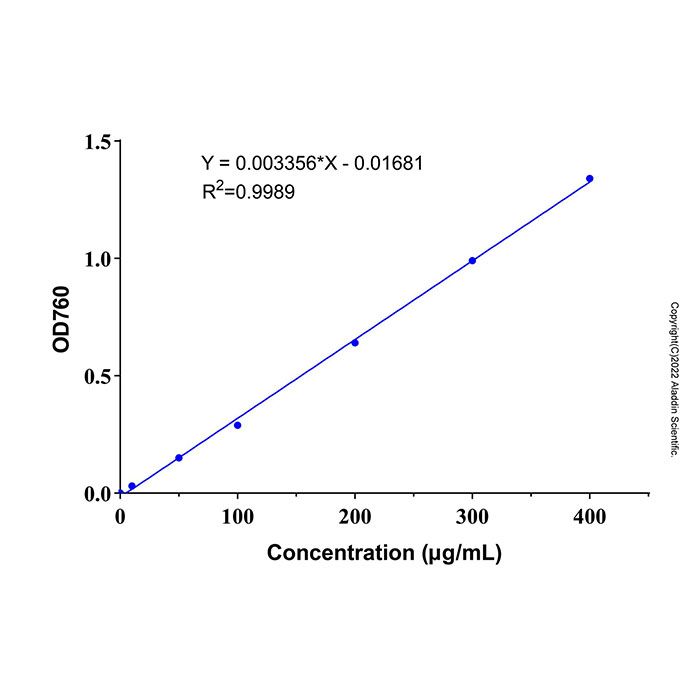
典型标准曲线:

Vitamin C (VC), also known as L-ascorbic acid, is an essential nutrient for higher primates and a few other organisms. As an endogenous antioxidant, it is an acidic hexose derivative and an enol-form hexonic acid lactone that protects the body from free radical damage. It also functions as a coenzyme, and is widely sourced from various fresh fruits and vegetables. VC exists in two isomeric forms: L-form and D-form. Only the L-form possesses physiological activity, and both its reduced and oxidized states are biologically active.
The Vitamin C Content Assay Kit (Phosphomolybdic Acid, Colorimetric Method) works on the following principle: in the presence of strong acid and metaphosphate ions, ammonium molybdate reacts with reduced vitamin C to form a blue compound. Within a certain concentration range, absorbance shows a linear correlation with vitamin C concentration. The vitamin C content is quantified by measuring absorbance at 760 nm using a spectrophotometer.
Product Components
Component No. | Component Name | Appearance | 50 T | Storage | Quantity Per Test |
V1515890A | VC Standard | powder | 2×5 mg | RT.Store in the dark. | 5 mg |
V1515890B | Tissue Homogenate Solution A | Liquid | 100 mL | RT | As need |
V1515890C | Tissue Homogenate Solution B | Liquid | 12 mL | RT | As need |
V1515890D | MPA | powder | 0.2 g | RT.Store in the dark. | As need |
V1515890E | Acidic Buffer A | Liquid | 12 mL | RT | As need |
V1515890F | Acidic Buffer B | Liquid | 25 mL | RT | 400μL |
V1515890G | Ammonium Molybdate | powder | 1.25 g | RT.Store in the dark. | As need |
Assay Procedure
1. Preparation of Working Tissue Homogenate
Mix Tissue Homogenate Solution A, Tissue Homogenate Solution B and distilled water in a volume ratio of 8:1:91.
2. Sample Preparation
Take test samples (e.g., green vegetables, fruits, pine needles), rinse and blot dry. Accurately weigh 1 g of sample, transfer to a grinder, add a small amount of tissue homogenate and grind thoroughly. Collect the supernatant, re-grind the residue with additional tissue homogenate, then transfer all contents into a 10 mL centrifuge tube. Centrifuge at 4000 r/min for 5 min. Collect the supernatant, top up to 10 mL with tissue homogenate, and mix thoroughly to obtain the test solution.
If the vitamin C concentration in the sample is low, the sample weight for homogenization may be increased appropriately.
3. Preparation of MPA Working Solution
Weigh 0.1 g of MPA powder and dissolve completely in 5 mL of Acidic Buffer A. Alternatively, weigh an appropriate amount of MPA and dissolve proportionally according to actual usage. The solution is stable for 3–4 days at 4℃.
4. Preparation of Ammonium Molybdate Working Solution
Weigh 0.25 g of ammonium molybdate powder and dissolve completely in 10 mL of distilled water. Alternatively, weigh an appropriate amount and dissolve proportionally according to actual usage. Store at 4℃ protected from light.
Note: If the solution gradually turns milky white, it is invalid and must not be used.
5. Preparation of Vitamin C Standard Series
Dissolve 5 mg of Vitamin C standard in 1 mL of tissue homogenate to prepare a 5 mg/mL Vitamin C standard solution, then dilute with tissue homogenate to a 400 μg/mL working standard. Take clean centrifuge tubes and perform serial dilutions according to the table below. The 5 mg/mL Vitamin C standard solution can be stored at -20℃ for short-term preservation
Volume of 400 μg/mL VC Standard Added (μL) | 50 | 125 | 250 | 500 | 750 | 1000 |
Tissue Homogenate (μL) | 950 | 875 | 750 | 500 | 250 | 0 |
Final VC Concentration (μg/mL) | 20 | 50 | 100 | 200 | 300 | 400 |
6. Sample Loading
Set up blank wells, standard wells and sample wells according to the table below. Add reagents sequentially in the indicated order and avoid generating bubbles. If the vitamin C content in the sample is too high, reduce the sample volume or dilute appropriately before assay. Duplicate wells are recommended for each sample, and the average value shall be used for calculation.
Reagent Added (μL) | Blank Well | Standard Well | Sample Well |
Tissue Homogenate | 400 | 0 | 0 |
Vitamin C Standard Series | 0 | 400 | 0 |
Test Solution | 0 | 0 | 400 |
Tissue Homogenate | 800 | 800 | 800 |
MPA Working Solution | 200 | 200 | 200 |
Acidic Buffer B | 400 | 400 | 400 |
Ammonium Molybdate Working Solution | 800 | 800 | 800 |
7. Detection
Mix thoroughly immediately, incubate in a 30°C water bath for 20 min. Zero the instrument with the blank well, then measure the absorbance of the serial standard wells and sample wells at 760 nm.
8. Calculation
Plot a standard curve with the standard VC concentrations as the x-axis and the corresponding absorbance values as the y-axis, and derive the regression equation. Substitute the absorbance of the sample well into the equation to calculate the vitamin C concentration in the test solution.
Vitamin C content per 100 g sample (mg)= (C × V) × 100 / (W × 1000) × D = (C × V) / (W × 10) × D
- C: Vitamin C concentration of the test solution read from the standard curve (μg/mL)
- V: Total volume of the test solution (mL) = 10
- W: Sample weight (g) = 1
- 1000: Conversion factor from μg to mg
- D: Dilution factor of the test sample
Notes
1. Avoid repeated freeze-thaw cycles of the Vitamin C standard to prevent inactivation or activity loss. Fresh preparation before use is recommended.
2. Crystallization may occur in Tissue Homogenate Solution A if stored at excessively low temperature. Dissolve the crystals in a warm water bath before use.
3. White viscous precipitates may form in the ammonium molybdate working solution if stored at room temperature for too long or past expiration. Do not use such solution and replace with fresh reagent. Storage at 4℃ is recommended when not in use.
4. If the test sample cannot be assayed immediately, store at 2–8℃; it remains stable for 3 days.
5. If the sample concentration is too high, dilute with Tissue Homogenate and re-assay. Multiply the final result by the dilution factor.
Results Presentation
Typical standard curve:



 危险品化学品经营许可证(带存储)