维生素C(Vitamin C)又称L-抗坏血酸,是高等灵长类动物与其他少数生物的必需营养素,在生物体内维生素C是一种抗氧化剂,为酸性己糖衍生物,是稀醇式己糖酸内酯,保护身体免于自由基的威胁,同时也是一种辅酶,其广泛的食物来源为各类新鲜蔬果, VC 有L-型和D-型两种异构体,只有L-型的才具有生理功能,还原型和氧化型都有生理活性。
维生素C检测试剂盒(菲咯啉微量法)检测原理是在酸性条件下,维生素C把三价铁离子还原成亚铁离子,后者与菲咯啉形成稳定的红色螯合物,以酶标仪在534 nm处检测吸光度,在一定浓度范围吸光度与维生素C含量呈线性关系,获得Vitamin C含量。
产品组分
V1515893 | 组分 | 48 T | 96 T | 储存条件 | V1515893A | 提取液(5×) | 10 mL | 20 mL | 2-8℃.避光 | V1515893B | 酸性缓冲液 | 1.5 mL | 3 mL | 2-8℃. | V1515893C | 检测试剂 A | 15 mg | 25 mg | 2-8℃. 避光 | V1515893D | 检测试剂 B | 1 mL | 2 mL | 2-8℃. 避光 | V1515893E | VC 标准品 | 2×5 mg | 4×5 mg | 2-8℃. 避光 |
|
使用方法
1.试剂准备
(1) 试剂盒中的试剂平衡至室温。
(2) 1×提取液的配置按提取液(5×):双蒸水为1:4的体积比混匀即可,2-8℃避光保存。
(3) 将5 mL(96 T)或3 mL(48 T)无水乙醇加入检测试剂A中混匀,2-8℃避光保存。
取一只 VC 标准品加入1 mL 1×提取液,即得浓度为5 mg/mL的 VC 标准品,再用1×提取液稀释为250 μg/mL Vc标准品,按照下表稀释,现配现用:
VC 标准品(250 μg/mL)加入体积(μL) | 1.6 | 8 | 16 | 24 | 32 | 40 | 1×提取液 | 38.4 | 32 | 24 | 16 | 8 | 0 | VC 含量(μg/mL) | 10 | 50 | 100 | 150 | 200 | 250 |
|
2. 样本制备
(1) 样本中不能含有DTT、2-巯基乙醇等还原性试剂,不能添加HEDP、 EDTA 等螯合剂。
(2) 准确称取待测组织,按照重量(g):体积(mL)= 1:9 的比例加入9倍体积的1×提取液,研磨匀浆,留取上清,4000 g 离心 10 min,上清液即为待测液。
3. 操作步骤
(1)正式测定前务必取 2-3 个预期差异较大的样本做预测定。
(2)酶标仪预热30 min,调节波长到534 nm。
(3)按照下表依次加入各试剂:
试剂(μL) | 空白孔 | 标准孔 | 测定孔 | 1×提取液 | 40 | -
| - | VC 标品 | - | 40 | - | 待测样品 | - | - | 40 | 去离子水 | 80 | 80 | 80 | 酸性缓冲液 | 20 | 20 | 20 | 试剂A | 40 | 40 | 40 | 试剂B | 20 | 20 | 20 |
|
混匀,30℃反应30 min,于96 孔板中检测 A534 吸光值。
4. 结果计算 有下标
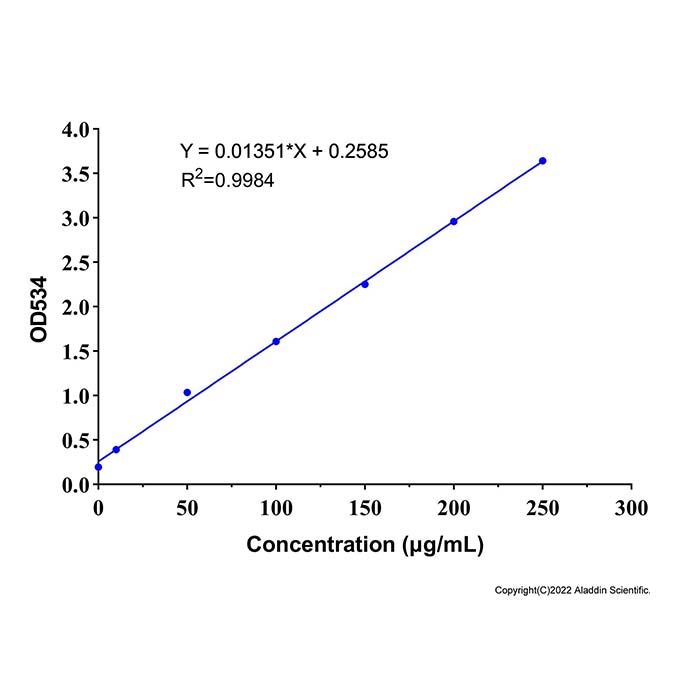
以系列标准 Vitamin C(0、10、50、100、150、200、250 μg/mL)为横坐标,以对应的吸光度为纵坐标,绘制标准曲线,求得回归方程。以测定孔吸光度代入回归方程求得维生素 C 含量。
维生素 C 含量(μg/g)=C样×V样×N/W
C样 :从标曲查得 维生素 C 浓度
VV样:样品提取液总体积(μL)
N:样品稀释倍数
W:样本质量
5. 注意事项
(1) 如果样品浓度过高,应用蒸馏水稀释后重测,结果乘以稀释倍数。
(2) 维生素C标准品易氧化,因此,最好在样本上清液制备好后再配标准,并在10分钟内进行检测。
6. 结果展示
典型标准曲线:
Vitamin C, also known as L-ascorbic acid, is an essential nutrient for higher primates and a few other organisms. In living organisms, vitamin C acts as an antioxidant, an acidic hexose derivative, and an enediol hexonic acid lactone, protecting the body from free radical damage. It also functions as a coenzyme and is widely found in various fresh fruits and vegetables. Vitamin C exists in two isomeric forms: L-form and D-form. Only the L-form has physiological functions, and both the reduced form and oxidized form exhibit biological activity.
The detection principle of the Vitamin C Assay Kit (Phenanthroline Colorimetric Method) is as follows: Under acidic conditions, vitamin C reduces ferric ions (Fe³⁺) to ferrous ions (Fe²⁺), which then form a stable red chelate complex with phenanthroline. The absorbance is measured at 534 nm using a microplate reader . Within a certain concentration range, the absorbance shows a linear relationship with the vitamin C content, allowing the determination of vitamin C concentration.
Product Components
V1515893 | Component | 48 T | 96 T | Storage conditions | V1515893A | Extraction buffer(5×) | 10 mL | 20 mL | 2-8℃. Store in the dark | V1515893B | Acidic Buffer | 1.5 mL | 3 mL | 2-8℃ | V1515893C | Assay Reagent A | 15 mg | 25 mg | 2-8℃. Store in the dark | V1515893D | Assay Reagent B | 1 mL | 2 mL | 2-8℃. Store in the dark | V1515893E | VC Standard | 2×5 mg | 4×5 mg | 2-8℃. Store in the dark |
|
Usage
1.Reagent Preparation
(1) Equilibrate all reagents in the kit to room temperature.
(2) Prepare 1× Extraction Solution by mixing Extraction Solution (5×) and double-distilled water in a volume ratio of 1:4. Store at 2-8°C protected from light.
(3) Add 5 mL (for 96 tests) or 3 mL (for 48 tests) of absolute ethanol to Detection Reagent A and mix well. Store at 2-8°C protected from light.
(4) Take one vial of Vitamin C standard, add 1 mL of 1× Extraction Solution to obtain a 5 mg/mL Vitamin C standard solution. Then dilute it with 1× Extraction Solution to a 250 μg/mL Vitamin C standard solution. Dilute according to the table below. Prepare fresh before use:
Volume of 250 μg/mL Vitamin C Standard (μL) | 1.6 | 8 | 16 | 24 | 32 | 40 | Volume of 1× Extraction Solution (μL) | 38.4 | 32 | 24 | 16 | 8 | 0 | Final Vitamin C Concentration (μg/mL) | 10 | 50 | 100 | 150 | 200 | 250 |
|
2. Sample Preparation (1) Samples must not contain reducing agents such as DTT or 2-mercaptoethanol, nor chelating agents such as HEDP or EDTA. (2) Accurately weigh the tissue sample, add 9 volumes of 1× Extraction Solution according to the weight (g): volume (mL) ratio of 1:9, grind and homogenize. Collect the supernatant after centrifugation at 4000 g for 10 minutes. The supernatant is the test solution. 3. Assay Procedure (1) Perform a preliminary assay on 2-3 samples with expected large differences before formal measurement. (2) Preheat the microplate reader for 30 minutes and set the wavelength to 534 nm. (3) Add reagents sequentially according to the table below: |
Reagent (μL) | Blank Well | Standard Well | Sample Well | 1× Extraction Buffer | 40 | - | - | Vitamin C Standard | - | 40 | - | Test Sample | - | - | 40 | Deionized Water | 80 | 80 | 80 | Acidic Buffer | 20 | 20 | 20 | Reagent A | 40 | 40 | 40 | Reagent B | 20 | 20 | 20 |
|
Mix well and incubate at 30°C for 30 minutes. Measure the absorbance at 534 nm in a 96-well microplate.
4. Result Calculation
Plot a standard curve with the series of standard vitamin C concentrations (0, 10, 50, 100, 150, 200, 250 μg/mL) as the x-axis and the corresponding absorbance values as the y-axis to obtain the regression equation. Substitute the absorbance of the sample well into the regression equation to calculate the vitamin C concentration.
Vitamin C Content (μg/g) = Cₛₐₘₚₗₑ × Vₛₐₘₚₗₑ × N / W
Cₛₐₘₚₗₑ: Vitamin C concentration obtained from the standard curve (μg/mL)
Vₛₐₘₚₗₑ: Total volume of sample extraction solution (μL)
N: Sample dilution factor
W: Sample mass (g)
5. Precautions
(1) If the sample concentration is too high, dilute it with distilled water and re-measure. Multiply the result by the dilution factor.
(2) Vitamin C standard is easily oxidized. Therefore, it is recommended to prepare the standard solution after the sample supernatant is prepared, and perform the assay within 10 minutes.
6. Result Presentation
Typical Standard Curve:


 ZJ26F0737072


 危险品化学品经营许可证(带存储)