
计算溶液所需的质量、体积或浓度。
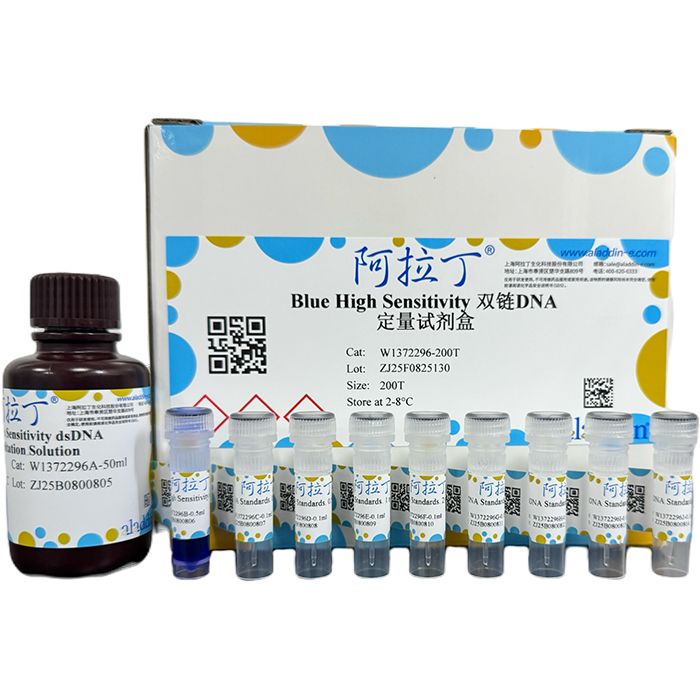
Blue High Sensitivity 双链DNA定量试剂盒
有货
Blue High Sensitivity 双链DNA定量试剂盒不同于常规的基于吸光度的测量,这款试剂盒可以区分dsDNA、ssDNA或RNA,有选择性地检测dsDNA(见图2)。与传统DNA定量方法相比,本产品具有检测范围广、高灵敏度、高特异性等优点。 Blue High Sensitivity 双链DNA定量试剂盒可以在200 μL体系内定量0.2-100 ng的dsDNA(见图3)。此外,本产品还可以将其他污染物的影响降低至最低,可以耐受常规污染物例如蛋白质,盐,有机溶剂和洗涤剂等(见表1),且 本产品不具有细胞膜通透性,没有细胞毒性和诱发突变性,对人体安全无害。
产品组分表:
| 组分货号 | 组分名称 | 物理外观 | 200 T | 1000 T | 储存 |
| W1372296A | Blue High Sensitivity dsDNA Quantitation Solution | 液体 | 50 mL | 250 mL | 2-8 ℃,避光 |
| W1372296B | Blue High Sensitivity dsDNA Enhancer, 100× | 液体 | 0.5 mL | 2 ×1.25 mL | 2-8 ℃,避光 |
| W1372296C | dsDNA Standards. 0 ng/uL dsDNA | 液体 | 0.1 mL | 0.5 mL | 2-8 ℃,避光 |
| W1372296D | dsDNA Standards. 0.5 ng/uL dsDNA | 液体 | 0.1 mL | 0.5 mL | 2-8 ℃,避光 |
| W1372296E | dsDNA Standards. 1 ng/uL dsDNA | 液体 | 0.1 mL | 0.5 mL | 2-8 ℃,避光 |
| W1372296F | dsDNA Standards. 2 ng/uL dsDNA | 液体 | 0.1 mL | 0.5 mL | 2-8 ℃,避光 |
| W1372296G | dsDNA Standards. 4 ng/uL dsDNA | 液体 | 0.1 mL | 0.5 mL | 2-8 ℃,避光 |
| W1372296H | dsDNA Standards. 6 ng/uL dsDNA | 液体 | 0.1 mL | 0.5 mL | 2-8 ℃,避光 |
| W1372296I | dsDNA Standards. 8 ng/uL dsDNA | 液体 | 0.1 mL | 0.5 mL | 2-8 ℃,避光 |
| W1372296J | dsDNA Standards. 10 ng/uL dsDNA | 液体 | 0.1 mL | 0.5 mL | 2-8 ℃,避光 |
储存条件
4℃避光保存,有效期见外包装。
产品参数
Ex/Em:485/530 nm(结合 dsDNA)

图 1. 在 dsDNA 过饱和的条件下,Blue的激发与发射光谱图
使用方法
1. 为了得到最佳结果,请使用精确校准的移液器和去 RNA 酶的枪头、试管以及检测板。建议检测时每个 DNA 标样和未知样品都设定 3 个复孔。如果检测时不只一块 96 孔板,建议每块 96 孔板都设定一条标准曲线,尽量减少检测板之间的误差。
2. 使用前,将产品从储存条件下取出恢复至室温。如果 B 组分出现沉淀,可以 37℃水浴溶解。每个组分应充分震荡或涡旋混匀、离心,以免造成不必要的试剂的损耗。
3. 每个待测样品对应 200 µL 的 Blue 工作液。对于一个 96 孔板,吸取 200 µL B 组分,加入到 20 mL A 组分中,涡旋混匀,配制成 Blue 工作液,为得到最佳结果,工作液应在一小时内使用完毕。如果将工作液重新储存并在 24 h 内使用,结果的准确性会有轻微损失。储存过程中,增强液可能会出现沉淀现象,可以通过涡旋震荡使其重悬。
4. 对于每个样品,吸取 200 µL 的工作液至黑色的 96 孔板微孔中。为确保结果精确可靠,建议每个测试样品和 DNA 标样分别做平行 3 个复孔,此过程也可以使用有精确量程的多通道移液器进行。黑色的检测板可以减少各测试样品间的荧光干扰。
5. 在 96 孔板微孔中,每孔加入 10 µL 的 dsDNA 标样或 1-20 µL 未知样品,并用移液器轻轻混匀。
6. 将微孔板室温避光孵育 5-10 min,为得到最佳结果,孵育结束后,应立即读取检测板。也可以在 6 h 内读取数据,但结果的精确性会有轻微损失。
7. 使用激发波长和发射波长在 485 nm 和 530 nm 处的酶标仪测量荧光值。
8. 制作一条标准曲线,计算检测样品的 DNA 浓度(见图 2)。
注:图 3 标准曲线仅供参考,您可以根据实际测得的数据自制标准曲线,从而求算样品的浓度。

图 2. 使用 Blue High Sensitivity 双链 DNA 定量试剂盒检测不同类型核酸得到的相对荧光强度。

图 3. 使用 Blue High Sensitivity 双链 DNA 定量试剂盒制作的 calf thymus DNA 标准曲线(Ex/Em 485/530)。
实验参考因素
1. 对于要检测的植物或动物来源的DNA样本,小牛胸腺DNA(Calf thymus DNA )常常作为制作DNA标样的参照物。 因为Calf thymus DNA具有双链结构、高度聚合,碱基分配均匀(AT含量58%,GC含量42%)。如果检测样品的荧光值超过了标准曲线,那么需要将样品做进一步稀释处理。为了保持结果的一致性,务必使每孔上样量均等,且不含有其他高浓度的污染物。
2. Blue High Sensitivity 双链DNA定量试剂盒可以测量范围在0.2-100 ng的dsDNA。对于一些不需要线性检测的样品,试剂盒检测范围可以扩展至200 ng。如需检测更低含量的样品,您可以将DNA标样用1×TE缓冲液作进一步的稀释,浓度可以稀释到0.02 ng/μL,然后按照常规程序每孔10 μL上样。
3. 对于不同种类的检测仪器,您可以优化仪器设置,以获取最佳线性度。一些可能会影响最终线性度和相对荧光强度的因素有:(1)激发和发射波长与带宽;(2)截止型滤波器;(3)灵敏度设置;(4)移液的准确性;(5)微孔板制造商。
4. 表1详细列出了几种常见的DNA污染物,如盐、溶剂、洗涤剂和蛋白质等。
表 1. 常见的 DNA 污染物对 Blue High Sensitivity 双链 DNA 定量试剂盒的影响
|
注:三份 dsDNA 平行样品的标准曲线,分别在上述含有指定浓度污染物的条件下(初始浓度进行检测,“Pass”指与没有污染物的体系相比较,实验结果变化范围<20%。所有样品用 Molecular Devices Gemini XS 酶标仪在 485 nm 处激发,在 530 nm 处测荧光强度。“ Pass *”指由此条件测得的标准曲线有少许变动。“dNTPs**”指 dATP, dCTP, dGTP, dTTP 的混合物。
注意事项
1. 使用前请将产品瞬时离心至管底,再进行后续实验。
2. 荧光染料均存在淬灭问题,请尽量注意避光,以减缓荧光淬灭。
3. 为了您的安全和健康,请穿实验服并戴一次性手套操作。
Blue High Sensitivity Double-Stranded DNA Quantification Kit differs from conventional absorbance-based assays. It can distinguish dsDNA, ssDNA and RNA, enabling selective detection of dsDNA (Figure 2). Compared with traditional DNA quantitation methods, this product features a wide detection range, high sensitivity and high specificity.
The Blue High Sensitivity dsDNA Quantitation Kit quantifies dsDNA ranging from 0.2 to 100 ng in a 200 μL reaction system (Figure 3). In addition, it minimizes interference from other contaminants and tolerates common impurities such as proteins, salts, organic solvents and detergents (Table 1). Moreover, the reagent is cell-impermeable, non-cytotoxic and non-mutagenic, making it safe for human use.
Contents & Storage:
| Component No. | Component Name | Appearance | 200 T | 1000 T | Storage |
| W1372296A | Blue High Sensitivity dsDNA Quantitation Solution | Liquid | 50 mL | 250 mL | 2-8 ℃. Store in the dark. |
| W1372296B | Blue High Sensitivity dsDNA Enhancer, 100× | Liquid | 0.5 mL | 2 ×1.25 mL | 2-8 ℃. Store in the dark. |
| W1372296C | dsDNA Standards. 0 ng/uL dsDNA | Liquid | 0.1 mL | 0.5 mL | 2-8 ℃. Store in the dark. |
| W1372296D | dsDNA Standards. 0.5 ng/uL dsDNA | Liquid | 0.1 mL | 0.5 mL | 2-8 ℃. Store in the dark. |
| W1372296E | dsDNA Standards. 1 ng/uL dsDNA | Liquid | 0.1 mL | 0.5 mL | 2-8 ℃. Store in the dark. |
| W1372296F | dsDNA Standards. 2 ng/uL dsDNA | Liquid | 0.1 mL | 0.5 mL | 2-8 ℃. Store in the dark. |
| W1372296G | dsDNA Standards. 4 ng/uL dsDNA | Liquid | 0.1 mL | 0.5 mL | 2-8 ℃. Store in the dark. |
| W1372296H | dsDNA Standards. 6 ng/uL dsDNA | Liquid | 0.1 mL | 0.5 mL | 2-8 ℃. Store in the dark. |
| W1372296I | dsDNA Standards. 8 ng/uL dsDNA | Liquid | 0.1 mL | 0.5 mL | 2-8 ℃. Store in the dark. |
| W1372296J | dsDNA Standards. 10 ng/uL dsDNA | Liquid | 0.1 mL | 0.5 mL | 2-8 ℃. Store in the dark. |
Storage Conditions
Store at 4 °C, protected from light. Expiry date is indicated on the outer package.
Product Specifications
Ex/Em: 485/530 nm (when bound to dsDNA)

Figure 1. Excitation and emission spectra of Blue under dsDNA-saturated conditions
Protocol:
1. For optimal results, use accurately calibrated pipettors and RNase-free tips, tubes and assay plates. It is recommended to set up 3 technical replicates for each DNA standard and unknown sample. If multiple 96-well plates are assayed, a standard curve should be prepared for each plate to minimize inter-plate variation.
2. Remove the kit from storage and equilibrate to room temperature before use. If Component B forms a precipitate, dissolve it in a 37 °C water bath. Vortex and centrifuge each component thoroughly to avoid unnecessary reagent loss.
3. Prepare 200 µL of Blue working solution per test sample. For one 96-well plate, transfer 200 µL of Component B into 20 mL of Component A, then vortex to prepare Blue working solution. For best performance, use the working solution within 1 hour. If the working solution is stored and reused within 24 h, a slight reduction in accuracy may occur. Precipitation may form in the working solution during storage; re-suspend by vortexing.
4. Add 200 µL of working solution into each well of a black 96-well plate. For reliable and accurate results, prepare 3 parallel technical replicates for each test sample and DNA standard. A properly sized multichannel pipettor may be used for this step. Black plates reduce fluorescence crosstalk between samples.
5. Add 10 µL of dsDNA standard or 1–20 µL of unknown sample into each well, and mix gently by pipetting.
6. Incubate the plate at room temperature, protected from light, for 5–10 min. For optimal results, read the plate immediately after incubation. Readings may be taken within 6 h, with a slight loss in precision.
7. Measure fluorescence intensity using a microplate reader with excitation at 485 nm and emission at 530 nm.
8. Generate a standard curve and calculate the DNA concentration of test samples (see Figure 2).
Note: The standard curve in Figure 3 is for reference only. Prepare your own standard curve using your experimental data to calculate sample concentrations.
Figure 2. Relative fluorescence intensity of different nucleic acids detected using the Blue High Sensitivity dsDNA Quantitation Kit.
Figure 3. Standard curve of calf thymus DNA generated with the Blue High Sensitivity dsDNA Quantitation Kit (Ex/Em 485/530 nm).
Experimental Considerations:
1. For DNA samples derived from plants or animals, calf thymus DNA is commonly used as the reference for preparing DNA standards. It is double‑stranded, highly polymerized, and features an even base composition (58% AT, 42% GC). If the fluorescence reading of a test sample exceeds the range of the standard curve, further dilution of the sample is required. To ensure consistent results, maintain equal loading volume in each well and avoid high concentrations of other contaminants.
2. The Blue High Sensitivity dsDNA Quantitation Kit quantifies dsDNA within the range of 0.2–100 ng. For samples where linear quantitation is not required, the detectable range of the kit can be extended to 200 ng. For samples with lower DNA levels, dilute the DNA standards with 1×TE buffer down to 0.02 ng/μL, then load 10 μL per well following the standard protocol.
3. Instrument settings may be optimized for different plate readers to achieve optimal linearity. Factors that can affect final linearity and relative fluorescence intensity include: (1) excitation and emission wavelengths and bandwidth; (2) cutoff filters; (3) gain/sensitivity settings; (4) pipetting accuracy; (5) microplate manufacturer.
4. Table 1 lists several common DNA contaminants, including salts, solvents, detergents and proteins.
Table 1. Effects of Common DNA Contaminants on the Blue High Sensitivity dsDNA Quantitation Kit
|
Precautions:
1. Briefly centrifuge the product to collect contents at the bottom of the tube before use.
2. Fluorescent dyes are susceptible to photobleaching. Protect the reagent from light to slow down photobleaching.
3. For your safety and health, wear a lab coat and disposable gloves during operation.
| 组分货号 | 组分名称 | 物理外观 | 200 T | 1000 T | 储存 |
| W1372296A | Blue High Sensitivity dsDNA Quantitation Solution | 液体 | 50 mL | 250 mL | 2-8 ℃,避光 |
| W1372296B | Blue High Sensitivity dsDNA Enhancer, 100× | 液体 | 0.5 mL | 2 ×1.25 mL | 2-8 ℃,避光 |
| W1372296C | dsDNA Standards. 0 ng/uL dsDNA | 液体 | 0.1 mL | 0.5 mL | 2-8 ℃,避光 |
| W1372296D | dsDNA Standards. 0.5 ng/uL dsDNA | 液体 | 0.1 mL | 0.5 mL | 2-8 ℃,避光 |
| W1372296E | dsDNA Standards. 1 ng/uL dsDNA | 液体 | 0.1 mL | 0.5 mL | 2-8 ℃,避光 |
| W1372296F | dsDNA Standards. 2 ng/uL dsDNA | 液体 | 0.1 mL | 0.5 mL | 2-8 ℃,避光 |
| W1372296G | dsDNA Standards. 4 ng/uL dsDNA | 液体 | 0.1 mL | 0.5 mL | 2-8 ℃,避光 |
| W1372296H | dsDNA Standards. 6 ng/uL dsDNA | 液体 | 0.1 mL | 0.5 mL | 2-8 ℃,避光 |
| W1372296I | dsDNA Standards. 8 ng/uL dsDNA | 液体 | 0.1 mL | 0.5 mL | 2-8 ℃,避光 |
| W1372296J | dsDNA Standards. 10 ng/uL dsDNA | 液体 | 0.1 mL | 0.5 mL | 2-8 ℃,避光 |
通过匹配包装上的批号来查找并下载产品的 COA,每批产品都进行了严格的验证,您可放心使用!
| 批号(Lot Number) | 证书类型 | 货号 |
|---|---|---|
 ZJ25F0825130 |
分析证书 | W1372296 |
我们的级别选择指南涵盖了目录中所有的变体的纯度、稳定剂状态和应用适用性。
查看 BioReagent 级别指南 → 查看 Suitable for molecular biology 级别指南 →

 危险品化学品经营许可证(带存储)