产品介绍
黄嘌呤氧化酶(XOD)是体内嘌呤代谢与氧化应激调控的关键限速酶,主要分布于哺乳动物肝脏、心、肺、肠道等组织,可特异性催化黄嘌呤与水、氧气反应,生成尿酸、过氧化氢和超氧阴离子;体系中存在的水溶性四唑盐显色底物 WST-8时,可在电子传递剂 PMS 的介导下,被超氧阴离子定量还原为水溶性甲臜产物,该产物在450nm(特征吸收峰 440-480nm)处有最大可见光吸收,吸光度的上升速率与样本中 XOD 的活性呈严格线性正相关,通过标准曲线可精准定量样本中 XOD 的活性。
X1515833 | 组分 | 物理外观 | 48 T | 96 T | 储存条件 | 单次测试使用量 |
X1515833A | 提取液 | 液体 | 10 mL | 20 mL | -20℃. | 按需 |
X1515833B | 缓冲液 | 液体 | 15 mL | 25 mL | -20℃. | 按需 |
X1515833C | 检测试剂 A | 液体 | 0.1 mL | 0.2 mL | -20℃. 避光保存. | 2 μL |
X1515833D | 检测试剂 B | 液体 | 0.1 mL | 0.2 mL | -20℃. 避光保存. | 2 μL |
X1515833E | 底物 | 液体 | 0.1 mL | 0.2 mL | -20℃. 避光保存. | 2 μL |
X1515833F | XOD标准品(5 U/mL) | 液体 | 30 μL | 60 μL | -20℃. 避光保存. | 8 μL |
使用方法
1. 样本制备
(1) 血液样品的准备:对于血清样品,将全血在常温下静置30分钟-2小时,4ºC约1000-2000×g离心10分钟,取上清;对于血浆样品,将全血用肝素或者EDTA进行抗凝,4ºC约1000-2000×g离心10分钟,取上清。
(2) 细胞样本的准备:对于培养的贴壁细胞,PBS洗涤细胞一次。对于培养的悬浮细胞,离心收集细胞用PBS洗涤细胞一次。按照每100万细胞加入100-200 μL 提取液的比例加入提取液,适当吹打,冰浴10分钟充分裂解细胞。4ºC, 12,000×g离心5分钟,取上清用于后续检测。
(3) 对于组织样品,按照每10 mg组织加入100 μL 提取液的比例,使用匀浆器冰浴匀浆。4ºC约12,000×g离心5分钟,取上清用于后续检测。
(4) 细胞培养上清样品的准备:对于贴壁细胞,直接取培养液;对于悬浮细胞,离心取培养液。
以上操作除血液凝固步骤外,其他的需要在4℃或冰上进行。制备好的细胞或组织样品如果不能立即检测,可以-20ºC或-80ºC冻存。
2. 试剂准备
(1)除XOD以外的其它所有试剂平衡至室温。XOD置于冰浴备用,使用完毕后宜立即按照试剂盒要求的条件保存。
(2)配制系列 XOD标准溶液:取8 μL (5 U/mL) XOD标准品加入92μL缓冲液,混匀,即得浓度为400 mU/mL的XOD,分别取400 mU/mL的XOD 1、2.5、5、10、15、20 μL加入96孔板的标准品孔中,并用对应的提取液或缓冲液补足至20μl(如果检测用提取液制备的细胞或组织样品,使用提取液;如果检测血液、上清等无需处理的样品,使用缓冲液),此时标准曲线的浓度为20、50、100、200、300、400 mU/ml。
WST-8显色工作液的配制:按照下表配制WST-8工作液
样本数 | 1 | 10 | 20 | 50 |
缓冲液(μL) | 74 | 740 | 1480 | 3700 |
检测试剂A(μL) | 2 | 20 | 40 | 100 |
检测试剂B(μL) | 2 | 20 | 40 | 100 |
底物(μL) | 2 | 20 | 40 | 100 |
总体积(μL) | 80 | 800 | 1600 | 4000 |
3. 样本测定
(1)加入1-20 μL样品或稀释后的样品到96孔板样品孔中,并相应地再加入提取液或检测缓冲液至样品孔中,补足到20 µL。同时设置仅含提取液或检测缓冲液的孔为空白对照孔(如果检测用提取液制备的细胞或组织样品,使用提取液;如果检测血液、上清等无需处理的样品,使用缓冲液)。
(2) 各孔加入WST-8显色工作液80 μL,混匀,37ºC反应30分钟。
(3) 在450 nm处测定吸光度。
4. 结果计算
建立标准曲线,并计算样品中黄嘌呤氧化酶的活性为A,黄嘌呤氧化酶酶活性计算公式如下:
C (mU/ml) = A × n
A为标曲上计算的数值
n为样品总稀释倍数
黄嘌呤氧化酶酶活性单位的定义为:在室温条件下,每分钟催化黄嘌呤产生1.0 μmol尿酸和过氧化氢所需的酶量。
5. 注意事项
(1) 各组分需要完全解冻并平衡至室温后再使用,否则会影响检测结果。
(2) 血清等样品如在4ºC保存,保存时间不得超过2周,否则会影响检测结果的准确性。通常血清样品宜-20ºC保存,-80ºC保存更佳。
(3) 在正式检测前,需选择2-3个预期差异大的样本稀释成不同浓度进行预实验。
6.结果展示
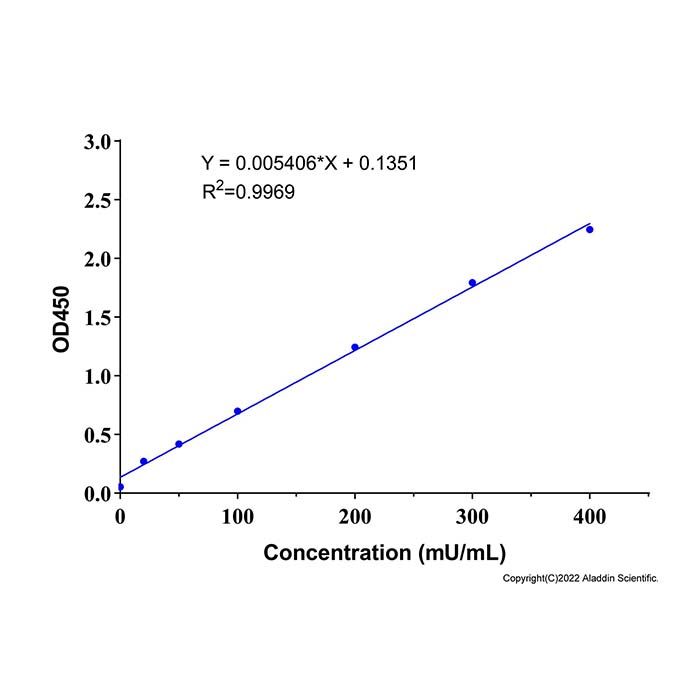
典型标准曲线:

Product Description
Xanthine oxidase (XOD) is a key rate-limiting enzyme involved in purine metabolism and oxidative stress regulation in vivo. It is mainly distributed in tissues such as the liver, heart, lung and intestine of mammals. It can specifically catalyze the reaction of xanthine with water and oxygen to produce uric acid, hydrogen peroxide and superoxide anion. In the presence of the water-soluble tetrazolium chromogenic substrate WST-8, the latter can be quantitatively reduced by superoxide anion to a water-soluble formazan product mediated by the electron transfer agent PMS. This product exhibits maximum visible light absorption at 450 nm (characteristic absorption peak: 440-480 nm). The increasing rate of absorbance shows a strict linear positive correlation with XOD activity in the sample, allowing accurate quantification of XOD activity via a standard curve.
X1515833 | Component | Appearance | 48 T | 96 T | Storage conditions | Quantity Per Test |
X1515833A | Extraction buffer | Liquid | 10 mL | 20 mL | -20℃. | As need |
X1515833B | Assay Buffer | Liquid | 15 mL | 25 mL | -20℃. | As need |
X1515833C | Assay Reagent A | Liquid | 0.1 mL | 0.2 mL | -20℃. Store in the dark. | 2 μL |
X1515833D | Assay Reagent B | Liquid | 0.1 mL | 0.2 mL | -20℃. Store in the dark. | 2 μL |
X1515833E | Substrate | Liquid | 0.1 mL | 0.2 mL | -20℃. Store in the dark. | 2 μL |
X1515833F | XOD Standard(5 U/mL) | Liquid | 30 μL | 60 μL | -20℃. Store in the dark. | 8 μL |
Protocol
1. Sample Preparation
(1) Blood samples
Serum samples: Allow whole blood to stand at room temperature for 30 minutes to 2 hours. Centrifuge at 1000–2000×g for 10 minutes at 4°C, and collect the supernatant.
Plasma samples: Anticoagulate whole blood with heparin or EDTA. Centrifuge at 1000–2000×g for 10 minutes at 4°C, and collect the supernatant.
(2) Cell samples
Adherent cells: Wash cells once with PBS.
Suspension cells: Collect cells by centrifugation and wash once with PBS.
Add extraction buffer at a ratio of 100–200 μL per 1×10⁶ cells, pipette gently, and incubate on ice for 10 minutes to fully lyse cells. Centrifuge at 12,000×g for 5 minutes at 4°C, and collect the supernatant for subsequent detection.
(3) Tissue samplesAdd extraction buffer at a ratio of 100 μL per 10 mg tissue, and homogenize on ice using a homogenizer. Centrifuge at approximately 12,000×g for 5 minutes at 4°C, and collect the supernatant for subsequent detection.
(4) Cell culture supernatant:
For adherent cells: Collect the culture medium directly.
For suspension cells: Collect the culture medium after centrifugation.
Except for the blood coagulation step, all the above procedures should be performed at 4°C or on ice. If prepared cell or tissue samples are not assayed immediately, they may be stored frozen at -20°C or -80°C.
2. Reagent Preparation
(1) Thaw all reagents except XOD and equilibrate them to room temperature. Keep XOD on ice for use. After use, store XOD immediately under the conditions specified by the kit.
(2) Preparation of serial XOD standard solutions:
Add 8 μL of XOD standard (5 U/mL) to 92 μL buffer and mix thoroughly to obtain XOD solution at a concentration of 400 mU/mL.Pipette 1,2.5,5,10,15 and 20 μL of the 400 mU/mL XOD solution into the standard wells of a 96‑well plate respectively, and add the corresponding extraction buffer or assay buffer to make the total volume up to 20 μL(use extraction buffer for cell or tissue samples prepared with extraction buffer; use assay buffer for untreated samples such as blood and supernatant).
The concentrations for the standard curve are 20, 50, 100, 200, 300, and 400 mU/mL.
(3) Preparation of WST-8 chromogenic working solution:Prepare the WST-8 working solution according to the table below.
Number of Samples | 1 | 10 | 20 | 50 |
Assay buffer (μL) | 74 | 740 | 1480 | 3700 |
Assay Reagent A(μL) | 2 | 20 | 40 | 100 |
Assay Reagent B(μL) | 2 | 20 | 40 | 100 |
Substrate(μL) | 2 | 20 | 40 | 100 |
Total Volume (μL) | 80 | 800 | 1600 | 4000 |
3. Sample Assay
(1) Add 1-20 μL of sample or diluted sample to the sample wells of a 96-well plate, and add corresponding extraction buffer or assay buffer to bring the total volume to 20 µL.
Meanwhile, set wells containing only extraction buffer or assay buffer as blank control wells(use extraction buffer for cell or tissue samples prepared with extraction buffer; use assay buffer for untreated samples such as blood and supernatant).
(2) Add 80 μL of WST-8 chromogenic working solution to each well, mix well, and incubate at 37°C for 30 minutes.
(3) Measure the absorbance at 450 nm.
4. Calculation of Results
Establish a standard curve and calculate the activity of xanthine oxidase (XOD) in the sample as A. The formula for calculating XOD activity is as follows:
C (mU/mL) = A × n
- A: Value calculated from the standard curve
- n: Total dilution factor of the sample
Definition of XOD activity unit:
The amount of enzyme that catalyzes the production of 1.0 μmol of uric acid and hydrogen peroxide from xanthine per minute at room temperature.
5. Notes
(1) All components must be completely thawed and equilibrated to room temperature before use, otherwise the test results will be affected.
(2) If serum samples are stored at 4°C, the storage time shall not exceed 2 weeks, otherwise the accuracy of test results will be affected. Generally, serum samples should be stored at -20°C, and -80°C is more preferable.
(3) Before formal testing, 2-3 samples with expected large differences should be diluted to different concentrations for a preliminary experiment.
6. Results Presentation
Typical standard curve:



 危险品化学品经营许可证(带存储)