
计算溶液所需的质量、体积或浓度。
概述
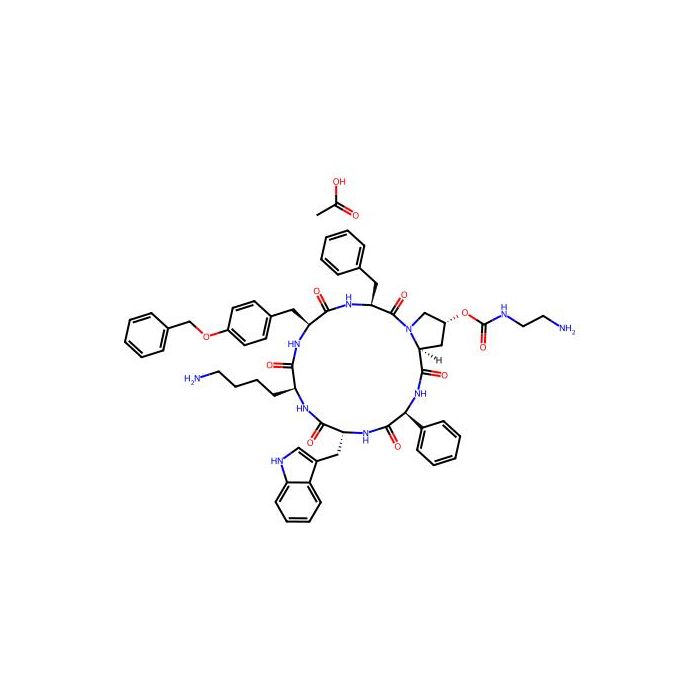
Pasireotide (SOM230) acetate, a long-acting cyclohexapeptide somatostatin analogue, can improve agonist activity at somatostatin receptors (subtypes sst1/2/3/4/5 , pK i =8.2/9.0/9.1/<7.0/9.9, respectively). Pasireotide acetate can suppress GH, IGF-I and ACTH secretion, indicating potential efficacy in acromegaly and Cushing's disease. Pasireotide acetate also exhibits antisecretory, antiproliferative, and proapoptotic activity
In Vitro
Pasireotide acetate exhibits unique high-affinity binding to human somatostatin receptors (subtypes sst1/2/3/4/5, pK i =8.2/9.0/9.1/<7.0/9.9, respectively). Pasireotide acetate effectively inhibits the growth hormone releasing hormone (GHRH) induced growth hormone (GH) release in primary cultures of rat pituitary cells, with an IC 50 of 0.4 nM. MCE has not independently confirmed the accuracy of these methods. They are for reference only.
In Vivo
Pasireotide acetate (160 mg/kg/mouth; s.c. for 4 months) significantly decreases the serum insulin, increases serum glucose, reduces the tumor size and increases apoptosis in Pdx1-Cre. Pasireotide acetate (2-50 μg/kg; s.c. twice daily for 42 days) exerts the antinociceptive and antiinflammatory actions via the SSTR2 receptor in a mouse model of immune-mediated arthritis. MCE has not independently confirmed the accuracy of these methods. They are for reference only. Animal Model: 12 month-old conditional Men1 knockout mice with insulinomaDosage: 160 mg/kg/mouth Administration: S.c. every month for 4 months Result: Decreased the serum insulin from 1.060 μg/L to 0.3653 μg/L and increased the serum glucose from 4.246 mM to 7.122 mM. Significantly reduced the tumor size and increased apoptosis.
Form:Solid
IC50& Target:pKi: 8.2 (sst1), 9.0 (sst2), 9.1 (sst3), <7.0 (sst4), 9.9 (sst5)
规格
别名
醋酸帕瑞肽
规格或纯度
≥99%
英文名称
Pasireotide acetate
生化机理
醋酸帕西洛肽(SOM230)是一种长效环己肽类体生长抑素类似物,可提高体生长抑素受体(sst1/2/3/4/5 亚型,pK i 分别为 8.2/9.0/9.1/<7.0/9.9 )的激动剂活性。醋酸帕西瑞奥肽可抑制 GH、IGF-I 和 A
储存条件
避光,充氩,干燥,-80℃储存
运输条件
特低温运输
作用类型
激动剂
纯度
≥99%
名称和识别符
分子类型
小分子
Isomeric SMILES
CC(=O)O.C1[C@H](CN2[C@@H]1C(=O)N[C@H](C(=O)N[C@@H](C(=O)N[C@H](C(=O)N[C@H](C(=O)N[C@H](C2=O)CC3=CC=CC=C3)CC4=CC=C(C=C4)OCC5=CC=CC=C5)CCCCN)CC6=CNC7=CC=CC=C76)C8=CC=CC=C8)OC(=O)NCCN
PubChem CID
分子量
1107.26
高级数据
化学和物理性质
溶解性
DMSO : 100 mg/mL (90.31 mM; Need ultrasonic) H2O : 1 mg/mL (0.90 mM; ultrasonic and warming and heat to 60°C)
质检证书(CoA,COO,BSE/TSE 和分析图谱)
C of A & Other Certificates(BSE/TSE, COO):
输入批号以搜索分析图谱:
溶液计算器
常见问题
本产品的纯度是多少?
本产品的化学纯度(含量)为 ≥99%。批次的具体数值以分析证书(COA)为准。
本产品应如何储存?
请于?80 °C、避光、氩气保护、干燥条件下保存。本品在氩气保护下供应,每次取用后请在惰性气体下重新密封。
本产品如何运输?
本产品采用干冰配冷袋冷冻运输。收货后请立即拆包,并按上述储存条件保存;处理干冰时请戴隔热手套并保持通风。
本产品的 CAS 号、分子式和分子量是多少?
本产品的 CAS 号为 396091-76-2,分子式为 C60H70N10O11,分子量为 1107.26 g/mol。
如何获取批次专用COA?
每个订单都会随附分析证书(COA),您也可以从账户订单历史中下载。如需订购前的COA,请联系您的客户代表,或使用PDP上的"申请COA"按钮——我们将提供代表性批次的COA。
产品仅提供给经过验证的企业、机构和合格的专业人员用于研发。不适用于人类、动物、诊断或治疗。
Copyright © 2023至今 上海阿拉丁生化科技股份有限公司 SSE:688179 保留所有权利。


 危险品化学品经营许可证(带存储)