
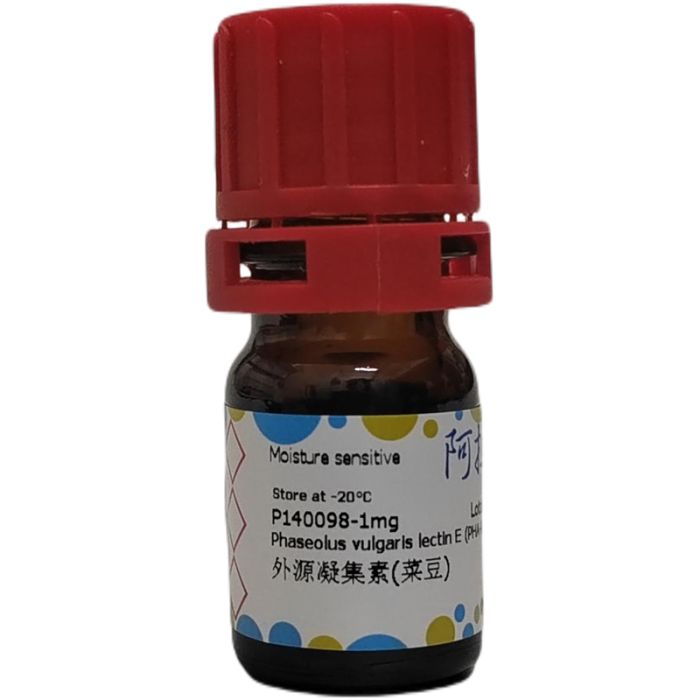
 E2527671
计算溶液所需的质量、体积或浓度。
概述
Phaseolus vulgaris lectin (PHA-E) is isolated from red kidney beans and purified by affinity chromatography and ion-exchange chromatography. It is a tetrameric protein with a molecular weight of 128 kDa. The lectin recognizes and binds specifically to terminal galactose, N-acetylglucosamine and mannose residues of complex glycans on mammalian glycoproteins. Because of its strong erythrocyte agglutinating activity, it is also known as Erythroagglutinin (PHA-E). PHA-E is not blood group specific. Less than 5 μg/ml agglutinates human erythrocytes of type O and agglutination can be inhibited by certain oligosaccharides. PHA-E lectin is supplied as a white lyophilized powder from a buffer containing from 50 mM NH4HCO3. The purity of the lectin in determined by SDS-PAGE, which generate one single band at 34 kDa. Erythrocyte agglutination studies;Model system of how proteins recognize carbohydrates● Ultrapure quality ● Sμgar specificity: complex oligosaccharides ● Strong erythroagglutinin activity ● Lyophilized powderRed kidney beans
Phaseolus vulgaris lectin (PHA-E) is isolated from red kidney beans and purified by affinity chromatography and ion-exchange chromatography. It is a tetrameric protein with a molecular weight of 128 kDa. The lectin recognizes and binds specifically to terminal galactose, N-acetylglucosamine and mannose residues of complex glycans on mammalian glycoproteins. Because of its strong erythrocyte agglutinating activity, it is also known as Erythroagglutinin (PHA-E). PHA-E is not blood group specific. Less than 5 μg/ml agglutinates human erythrocytes of type O and agglutination can be inhibited by certain oligosaccharides. PHA-E lectin is supplied as a white lyophilized powder from a buffer containing from 50 mM NH4HCO3. The purity of the lectin in determined by SDS-PAGE, which generate one single band at 34 kDa.
● Ultrapure quality
● Sugar specificity: complex oligosaccharides
● Strong erythroagglutinin activity
● Lyophilized powder
Erythrocyte agglutination studies;Model system of how proteins recognize carbohydrates
规格
别名
植物血球凝集素
英文别名
Lectin from Phaseolus vulgaris (red kidney bean) | Phaseolus vulgaris agglutinin | PHA
英文名称
Phaseolus vulgaris lectin E (PHA-E)
生化机理
PHA 由两种分子组成,一种是红细胞凝集素(PHA-E),它具有较低的有丝分裂活性和较高的红细胞凝集素活性;另一种是白细胞凝集素(PHA-L),它具有较高的有丝分裂活性和白细胞凝集素活性,但红细胞凝集素活性很低;PHA-E 没有血型特异性,但某些寡糖可抑制凝集。
储存条件
-20°C储存
运输条件
超低温运输
名称和识别符
分子类型
蛋白质
高级数据
化学和物理性质
敏感性
对湿度敏感
质检证书(CoA,COO,BSE/TSE 和分析图谱)
C of A & Other Certificates(BSE/TSE, COO):
输入批号以搜索分析图谱:
技术文档和文章
溶液计算器
常见问题
本产品应如何储存?
请于?20 °C条件下保存。需冷冻保存以维持规定的有效期。
本产品如何运输?
本产品采用保温箱配冰袋运输。收货后请立即拆包,并按上述储存条件保存。
如何获取批次专用COA?
每个订单都会随附分析证书(COA),您也可以从账户订单历史中下载。如需订购前的COA,请联系您的客户代表,或使用PDP上的"申请COA"按钮——我们将提供代表性批次的COA。
产品仅提供给经过验证的企业、机构和合格的专业人员用于研发。不适用于人类、动物、诊断或治疗。
Copyright © 2023至今 上海阿拉丁生化科技股份有限公司 SSE:688179 保留所有权利。


 危险品化学品经营许可证(带存储)