Measured by its ability to cleave a colorimetric peptide substrate, N-carbobenzyloxy-Lys-ThioBenzyl ester (Z-Lys-SBzl), in the presence of 5,5’Dithio-bis (2-nitrobenzoic acid) (DTNB). Edwards, K.M.et al. (1999) J. Biol. Chem.274:30468. The specific activity is >20,000 pmol/min/µg, as measured under the described conditions.
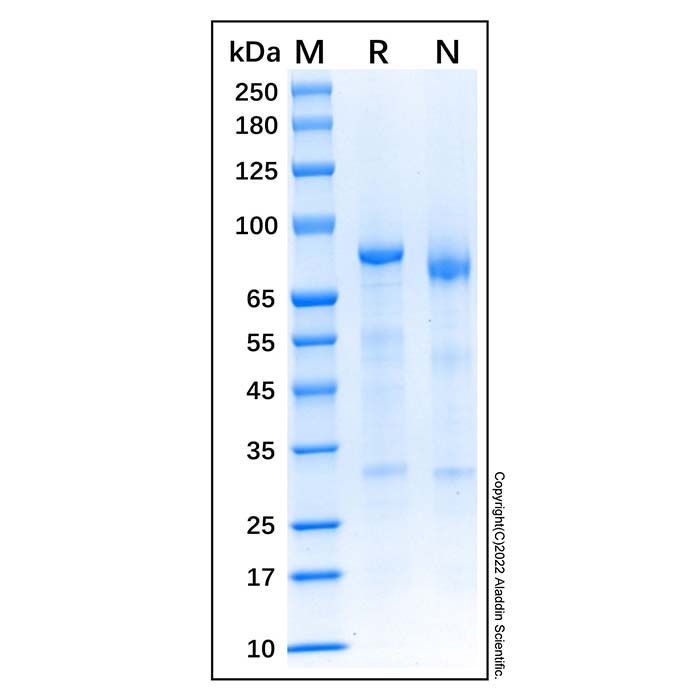
Purity: >90%, by SDS-PAGE visualized with Coomassie® Blue Staining.
Description:
Complement is an integral component of the adaptive and innate immune systems and represents one of the major effector systems for the immune responses. The classical complement pathway is triggered by C1, a complex composed of the binding protein C1q and two proenzymes, C1r and C1s. Upon binding of IgG to the head of C1q, C1r undergoes autoactivation and in turn cleaves and activates C1s. C1r and C1s, the proteases responsible for activation and proteolytic activity of the C1 complex of complement, share similar overall structural organizations featuring five nonenzymic protein modules (two CUB modules surrounding a single EGF module, and a pair of CCP modules) followed by a serine protease domain. Besides highly specific proteolytic activities, both proteases exhibit interaction properties associated with their N-terminal regions. In contrast, C1r and C1s widely differ from each other by their glycosylation patterns: both proteins contain Asn-linked carbohydrates, but four glycosylation sites are present on C1r, and only two on C1s. As a highly specific serine protease, C1s executes the catalytic function of the C1 complex: the cleavage of C4 and C2, and thus instigates a sequence of activation steps of other components of the complement system, culminating in the formation of the membrane attack complex which induces cell lysis. Like other complement serine proteases C1s has restricted substrate specificity and it is engaged into specific interactions with other subcomponents of the complement system. The only other protein known to interact with C1s physiologically is SerpinC1, an inhibitor of serine protease, which inhibits C1s activity and thus plays a regulatory role in controlling the function of C1s enzyme.
Measured by its ability to cleave a colorimetric peptide substrate, N-carbobenzyloxy-Lys-ThioBenzyl ester (Z-Lys-SBzl), in the presence of 5,5’Dithio-bis (2-nitrobenzoic acid) (DTNB). Edwards, K.M.et al. (1999) J. Biol. Chem.274:30468. The specific activity is >20,000 pmol/min/µg, as measured under the described conditions.
83.4 kDa and 55.9 kDa and 31.8 kDa, under reducing conditions; 78.0 kDa and 51.3 kDa and 31.4 kDa, under non-reducing conditions
分子类型
蛋白质
产品线
生物产品
储存与运输
物理形态
冻干(Lyophilized)
储存缓冲液
Lyophilized from PBS, pH7.4
复溶
We recommend that this vial be briefly centrifuged prior to opening to bring the contents to the bottom. Reconstitute at 0.5 mg/mL in sterile distilled water. Stock solutions should be apportioned into working aliquots and stored at ≤ -20 °C. Further dilutions should be made in appropriate buffered solutions.
储存条件
-20°C储存,避免反复冻融
运输条件
超低温运输
稳定性与储存
在 -20°C 下可保存 1 年。避免冷冻/解冻循环。
图片
Recombinant Human Complement Component C1s Protein (rp169561) - SDS-PAGE 3 μg/lane of Recombinant Human Complement Component C1s Protein was resolved with SDS-PAGE under reducing (R) and non-reducing (N) conditions and visualized by Coomassie® Blue staining, showing a band at 83.4 kDa and 55.9 kDa and 31.8 kDa under reducing conditions and 78.0 kDa and 51.3 kDa and 31.4 kDa under non-reducing conditions.

 ZJ24F0404844


 危险品化学品经营许可证(带存储)