Complement component 7 is a component of the complement system. It belongs to the complement C6/C7/C8/C9 family. It contains 1 EGF-like domain, 1 LDL-receptor class A domain, 1 MACPF domain, 2 Sushi (CCP/SCR) domains and 2 TSP type-1 domains. Complement component 7 serves as a membrane anchor. It participates in the formation of Membrane Attack Complex (MAC). People with C7 deficiency are prone to bacterial infection. It is a constituent of MAC that plays a key role in the innate and adaptive immune response by forming pores in the plasma membrane of target cells. Defects in C7 are a cause of complement component 7 deficiency (C7D). A rare defect of the complement classical pathway associated with susceptibility to severe recurrent infections, predominantly by Neisseria gonorrhoeae or Neisseria meningitidis.
Post-translational: C7 has 28 disulfide bridges. C-, N- and O-glycosylated. O-glycosylated with core 1 or possibly core 8 glycans.
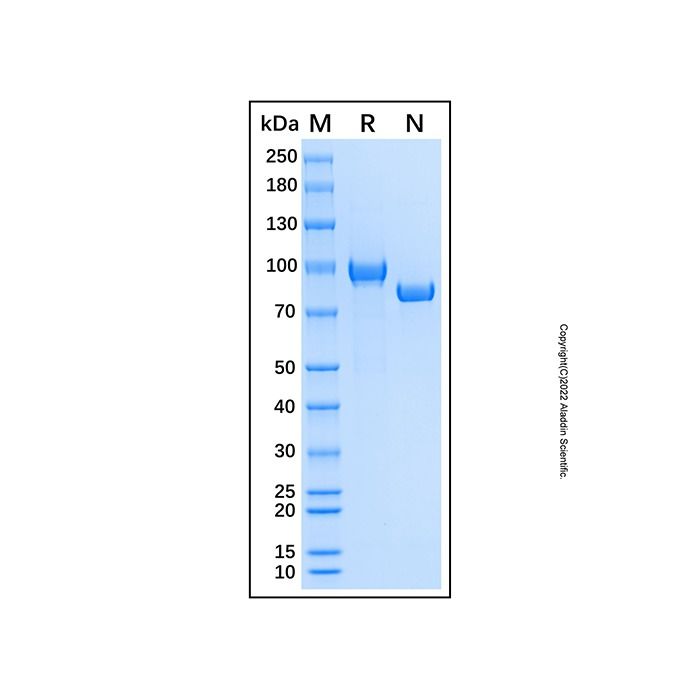
88.7-105.2 kDa, under reducing conditions; 75.4-89.6 kDa, under non-reducing conditions.
分子类型
蛋白质
产品线
生物产品
储存与运输
物理形态
冻干(Lyophilized)
储存缓冲液
Lyophilized from PBS, pH 7.4
浓度
见COA
复溶
We recommend that this vial be briefly centrifuged prior to opening to bring the contents to the bottom. Reconstitute at 0.5 mg/mL in sterile distilled water. Stock solutions should be apportioned into working aliquots and stored at ≤ -20 °C. Further dilutions should be made in appropriate buffered solutions.
储存条件
-20°C储存,避免反复冻融
运输条件
超低温运输
稳定性与储存
Store at -20°C for 1 year. Avoid freeze/thaw cycle.
图片
Recombinant Human Complement C7 Protein (rp188334) - SDS-PAGE 3 μg/lane of Recombinant Human Complement C7 Protein was resolved with SDS-PAGE under reducing (R) and non-reducing (N) conditions and visualized by Coomassie® Blue staining, showing a band at 88.7-105.2 kDa under reducing conditions and 75.4-89.6 kDa under non-reducing conditions.

 ZJ25F0319973


 危险品化学品经营许可证(带存储)