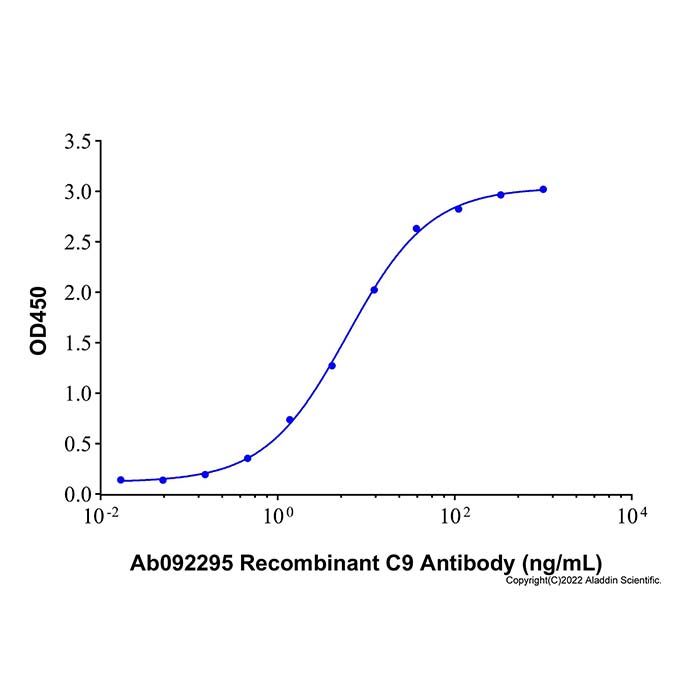
Immobilized Recombinant Human Complement Component C9 Protein (rp188480) at 1.0 μg/mL can bind Recombinant C9 Antibody (Ab092295) with the EC50 of 6.2 ng/mL.
Pore-forming component of the membrane attack complex (MAC), a multiprotein complex activated by the complement cascade, which inserts into a target cell membrane and forms a pore, leading to target cell membrane rupture and cell lysis (PubMed:22832194, PubMed:26841837, PubMed:26841934, PubMed:27052168, PubMed:30552328, PubMed:6177822, PubMed:9212048, PubMed:9634479). The MAC is initiated by proteolytic cleavage of C5 into complement C5b in response to the classical, alternative, lectin and GZMK complement pathways (PubMed:9212048, PubMed:9634479). The complement pathways consist in a cascade of proteins that leads to phagocytosis and breakdown of pathogens and signaling that strengthens the adaptive immune system (PubMed:9212048, PubMed:9634479). Constitutes the pore-forming subunit of the MAC complex: during MAC assembly, C9 associates with the C5b8 intermediate complex, and polymerizes to complete the pore (PubMed:26841934, PubMed:30111885, PubMed:30552328, PubMed:34752492, PubMed:4055801, PubMed:6177822). Membrane attack complex (MAC) assembly is inhibited by CD59, thereby protecting self-cells from damage during complement activation (PubMed:36797260). CD59 acts by preventing incorporation of the multiple copies of C9 required for complete formation of the osmolytic pore (PubMed:36797260). MAC assembly is also inhibited by clusterin (CLU) chaperones that inhibit polymerization of C9 (PubMed:34667172). Specifically inhibited by the antibody aE11, thereby inhibiting MAC assembly (PubMed:36639734).
Post-translational: Thrombin cleaves factor C9 to produce C9a and C9b. Phosphorylation sites are present in the extracellular medium. Initially, positions and connectivity of disulfide bonds were based on peptide sequencing done for the human protein (PubMed:8603752). The crystal structures for the human and mouse proteins corrected the positions and connectivities of the disulfide bonds (PubMed:30111885). The distance between Cys-57 and Cys-94 in the monomeric mouse protein precludes formation of a disulfide bond, contrary to what is seen in the structure of the human polymeric form of the protein (Probable).
生物活性
Immobilized Recombinant Human Complement Component C9 Protein (rp188480) at 1.0 μg/mL can bind Recombinant C9 Antibody (Ab092295) with the EC50 of 6.2 ng/mL.
59.1-69.5 kDa, under reducing conditions; 54.7-63.9 kDa, under non-reducing conditions.
分子类型
蛋白质
产品线
生物产品
储存与运输
物理形态
冻干(Lyophilized)
储存缓冲液
Lyophilized from PBS, pH 7.4.
浓度
见COA
复溶
We recommend that this vial be briefly centrifuged prior to opening to bring the contents to the bottom. Reconstitute at 1.0 mg/mL in sterile distilled water. Stock solutions should be apportioned into working aliquots and stored at ≤ -20 °C. Further dilutions should be made in appropriate buffered solutions.
储存条件
-20°C储存
运输条件
超低温运输
稳定性与储存
-20℃保存 12个月;复溶后建议分装,避免反复冻融。
图片
Recombinant Human Complement Component C9 Protein (rp188480) - ELISA
Immobilized Recombinant Human Complement Component C9 Protein (rp188480) at 1.0 μg/mL can bind Recombinant C9 Antibody (Ab092295) with the EC₅₀ of 6.2 ng/mL.
Recombinant Human Complement Component C9 Protein (rp188480) - SDS-PAGE
3 μg/lane of Recombinant Human Complement Component C9 Protein was resolved with SDS-PAGE under reducing (R) and non-reducing (N) conditions and visualized by Coomassie® Blue staining, showing a band at 59.1-69.5 kDa under reducing conditions and 54.7-63.9 kDa under non-reducing conditions.
The presence of two bands under non-reducing conditions may be due to the protein existing in two different conformations in this state (Uniprot: P02748).

 ZJ25F1230177


 危险品化学品经营许可证(带存储)