CD59 glycoprotein, also known as 2 kDa homologous restriction factor, HRF2, MAC-inhibitory protein, Membrane attack complex inhibition factor, Membrane inhibitor of reactive lysis, MIC11, MIRL and CD59, is a cell membrane protein which contains one UPAR/Ly6 domain. CD59 is a small, highly glycosylated, GPI-linked protein, with a wide expression profile. The soluble form of CD59 from urine retains its specific complement binding activity, but exhibits greatly reduced ability to inhibit MAC assembly on cell membranes. CD59 is a potent inhibitor of the complement membrane attack complex (MAC) action. CD59 was first identified as a regulator of the terminal pathway of complement. It acts by binding to the C8 and/or C9 complements of the assembling MAC, thereby preventing incorporation of the multiple copies of C9 required for complete formation of the osmolytic pore. This inhibitor appears to be species-specific. CD59 is involved in signal transduction for T-cell activation complexed to a protein tyrosine kinase. Defects in CD59 are the cause of CD59 deficiency (CD59D).
Post-translational: N- and O-glycosylated. The N-glycosylation mainly consists of a family of biantennary complex-type structures with and without lactosamine extensions and outer arm fucose residues. Also significant amounts of triantennary complexes (22%). Variable sialylation also present in the Asn-43 oligosaccharide. The predominant O-glycans are mono-sialylated forms of the disaccharide, Gal-beta-1,3GalNAc, and their sites of attachment are probably on Thr-76 and Thr-77. The GPI-anchor of soluble urinary CD59 has no inositol-associated phospholipid, but is composed of seven different GPI-anchor variants of one or more monosaccharide units. Major variants contain sialic acid, mannose and glucosamine. Sialic acid linked to an N-acetylhexosamine-galactose arm is present in two variants. Glycated. Glycation is found in diabetic subjects, but only at minimal levels in nondiabetic subjects. Glycated CD59 lacks MAC-inhibitory function and confers to vascular complications of diabetes.
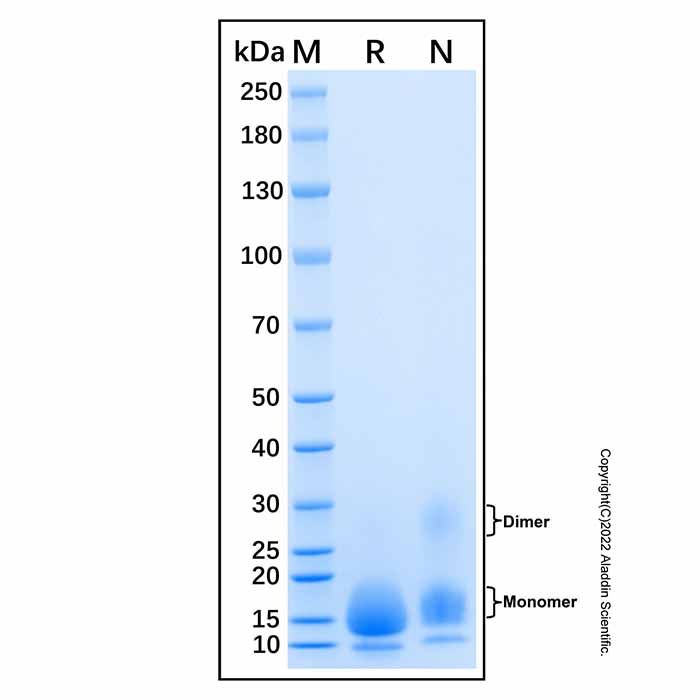
11.0-20.9 kDa, under reducing conditions; 13.6-20.5 & 26.9-31.2 kDa, under non-reducing conditions.
分子类型
蛋白质
产品线
生物产品
储存与运输
物理形态
冻干(Lyophilized)
储存缓冲液
Lyophilized from PBS, pH 7.4
浓度
见COA
复溶
We recommend that this vial be briefly centrifuged prior to opening to bring the contents to the bottom. Reconstitute at 1.0 mg/mL in sterile distilled water. Stock solutions should be apportioned into working aliquots and stored at ≤ -20 °C. Further dilutions should be made in appropriate buffered solutions.

 ZJ25F0825710


 危险品化学品经营许可证(带存储)