The cluster of differentiation (CD) system is commonly used as cell markers in Immunophenotyping. Different kinds of cells in the immune system can be identified through the surface CD molecules associating with the immune function of the cell. There are more than 320 CD unique clusters and subclusters have been identified. Some of the CD molecules serve as receptors or ligands important to the cell through initiating a signal cascade which then alter the behavior of the cell. Some CD proteins do not take part in cell signal process but have other functions such as cell adhesion. CD21, also known as Complement component (3d / Epstein Barr virus) receptor 2 and CR2, is a member of the CD system and is a protein involved in complement system. CD21 is present on all mature B-cells and some T-cells and follicular dendritic cells. CD21 on mature B-cells form a complex called the B cell receptor complex with two other membrane proteins, CD19 and CD81. CD21 has a function in the complement system through serving as the cellular receptor specific for ligands such as C3 and C4 which can be attached to foreign macromolecules in order to remove or uptake them. This results in B-cells having enhanced response to the antigen.
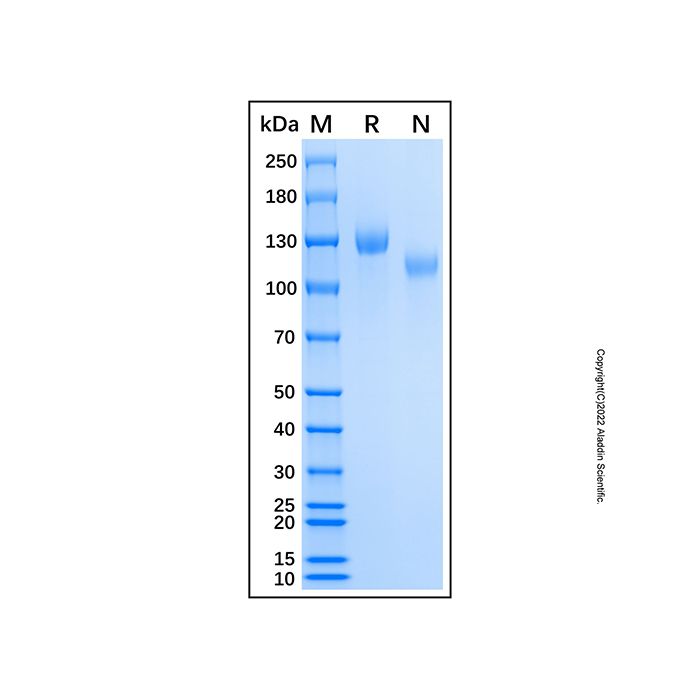
121.3-144.5 kDa, under reducing conditions; 106.4-120.2 kDa, under non-reducing conditions.
分子类型
蛋白质
产品线
生物产品
储存与运输
物理形态
冻干(Lyophilized)
储存缓冲液
Lyophilized from PBS, pH 7.4.
浓度
见COA
复溶
We recommend that this vial be briefly centrifuged prior to opening to bring the contents to the bottom. Reconstitute at 0.5 mg/mL in sterile distilled water. Stock solutions should be apportioned into working aliquots and stored at ≤ -20 °C. Further dilutions should be made in appropriate buffered solutions.
储存条件
-20°C储存,避免反复冻融
运输条件
超低温运输
稳定性与储存
-20℃保存 12个月;复溶后建议分装,避免反复冻融。
图片
Recombinant Human CD21 Protein (rp226956) - SDS-PAGE 3 μg/lane of Recombinant Human CD21 Protein was resolved with SDS-PAGE under reducing (R) and non-reducing (N) conditions and visualized by Coomassie® Blue staining, showing a band at 121.3-144.5 kDa under reducing (R) conditions and 106.4-120.2 kDa under non-reducing (N) conditions.

 ZJ25F0825999


 危险品化学品经营许可证(带存储)