PLAT, also known as tissue-type plasminogen activator (tPA), is a secreted serine protease synthesized by endothelial cells (1). The partially active single chain can be further processed to full activity by plasmin, tissue kallikrein or Factor Xa. Active PLAT converts plasminogen to plasmin, a fibrinolytic protease, by hydrolyzing an Arg-Val peptide bond in plasminogen. Unusually high levels of tPA activity can result in excessive bleeding, and low levels of tPA activity can result in thrombosis or embolism. Human PLAT contains 4 domains; the N-terminal fibronectin type-1 domain, an epidermal growth factor-like domain, two kringle domains and a serine protease catalytic domain.
Converts the abundant, but inactive, zymogen plasminogen to plasmin by hydrolyzing a single Arg-Val bond in plasminogen. By controlling plasmin-mediated proteolysis, it plays an important role in tissue remodeling and degradation, in cell migration and many other physiopathological events. Play a direct role in facilitating neuronal migration.
Store at -20°C for 1 year. Avoid freeze / thaw cycle.
图片
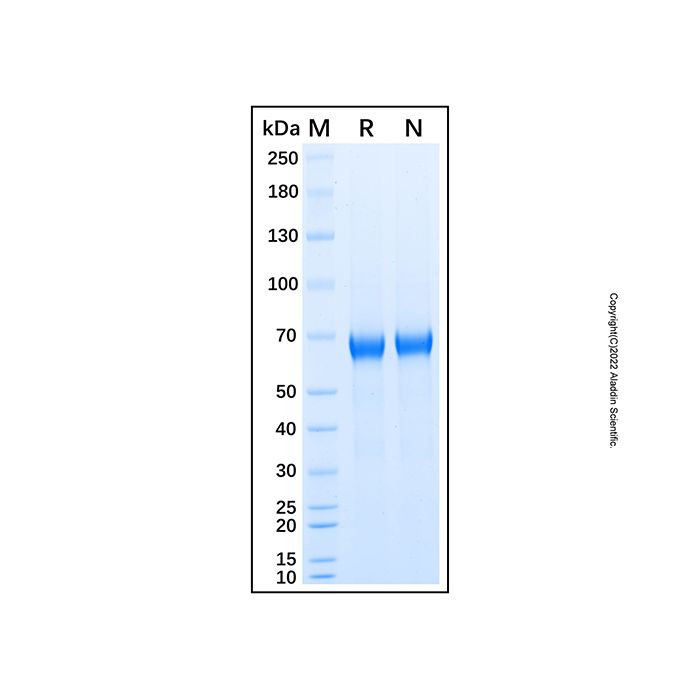
Alteplase (A1443673) - SDS-PAGE
3 μg/lane of Alteplase was resolved with SDS-PAGE under reducing (R) and non-reducing (N) conditions and visualized by Coomassie® Blue staining, showing a band at 60.2-71.9 kDa under reducing conditions and 61.5-73.1 kDa under non-reducing conditions.

 ZJ26F0737767


 危险品化学品经营许可证(带存储)