该试剂盒可用于快速、便捷地检测细胞、组织的裂解液、血清、血浆、尿液等样品中内源性的碱性磷酸酶活性。碱性磷酸酶(Alkaline Phosphatase),也称碱性磷酸酯酶,可在碱性条件下催化磷酸酯键的水解。包括肠道碱性磷酸酶、非组织特异性碱性磷酸酶和胎盘碱性磷酸酶。除胎盘碱性磷酸酶外,其它的加热后易失活。
Para-nitrophenyl phosphate (pNPP)是一种常用的磷酸酶显色底物,在碱性条件下,可在碱性磷酸酶作用下生成para-nitrophenol。para-nitrophenol (p-nitrophenol)在碱性条件下,呈黄色产物,可以在405nm检测吸光度。产物黄色越深,说明碱性磷酸酶检活性越高,反之则酶活性越低。据此通过比色分析就可以计算出碱性磷酸酶活性水平。
该试剂盒足够进行100次反应。
产品组分表
A1491772
| Component
| 100T | Storage
|
A1491772A
| 检测缓冲液 | 50 mL | -20℃ |
A1491772B
| 显色底物 | 2 管 | -20℃. Store in the dark.
|
A1491772C
| p-nitrophenol
| 1 mg | -20℃. Store in the dark.
|
A1491772D
| 反应终止液
| 12 mL | -20℃ |
检测仪器:酶标仪
使用说明
1、试剂准备:将所有试剂取出,恢复至室温使用。
1.1 显色底物溶液:取一管显色底物,溶解于2.51mL的检测缓冲液中,充分溶解和混匀,冰上放置。新鲜配制的显色底物溶液需在6h内使用。
1.2 10mM p-nitrophenol 储备液:将 1mg p-nitrophenol 完全溶解于719μL超纯水中,其浓度为10mM,-20°C保存。
1.3 标准品工作液:取10μL p-nitrophenol溶液 (10mM),用检测缓冲液稀释至0.2mL,其终浓度为0.5mM。
2 样品准备:
2.1 细胞或组织裂解液的准备:采用适当细胞或组织裂解液裂解细胞或组织,随后离心取上清,用于碱性磷酸酶的检测。注意:裂解液中不能含有磷酸酶抑制剂。样品可-80°C冻存,但需避免反复冻融。推荐使用western及IP裂解液(不含蛋白酶抑制剂)。
2.2 血浆、血清和尿液的准备:血浆和血清按照常规方法制备后可直接用于本试剂盒的测定, 但为了消除样品本身颜色的干扰,需设置加了血浆或血清但不加底物的对照。血浆制备时不能用含EDTA和柠檬酸盐的抗凝管。尿液通常也可以直接用于测定。上述样品可以-80°C冻存,但需避免反复冻融。
2.3 样品的稀释:如果样品中含有较高活性的碱性磷酸酶,可以使用原有的裂解液或PBS等进行稀释,也可以采用试剂盒中的检测缓冲液进行稀释。如果使用试剂盒中提供的检测缓冲液进行稀释,需注意保留足够的检测缓冲液用于试剂盒的检测过程。
3、将底物溶液在37°C下平衡,将酶标仪的检测波长设置为405nm;
4、参考下表使用96孔板设置空白对照孔、标准品孔和样品孔。标准品的用量分别为4、8、16、24、32和40μL,样品通常可以直接加50μL。如果样品中的碱性磷酸酶活性过高,可以减少样品用量或适当稀释后再进行测定。
| 空白对照 (Blank)
| 标准品 (Standard)
| 样品 (Sample)
|
检测缓冲液
| 50 μL
| (100-X) μL
| (50-Y) μL
|
显色底物
| 50 μL
| —
| 50 μL
|
样品
| —
| —
| Y μL
|
标准品工作液
| —
| X μL
| —
|
5、用枪头轻轻吹打混匀,也可借助摇床进行混匀。
6、37℃孵育5~10min。(说明:待测样品中碱性磷酸酶活性较低时,可适当延长孵育时间至30min)。
7、每孔加入100μL反应终止液终止反应。此时,标准品或有碱性磷酸酶活性的孔会呈现不同深浅的黄色。
8、在405nm测定吸光度。
9、碱性磷酸酶活性单位的定义:
在pH9.8 diethanolamine(DEA)缓冲液中,37°C 条件下,每分钟水解 para-nitrophenyl phosphate 显色底物产生1μM p-nitrophenol 所需的碱性磷酸酶的量定义为一个酶活力单位,也称作一个DEA酶活力单位。
在pH9.6 甘氨酸缓冲液中,25°C条件下,每分钟水解para-nitrophenyl phosphate显色底物产生1μM p-nitrophenol所需的碱性磷酸酶的量定义为一个酶活力单位,也称作一个Glycine酶活力单位。
一个Glycine酶活力单位约相当于3个DEA酶活力单位。本试剂盒测定的是DEA酶活力单位。
10、根据酶活性定义,计算出样品中的碱性磷酸酶活性。
计算方法:
1、标准品的浓度是500uM。
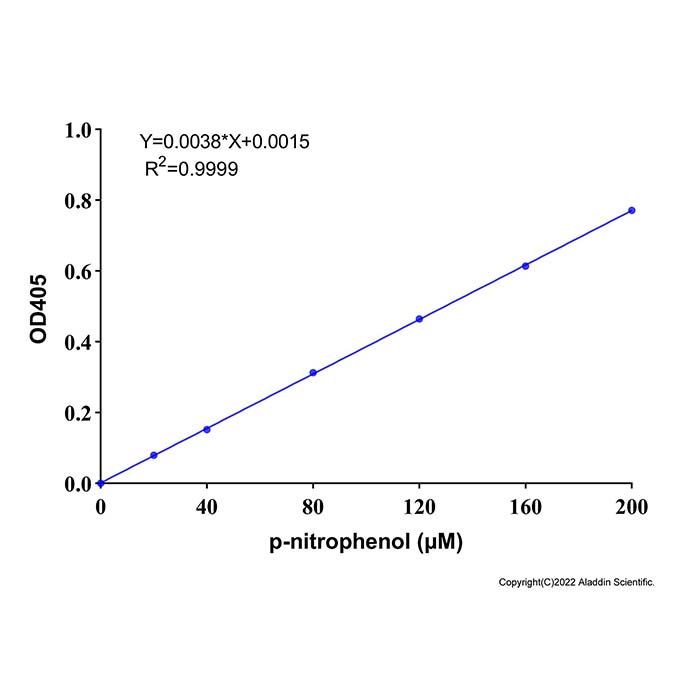
2、标准品的用量分别为:4、8、16、24、32和40μL,对应的终浓度分别为:20uM、40uM、 80uM、120uM、160uM 和 200uM;分别代表20单位、40单位、80单位、120单位、160单位和200单位。
3、其中第六步的孵育时间尽量为一致时间,比如孵育5分钟,便于比较。
4、用标准品做标准曲线,A标准品测量值-A空白值 =标准品实际测量值,计算回归方程。
5、A样品测量值-A 空白值 =样品实际测量值。
6、代入回归方程,计算样品的单位。
注意事项:
1、如果希望进行酶活性的绝对定量,进行酶反应时必须注意精确计时。此时推荐采用孵育 30min 等较长的时间,以减小操作过程中的时间误差。同时如果样品中酶活性较高,则可以预先适当稀释样品。
2、样品溶液中须避免出现EDTA、氟离子、柠檬酸盐等碱性磷酸酶的抑制剂。
3、检测缓冲液和p-nitrophenol溶液对人体有害,请注意适当防护。反应终止液有腐蚀性, 请小心操作。
4、第一次使用本试剂盒时建议先取1~2个样品做预实验。
5、为了您的自身安全,使用试剂前,请做好防护,如穿实验服,带手套等。
This kit enables rapid and convenient detection of endogenous alkaline phosphatase (ALP) activity in cell or tissue lysates, serum, plasma, urine, and other sample types. Alkaline phosphatase, also known as alkaline phosphomonoesterase, catalyzes the hydrolysis of phosphate esters under alkaline conditions. Major ALP isozymes include intestinal, tissue-nonspecific, and placental alkaline phosphatases. With the exception of placental ALP, most isozymes are heat-labile.
Para-Nitrophenyl phosphate (pNPP) is a widely used chromogenic substrate for phosphatases. Under alkaline conditions, ALP hydrolyzes pNPP to generate para-nitrophenol (p-nitrophenol), which yields a yellow product in basic solution with maximum absorbance at 405 nm. The intensity of the yellow color is proportional to ALP activity, allowing quantitative measurement via spectrophotometry.
This kit provides sufficient reagents for 100 assays.
Product Component Table
A1491772
| Component
| 100T | Storage
|
A1491772A
| Assay Buffer
| 50 mL | -20℃ |
A1491772B
| Chromogenic Substrate
| 2 tubes
| -20℃. Store in the dark.
|
A1491772C
| p-nitrophenol
| 1 mg | -20℃. Store in the dark.
|
A1491772D
| Stop Solution
| 12 mL | -20℃ |
Instructions for Use
1. Reagent Preparation: Bring all reagents to room temperature before use.
1.1 Chromogenic Substrate Solution: Dissolve one tube of substrate in 2.51 mL Assay Buffer. Mix thoroughly and keep on ice. Use within 6 hours.
1.2 10 mM p-Nitrophenol Stock Solution: Dissolve 1 mg p-nitrophenol in 719 µL ultrapure water to obtain 10 mM solution. Store at -20°C.
1.3 Standard Working Solution: Dilute 10 µL of 10 mM p-nitrophenol solution with Assay Buffer to 0.2 mL (final concentration: 0.5 mM).
2. Sample Preparation
2.1 Cell or Tissue Lysates: Lyse cells or tissues using an appropriate lysis buffer (without phosphatase inhibitors). Centrifuge and collect supernatant. Avoid repeated freeze-thaw cycles. Western & IP Lysis Buffer (without protease inhibitors) is recommended.
2.2 Plasma, Serum, Urine: These can be used directly. Include a no-substrate control for plasma/serum to account for background color. Do not use EDTA or citrate anticoagulants. Urine may typically be used directly. Avoid repeated freeze-thaw cycles.
2.3 Sample Dilution: If ALP activity is high, dilute samples with lysis buffer, PBS, or Assay Buffer. Ensure sufficient Assay Buffer remains for the assay.
3. Equilibrate substrate solution at 37°C and set microplate reader to 405 nm.
4. Set up blank, standard, and sample wells in a 96-well plate as below. Standard volumes: 4, 8, 16, 24, 32, 40 µL. Sample volume: typically 50 µL. Reduce volume or dilute if ALP activity is too high.
Reagent
| Blank
| Standard
| Sample
|
Assay Buffer
| 50 μL
| (100-X) µL
| (50-Y) µL
|
Substrate Solution
| 50 μL
| —
| 50 µL
|
Sample
| —
| —
| Y µL
|
Standard Working Sol.
| —
| X µL
| —
|
5. Mix gently by pipetting or using a plate shaker.
6. Incubate at 37°C for 5–10 min (extend to 30 min for low-activity samples).
7. Add 100 µL Stop Solution per well to terminate the reaction. A yellow color will develop in positive wells.
8. Measure absorbance at 405 nm.
Definition of ALP Activity Unit
1. One DEA unit is defined as the amount of enzyme required to produce 1 µM *p*-nitrophenol per minute at 37°C in pH 9.8 diethanolamine (DEA) buffer.
2. One Glycine unit is defined as the amount of enzyme required to produce 1 µM *p*-nitrophenol per minute at 25°C in pH 9.6 glycine buffer.
3. One Glycine unit ≈ 3 DEA units. This kit measures DEA units.
Calculation of ALP Activity
1. Standard working solution concentration: 500 µM.
2. Standard volumes correspond to final amounts of 20, 40, 80, 120, 160, and 200 units (for 5-min incubation).
3. Keep incubation time consistent for all samples (e.g., 5 min).
4. Generate standard curve: (A₄₀₅ Standard – A₄₀₅ Blank) → regression equation.
5. Calculate sample value: (A₄₀₅ Sample – A₄₀₅ Blank).
6. Interpolate sample value into standard curve to determine ALP activity.
Precautions
1. For absolute quantification, precisely time the reaction. Use longer incubation (e.g., 30 min) to reduce operational error. Dilute high-activity samples appropriately.
2. Avoid ALP inhibitors such as EDTA, fluoride, and citrate in samples.
3. Assay Buffer and *p*-nitrophenol are hazardous. Stop Solution is corrosive—handle with care.
4. It is recommended to test 1–2 samples initially as a pilot experiment.
5. Wear appropriate personal protective equipment (lab coat, gloves) while handling reagents.
6. For research use only.

 ZJ26F0130953

 危险品化学品经营许可证(带存储)