天冬氨酸转氨酶(Aspartate Aminotransferase, AST)是生物体内一类关键的氨基转移酶,广泛存在于动物组织、植物、微生物等各类生物体中,主要分布于心肌、肝脏、骨骼肌等组织,是机体氨基酸代谢、糖代谢过程中的核心功能酶。AST可催化天冬氨酸与α-酮戊二酸发生氨基转移反应,生成草酰乙酸和谷氨酸,参与机体氮素代谢与物质能量循环。当机体组织发生损伤、炎症或病变时,细胞内AST会大量释放至体液中,因此AST活性是临床检测、生物生理研究、病理分析的重要核心指标。
在天冬氨酸转氨酶(AST)的催化下,天冬氨酸(Aspartate)与α-酮戊二酸(α-Ketoglutarate)反应 生成谷氨酸(Glutamate)和草酰乙酸(Oxaloacetic acid),生成的草酰乙酸在草酰乙酸脱羧酶(Oxaloacetate decarboxylase, OADC)的催化下脱羧形成丙酮酸(Pyruvic acid)和CO₂ 。生成的丙酮酸在丙酮酸氧化酶(Pyruvate oxidase, PO)的催化下和氧气反应生成乙酰磷酸(Acetyl phosphate)、CO₂ 和 H₂O₂ ,再通过检测 H₂O₂ 与Amplex Red的反应产物试卤灵(Resorufin)的荧光强度或吸光度来最终计算样品中天冬氨酸转氨酶的活力。试卤灵的荧光强度或吸光度与样品中天冬氨酸转氨酶的活力成正比。
本试剂盒可采用分光光度法和荧光法两种方法进行检测,具有检测灵敏度高、线性范围宽、样品用量少等特点。在样品体积为 20 µL 时,采用分光光度法检测在 20-1000 μM 浓度范围内有良好的线性关系;采用荧光法检测在5-200 μM 浓度范围内有良好的线性关系。
A1510316 | 组分 | 物理外观 | 100 T | 500 T | 储存条件 | A1510316A | 酶混合液 | 液体 | 1.0 mL | 5.0 mL | -20℃.避光保存. | | A1510316B | 辅因子混合液 | 液体 | 1.0 mL | 5.0 mL | -20℃.避光保存. | | A1510316C | Amplex Red | 液体 | 0.2 mL | 1.0 mL | -20℃.避光保存. | | A1510316D | 底物 | 液体 | 0.8 mL | 4.0 mL | -20℃.避光保存. | | A1510316E | 草酰乙酸标准品 (10 mM) | 液体 | 0.1 mL | 0.5 mL | -20℃.避光保存. | | A1510316F | 检测缓冲液 | 液体 | 20.0 mL | 100.0 mL | -20℃. | |
|
使用方法
1. 试剂盒的准备
1) 融解Amplex Red和 检测缓冲液 ,平衡至室温后混匀备用。其它试剂存放于冰浴备用,使用完毕后宜立即按照试剂盒要求的条件保存。
2.标准曲线的测定
1) 草酰乙酸标准曲线设,吸光度或荧光检测可选取其中的一种,对于样品量较少或浓度较低的情况,优先推荐采用荧光检测。
a) 吸光度法检测。
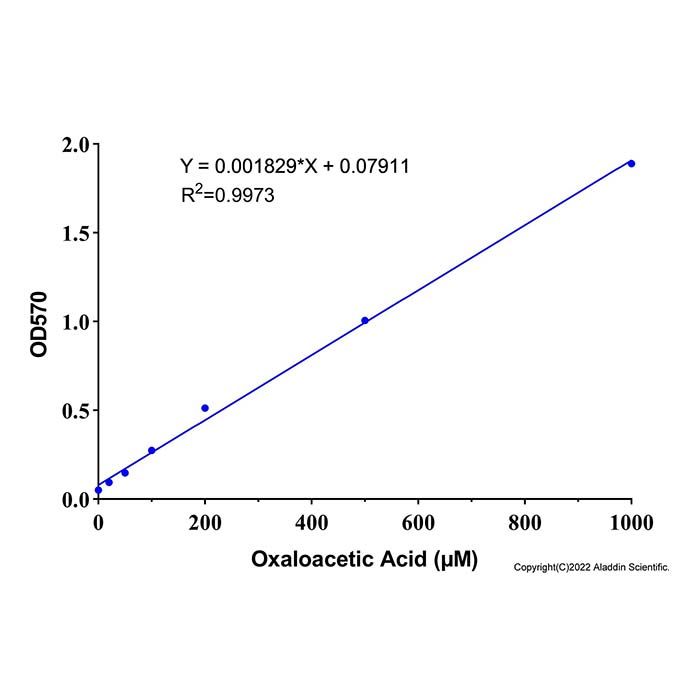
取10 μL 草酰乙酸标准品 (10 mM) , 加入90 µL检测缓冲液混匀 ,配制成浓度为1000 μM的草酰乙酸标准溶液。分别取1000 μM的草酰乙酸标准溶液0、0.4、1、2、4、10、20 μL加入96孔板的标准品孔中,并用 检测缓冲液 补足至20 μL,此时,标准曲线的浓度分别为0、20、50、100、200、500、1000 μM。
注:吸光度检测时建议使用透明96孔板
b) 荧光法检测
取2 μL草酰乙酸标准品 (10 mM) ,加入98 µL检测缓冲液混匀 ,配制成浓度为200 μM的草酰乙酸标准溶液。分别取200μM的草酰乙酸标准溶液0、0.5、1、2、5、10、20 μL加入96孔板的标准品孔 中,并相应地用检测缓冲液补足至20 μL,此时,标准曲线的浓度分别为0、5、10、20、50、100、200 μM。
注:荧光检测时建议使用96孔黑板
3. 样本制备
推荐使用新鲜样本,若不立即实验,-80℃可保存 1 个月,使用时冰上解冻。
1) 动物组织用冷 PBS 清洗组织,尽可能去除血液。吸干水分,称取 0.1 g,加入 1 mL 预冷的裂解液,冰浴匀浆。10000 g,4℃离心 5 min,取上清置冰上待测。
2) 植物组织称取约 0.1 g 样本,加入 1 mL 预冷的裂解液捣碎,冰浴超声破碎 5 min(功率 20% 或 200 W,超声 3 s,间隔 7 s,重复 30 次),10000 g,4℃离心 5 min,取上清置冰上待测。
3) 细胞(菌)收集 1×10⁶ 个细胞或细菌,用冷 PBS 清洗后,加入 0.1-0.2 mL 预冷的裂解液冰浴匀浆或超声破碎 5 min。12000 g,4℃离心 5 min,取上清置冰上待测。
4) 血浆、血清、尿液等生物体液去除蛋白后取上清:可使用 10 kDa 超滤管过滤取滤液;或将样本:30% ZnSO₄溶液 = 20:1 混合涡旋,10000 g 室温离心 5 min,取上清。
注1:裂解液需自行制备,不影响酶活检测即可,可使用PBS。
4. Amplex Red反应工作液的配制:
按照每个反应80 µL 的体积配制适量的Amplex Red反应工作液。均匀混合50 μL 检测缓冲液 、2 μL Amplex Red 、10 µL 酶溶液 、10 µL 辅因子 、8 µL 底物 ,即可配制成80 µL Amplex Red反应工作液。根据待检测样品(包括标准品)的数量,配制适量的Amplex Red反应工作液。配制好的 Amplex Red反应工作液置于4ºC或冰浴避光保存,可以在当天使用,建议尽量现配现用。
5. 样本中酶活性测定
1) 按以下体系加样:
试剂( μL ) | 对照孔 | 测定孔 |
探针 | 2 | 2 |
酶溶液 | 10 | 10 |
辅因子 | 10 | 10 |
底物 | / | 8 |
样品 | 20 | 20 |
检测缓冲液 | 58 | 50 |
注1:由于酶溶液的用量较少且易沉降,必须注意在使用前先轻轻离心一下,然后适当混匀后再使用。
注2:草酰乙酸、丙酮酸及 H₂O₂ 的存在会对天冬氨酸转氨酶的检测产生干扰。如果样品含有草酰乙酸、丙酮酸或者 H₂O₂ ,须同时设置背景对照孔,加入不含底物的Amplex Red反应工作液,即配制Amplex Red反应工作液时8 µL底物用检测缓冲液替代。
注3:为确保样品数值在标准曲线范围内,建议设置多个稀释倍数,以确定样品中大致酶活,如果数值不在标准曲线范围内,请使用检测缓冲液稀释。样品总稀释倍数记为n (例如本步骤中对样品进行10倍稀释,加入的 ‘‘稀释后的样品’’为20 µL,则n=10)。
2) 反应体系充分混匀后37℃避光孵育20 - 30 min。吸光度法检测,读取A570;如果是荧光法检测,设置激发波长560nm,发射波长590nm进行荧光强度检测。
注1:为取得最佳的检测效果,反应时间可以根据待测样品中的天冬氨酸转氨酶活性进行调整,但是必须确保读数在标准曲线范围内。对于天冬氨酸转氨酶活性较高的样品,建议测定总时间为20分钟或30分钟,对应的测定间隔时间设为2分钟或5分 钟;对于天冬氨酸转氨酶活性较低的样品,可以延长测定总时间为45至60分钟,对应的测定间隔时间设为5或10分钟。也可以连续测定30分钟,每隔1或2分钟测定1次,最后取检测数据中前期一段时间内呈现线性的数据用于分析和计算。
注2:随着反应时间的延长,高浓度标准品孔的信号值可能会达到平台期,从而导致其不在标准曲线的线性范围内,此时可以舍去异常点的数据,取在线性范围内的数据来拟合标准曲线。
6. 结果计算
建立标准曲线,将A或RFU带入标准曲线,即可算出在反应时间内样品中天冬氨酸转氨酶催化产生的草酰乙酸的浓度(B),如果样品的背景对照信号比较高,样品的信号值应减去样品背景对照的信号值。草酰乙酸标准曲线,吸光度检测在20-1000 μM浓度范围内有良好的线性关系,荧光检测5-200 μM浓度范围内有良好的线性关系。天冬氨酸转氨酶活力的计算公式如下:
AST (U/L)=B×n/T
注:B为根据标准曲线确定的草酰乙酸浓度浓度(μM);
n为样品总稀释倍数;
T为的反应时间(min)。
以标准品浓度为横坐标, A 为纵坐标绘制标准曲线,计算样品天冬氨酸转氨酶活性。
天冬氨酸转氨酶活性单位的定义为:1个酶活力单位(unit, U)为在37ºC条件下,在天冬氨酸存在时,每分钟将1.0 μmol的α-酮戊二酸转化为谷氨酸所需的酶量。
注意事项
1) Amplex Red 试剂光敏、易氧化,全程避光,开瓶 / 配制后尽快使用。
2) 天冬氨酸转氨酶浓度过高会导致信号下降,样品需提前稀释。
3) 反应体系避免含 DTT、2 - 巯基乙醇等还原剂,否则干扰检测。
4) 每次实验均需重新配制标准品并做标准曲线。
5) 为了您的安全和健康,请穿实验服并戴一次性手套操作。
6) 本产品仅限于专业人员的科学研究用,不得用于临床诊断或治疗,不得用于食品或药品。
Aspartate Aminotransferase (AST) is a vital class of aminotransferases in living organisms, ubiquitously found in animals, plants, microorganisms and other life forms. Predominantly localized in cardiac muscle, liver, skeletal muscle and other tissues, AST acts as a core functional enzyme involved in the amino acid and carbohydrate metabolism of organisms. It catalyzes the transamination reaction between aspartate and α-ketoglutarate to produce oxaloacetate and glutamate, participating in bodily nitrogen metabolism and material-energy cycling. Upon tissue injury, inflammation or pathological lesions, intracellular AST leaks into body fluids in large quantities. Accordingly, AST activity serves as a crucial core biomarker for clinical testing, biological physiological research and pathological analysis.
Catalyzed by aspartate aminotransferase (AST), aspartate reacts with α-ketoglutarate to generate glutamate and oxaloacetate. The resulting oxaloacetate undergoes decarboxylation under the catalysis of oxaloacetate decarboxylase (OADC) to form pyruvic acid and carbon dioxide (CO₂). Pyruvic acid further reacts with oxygen in the presence of pyruvate oxidase (PO), yielding acetyl phosphate, CO₂ and hydrogen peroxide (H₂O₂). The activity of aspartate aminotransferase in samples is quantified by measuring the fluorescence intensity or absorbance of resorufin, the reaction product of H₂O₂ and Amplex Red. The fluorescence intensity and absorbance of resorufin are directly proportional to AST activity in samples.
The kit supports both absorbance and fluorescence detection, featuring high sensitivity, wide linear range, and low sample consumption. With a sample volume of 20 µL:
- Absorbance assay: good linearity from 20-1000 µM
- Fluorescence assay: good linearity from 5-200 µM
A1510316 | Component | Appearance | 100 T | 500 T | Storage conditions | A1510316A | Enzyme Solution | Liquid | 1.0 mL | 5.0 mL | -20℃.Store in the dark. | A1510316B | Cofactor | Liquid | 1.0 mL | 5.0 mL | -20℃.Store in the dark. | A1510316C | Amplex Red | Liquid | 0.2 mL | 1.0 mL | -20℃.Store in the dark. | A1510316D | Substrate | Liquid | 0.8 mL | 4.0 mL | -20℃.Store in the dark. | A1510316E | Oxaloacetic Acid Standard (10 mM) | Liquid | 0.1 mL | 0.5 mL | -20℃.Store in the dark. | A1510316F | Assay Buffer | Liquid | 20.0 mL | 100.0 mL | -20℃. |
|
1. Kit Preparation
1) Thaw Amplex Red and Assay Buffer, equilibrate them to room temperature and mix well for later use. Keep other reagents on ice until use. Immediately store all reagents under the conditions specified in the kit manual after the experiment is completed..
2. Standard Preparation
1) Preparation of oxaloacetic acid standard curve. Either absorbance detection or fluorescence detection can be selected. Fluorescence detection is recommended preferentially for samples with low volume or low concentration.
a) Absorbance Detection
Transfer 10 µL of 10 mM Oxaloacetic Acid Standard and mix with 90 µL Assay Buffer to prepare a 1000 µM oxaloacetic acid standard solution. Pipette 0, 0.4, 1, 2, 4, 10 and 20 µL of the 1000 µM oxaloacetic acid standard solution into the standard wells of a 96-well plate respectively, then top up each well to 20 µL with AST Assay Buffer. The corresponding concentrations of the standard curve are 0, 20, 50, 100, 200, 500 and 1000 µM.
Note: A transparent 96-well plate is recommended for absorbance measurement.
b) Fluorescence Detection
Transfer 2 µL of 10 mM Oxaloacetic Acid Standard and mix with 98 µL Assay Buffer to prepare a 200 µM oxaloacetic acid standard solution. Pipette 0, 0.5, 1, 2, 5, 10 and 20 µL of the 200 µM oxaloacetic acid standard solution into the standard wells of a 96-well plate respectively, then top up each well to 20 µL with AST Assay Buffer. The corresponding concentrations of the standard curve are 0, 5, 10, 20, 50, 100 and 200 µM.
Note: A black 96-well plate is recommended for fluorescence measurement.
3. Sample Preparation
Fresh samples are recommended. If not assayed immediately, store samples at -80℃ for up to 1 month; thaw on ice before use.
1) Animal Tissue
Rinse tissue with cold PBS to remove blood; blot dry. Weigh 0.1 g, add 1 mL of cold lysis buffer , and homogenize on ice. Centrifuge at 10,000 g, 4℃ for 5 min. Collect supernatant on ice for assay.
2) Plant Tissue
Weigh ~0.1 g sample, add 1 mL of cold lysis buffer, and homogenize. Sonicate on ice for 5 min (20% or 200 W; 3 sec on, 7 sec off; 30 cycles). Centrifuge at 10,000 g, 4℃ for 5 min. Collect supernatant on ice for assay.
3) Cells / Bacteria
Collect 1×10⁶ cells or bacteria; wash with cold PBS. Add 0.1-0.2 mL of cold lysis buffer , then homogenize or sonicate on ice for 5 min. Centrifuge at 12,000 g, 4℃ for 5 min. Collect supernatant on ice for assay.
4) Plasma, Serum, Urine, and Other Biological Fluids
Deproteinize before use:Filter through a 10 kDa ultrafiltration tube and collect filtrate;
Mix sample : 30% ZnSO₄ solution = 20:1, vortex, centrifuge at 10,000 g, room temperature for 5 min, collect supernatant.
Note 1: Lysis buffer needs to be prepared by the user. Any formulation that does not interfere with enzyme activity measurement is acceptable; PBS can be used as an alternative.
4. Detection Working Solution Preparation
Prepare an appropriate volume of Amplex Red working solution based on a reaction volume of 80 µL per test. Mix 50 µL Assay Buffer, 2 µL Amplex Red, 10 µL Enzyme Solution,10 µLCofactor and 8 µLSubstrate thoroughly to prepare 80 µL Amplex Red working solution. Prepare sufficient working solution according to the total number of samples to be tested (including standards).
The prepared Amplex Red working solution should be stored at 4 °C or on ice under light protection and used within the same day. Fresh preparation prior to use is highly recommended.
5. Peroxidase Activity Assay
1) Set up reactions as follows:
Reagent(μL) | Control Well | Sample Well |
Amplex Red | 2 | 2 |
Enzyme Solution | 10 | 10 |
Substrate | / | 8 |
Cofactor | 10 | 10 |
Sample | 20 | 20 |
Detection Working Solution | 58 | 50 |
Note 1: The enzyme solution is used in a small volume and prone to sedimentation. Briefly centrifuge the tube gently before use and mix thoroughly prior to pipetting.
Note 2: Oxaloacetic acid, pyruvic acid and H₂O₂ interfere with AST measurement. If samples contain any of the above substances, background control wells must be set up in parallel, loaded with Amplex Red working solution without Substrate. Specifically, replace the 8 μL Substrate with AST Assay Buffer when preparing the Amplex Red working solution.
Note 3: To guarantee sample readings fall within the linear range of the standard curve, prepare serial dilutions to estimate the approximate AST activity in samples. If readings exceed the linear range, dilute samples with AST Assay Buffer. The total dilution factor of the sample is denoted as n (e.g., if the sample is diluted 10-fold and 20 μL of diluted sample is added, n = 10).
2) Thoroughly mix the reaction system and incubate at 37 °C protected from light for 20-30 min.
- Absorbance mode: read at 570 nm
- Fluorescence mode: excitation 560 nm, emission 590 nm
Note 1: Incubation time can be adjusted according to AST activity in test samples to achieve optimal detection performance, provided all readings stay within the standard curve linear range. For samples with high AST activity: total incubation time of 20 or 30 min is recommended, with measurement intervals of 2 or 5 min respectively.For samples with low AST activity: extend total incubation time to 45 - 60 min, with measurement intervals of 5 or 10 min respectively. Alternatively, continuous detection can be performed over 30 min at 1 or 2 min intervals. Only data showing linearity in the early reaction phase shall be adopted for analysis and calculation.
Note 2: Prolonged incubation may cause signal plateau in high-concentration standard wells, making data points out of the linear range. Abnormal plateau points can be excluded, and only linear-range data shall be used for standard curve fitting.
6. Data Analysis
1) Construct a standard curve, then substitute the absorbance (A) or relative fluorescence unit (RFU) value into the curve to calculate the concentration of oxaloacetic acid (B μM) generated by Aspartate aminotransferase catalysis in the sample within the reaction duration. If the background control signal of the sample is high, subtract the background signal value from the raw sample signal. For the oxaloacetic acid standard curve, good linearity is obtained from 20 - 1000 μM via absorbance measurement, and from 5 - 200 μM via fluorescence measurement.
The formula for calculating Aspartate aminotransferase activity is as follows:
- AST activity (U/L) = =B×n/T
- B = Oxaloacetic acid concentration (μM) calculated from the standard curve
- n = total dilution factor of the sample
- T = reaction incubation time (min)
- Plot the standard curve with standard concentration as the X-axis and absorbance (A) as the Y-axis to calculate AST activity in samples.
Definition of Aspartate aminotransferase Activity Unit
- One unit (U) is defined as the amount of AST enzyme that catalyzes the conversion of 1.0 μmol α-ketoglutarate to glutamate per minute at 37 °C in the presence of aspartate.
Precautions
1. Amplex Red is light‑sensitive and easily oxidized; protect from light throughout and use promptly after opening/preparation.
2. Excessively high peroxidase concentration reduces signal; dilute samples before assay if needed.
3. Avoid reductants such as DTT or 2‑mercaptoethanol in the reaction, which interfere with detection.
4. Fresh standards and a new standard curve must be used in every experiment.
5. Wear lab coat and disposable nitrile gloves during operation for personal safety and health protection.
6. This product is for research use only by qualified laboratory personnel. It shall not be used for clinical diagnosis, clinical therapy, food or pharmaceutical applications.

 ZJ26F0738059


 危险品化学品经营许可证(带存储)