
计算溶液所需的质量、体积或浓度。
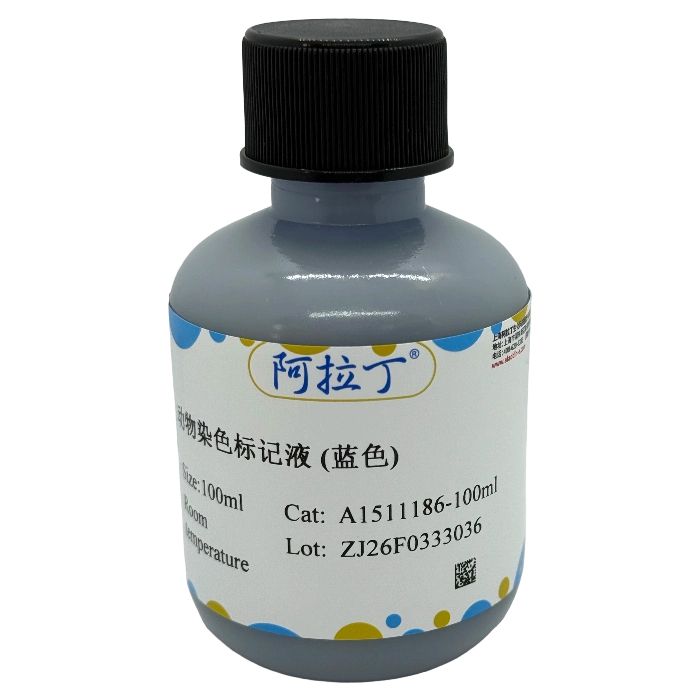
动物染色标记液 (蓝色)
有货
BioReagent,生物染色剂 级 ,适用于对基线干扰要求严格的色谱和分析工作流程。
避光,室温。常规运输 。请查阅批次 COA 获取详细规格。
SDS、COA、产品数据表及规格说明书均可下载。可通过批号查询获取批次 COA。
在色谱分析、有机合成和交叉偶联反应领域已被 0 篇同行评审文献引用。
实验动物是指以科学研究为核心目的,应用于生物检定、疾病诊断、生物制品研发、教学等场景,经人工饲养的动物。常见类型包含小鼠、大鼠、兔等小型实验动物,犬、羊、猪等大型实验动物,同时涵盖鱼、鸟、青蛙等其他实验用生物。在人类疾病防治的临床研究中,受伦理与实际操作限制,无法直接开展人体试验,实验动物成为不可或缺的研究载体,在相关科研工作中占据至关重要的地位。
动物实验技术是临床医学研究者必备的基础技能,主要涵盖实验动物筛选、实验动物操作、动物模型构建等核心内容。其完整技术体系还包括无菌操作技术、实验前方案规划与物资准备、实验后动物管理等模块。实验动物麻醉、手术区域脱毛与消毒,均属于动物手术前的关键准备工作。
实验动物分组后的标记在动物实验准备工作中很重要。为了区别和观察每一个动物,必须对其进行标记和编号,要根据动物的种类、数量和实验时间的长短来选择合适的标记方法,标记方法应保证号码清楚、耐久、简便、易认和适用。常用的标记方法有:染色法、挂牌法、耳缘剪孔法、烙印法、笼子编号和形态特征标记法等。其中,染色法最常用且操作简便。染色法是用染料在动物身体明显部位如被毛、四肢等处进行涂染或用不同颜色来区分。小鼠和大鼠模型常用此方法。该试剂仅用于科研领域,不宜用于临床诊断或其他用途。
使用说明
使用棉签或毛笔蘸取染色标记液,并点涂到动物相应编号部位。编号的原则为“从左到右、从前到后”,一般把涂在左前腿上的记为1号,左侧腰部为2号,左后腿为3号,头顶部为4号,腰背部为5号,尾基部为6号,右前腿为7号,右侧腰部为8号,右后腿为9号,不标记为10号,因此同一种颜色可标记10个动物,若编号超过10或更大数字时,可以同时使用两种或两种以上的颜色进行标记。
注意事项
1. 染色法常用于实验周期短的实验,方法简单,动物无痛苦损害,但常因动物相互摩擦、舔舐被毛、尿、水浸、被毛脱落等而标记丢失,因此不适用于长期的实验。
2. 实验中途染料退掉应及时补染。
3. 动物标记染色后应待干燥后才能将多个动物放在一起。
4. 苦味酸可标记为黄色,是首选的标记染液,因其不容易退色。
5. 硝酸银溶液可标记咖啡色,涂色后需光照10 min。
6. 试剂开封后请尽快使用,以防影响后续实验效果。
7. 为了您的安全和健康,请穿实验服并戴一次性手套操作。
Experimental animals refer to animals that are artificially bred for the primary purpose of scientific research and are used in scenarios such as bioassays, disease diagnosis, biopharmaceutical development, and teaching. Common types include small experimental animals such as mice, rats, and rabbits; large experimental animals such as dogs, sheep, and pigs; as well as other experimental organisms such as fish, birds, and frogs. In clinical research on the prevention and treatment of human diseases, direct human trials are not feasible due to ethical and practical constraints. Therefore, experimental animals serve as indispensable research vehicles and hold a crucial position in related scientific work.
Animal experimental techniques are essential foundational skills for clinical medical researchers, primarily covering core aspects such as experimental animal selection, handling, and animal model construction. The complete technical system also includes modules such as aseptic techniques, pre-experiment planning and material preparation, and post-experiment animal management. Anesthesia of experimental animals, as well as hair removal and disinfection of the surgical area, are key preparatory steps before animal surgery.
Marking after experimental animal grouping is an important aspect of animal experiment preparation. To distinguish and observe each animal, they must be marked and numbered. The appropriate marking method should be selected based on the species, number of animals, and duration of the experiment. The marking method should ensure clear, durable, simple, easily recognizable, and applicable numbering. Common marking methods include dyeing, tagging, ear notching, branding, cage numbering, and morphological feature marking. Among these, the dyeing method is the most commonly used and operationally simple. The dyeing method involves applying dye to prominent areas of the animal's body, such as the fur or limbs, or using different colors to differentiate animals. This method is commonly used for mouse and rat models. This reagent is intended solely for scientific research purposes and should not be used for clinical diagnosis or other applications.
Instructions for Use
Dip a cotton swab or brush into the staining marker solution and apply it to the corresponding numbered area on the animal. The numbering principle follows "left to right, front to back." Typically, the left forelimb is marked as number 1, the left flank as number 2, the left hind limb as number 3, the top of the head as number 4, the middle back as number 5, the base of the tail as number 6, the right forelimb as number 7, the right flank as number 8, and the right hind limb as number 9. No marking indicates number 10. Thus, a single color can mark up to 10 animals. If the numbering exceeds 10 or larger numbers, two or more colors can be used simultaneously for marking.
Precautions
The dyeing method is commonly used for short-term experiments. It is simple and causes no pain or harm to the animals. However, markings may fade due to factors such as mutual rubbing among animals, licking of fur, urine, water exposure, or fur loss, making it unsuitable for long-term experiments.
If the dye fades during the experiment, it should be reapplied promptly.
After marking animals with dye, they should be allowed to dry completely before being housed together.
Picric acid can be used to mark animals in yellow and is the preferred dyeing solution as it is less prone to fading.
Silver nitrate solution can be used to mark animals in brown, and the applied area should be exposed to light for 10 minutes after application.
Use the reagent as soon as possible after opening to avoid affecting subsequent experimental results.
For your safety and health, please wear a lab coat and disposable gloves during operation.
通过匹配包装上的批号来查找并下载产品的 COA,每批产品都进行了严格的验证,您可放心使用!
| 批号(Lot Number) | 证书类型 | 货号 |
|---|---|---|
 ZJ26F0333036 |
分析证书 | A1511186 |


 危险品化学品经营许可证(带存储)