The ABTS method is applicable to the determination of antioxidant capacity of both hydrophilic and lipophilic substances and is currently one of the most widely used indirect assays. ABTS is a mediator substance that, upon reaction with K₂S₂O₈, generates the stable cation radical ABTS⁺·, which exhibits a maximum absorbance at 734 nm. When the test sample is added to the ABTS⁺· solution, the antioxidant components present react with the ABTS radicals, causing decolorization of the reaction system and a consequent decrease in absorbance at 734 nm. Within a certain range, the degree of absorbance change is proportional to the scavenging ratio of free radicals. Therefore, by measuring the decrease in absorbance, the ABTS radical scavenging capacity of the sample can be quantitatively analyzed. This kit is intended for research use only and is not suitable for clinical diagnosis or other applications.
ABTS is oxidized to form stable blue-green cationic radical ABTS⁺, which is soluble in aqueous phase or acidic ethanol medium and exhibits maximum absorbance at 734 nm. After the test substance is added into the ABTS⁺ solution, the antioxidant components contained in the sample react with ABTS⁺ and decolorize the reaction system. The absorbance change is measured at 734 nm, and vitamin C is used as the reference system to quantify the antioxidant capacity of antioxidants.
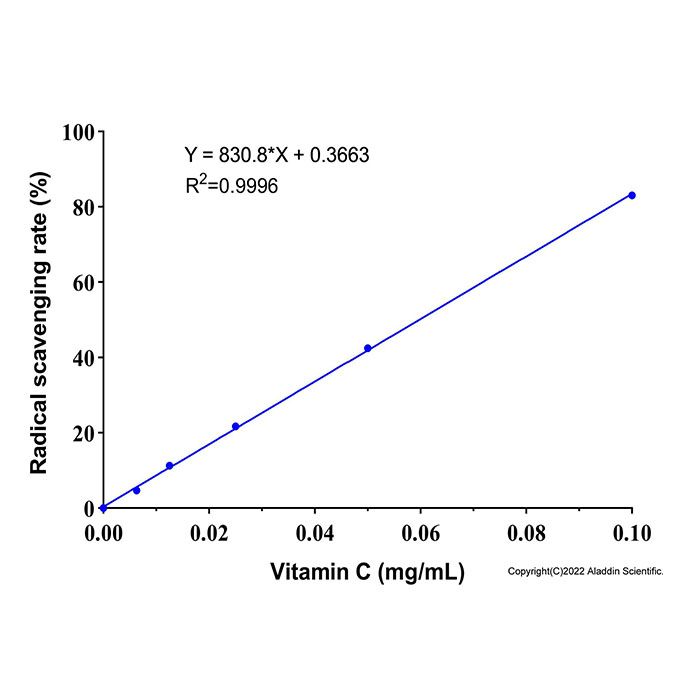
When the sample volume is 50.0 μL, the spectrophotometric detection shows a good linear relationship for the scavenging rate within the concentration range of 0.0063-0.1 mg/mL.



 危险品化学品经营许可证(带存储)