
 C2308476
计算溶液所需的质量、体积或浓度。
为什么选择此级别
提供 ≥97% 纯度,适用于对基线干扰要求严格的色谱和分析工作流程。
储存与运输
室温。常规运输 。请查阅批次 COA 获取详细规格。
质量文档
SDS、COA、产品数据表及规格说明书均可下载。可通过批号查询获取批次 COA。
文献证明
在色谱分析、有机合成和交叉偶联反应领域已被 0 篇同行评审文献引用。
规格
英文别名
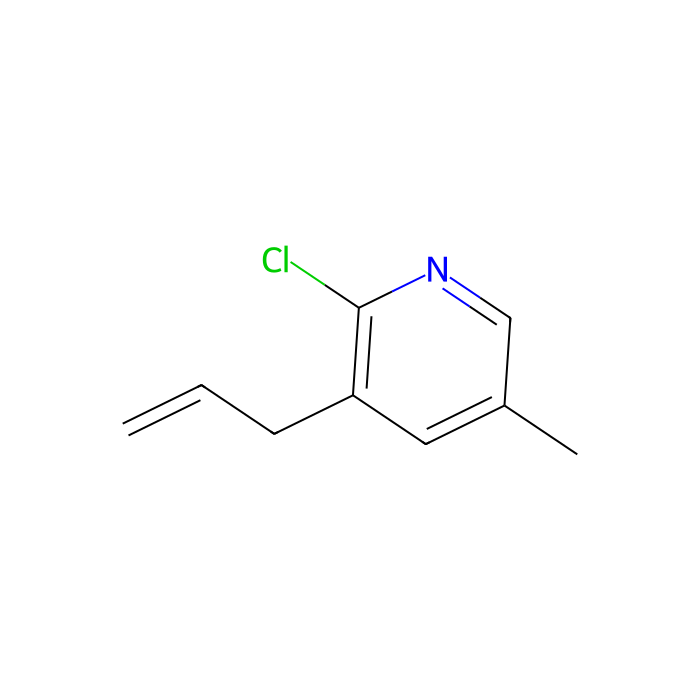
2-chloro-5-methyl-3-prop-2-enylpyridine | 2-chloro-5-methyl-3-(prop-2-en-1-yl)pyridine
规格或纯度
≥97%
英文名称
3-Allyl-2-chloro-5-methylpyridine
应用
Catalytic Activity and Polymer Synthesis
One notable application involves the use of derivatives similar to 3-Allyl-2-chloro-5-methylpyridine in catalytic processes and polymer synthesis. For instance, studies have demonstrated the redox and electrocatalytic properties of cobalt-bipyridyl-polypyrrole film electrodes, which indicate the potential for these materials in catalytic reduction processes. Similarly, the synthesis and properties of films from polymer gels based on polymer-metal complexes have been explored, showing the interaction between polymeric materials and metal ions for potentially creating highly ordered structures and films with high thermal stabilities .
Organic Synthesis and Medicinal Chemistry
Research into the synthesis of imidazo[1,2-a]pyridines, a structure related to pyridine derivatives like 3-Allyl-2-chloro-5-methylpyridine, highlights their importance in medicinal chemistry due to their wide range of applications, including drug development. This underscores the compound's relevance in creating bioactive molecules.
Advanced Materials and Chemical Engineering
The compound and its derivatives find applications in the development of advanced materials and methodologies in chemical engineering. For example, the circular microreaction method has been identified as an efficient and safe approach for synthesizing 3-methylpyridine-N-oxide, an intermediate in preparing derivatives like 2-chloro-5-methylpyridine, which is crucial for producing nicotine insecticides .
Catalysis and Stereoselective Synthesis
Furthermore, research into the catalytic and stereoselective synthesis aspects demonstrates the utility of related complexes in organic transformations. For instance, ruthenium-catalyzed decarboxylative allylation of nonstabilized ketone enolates, involving bipyridyl(pentamethylcyclopentadienyl)ruthenium chloride, showcases the role of pyridine derivatives in facilitating complex organic reactions.
储存条件
室温
运输条件
常规运输
纯度
≥97%
名称和识别符
技术文档
高级数据
系统学分类
分类树(Taxonomy Tree)
| 界(kingdom) | 有机化合物 |
|---|---|
| 超类(Superclass) | 有机杂环化合物 |
| 类(Class) | 吡啶及其衍生物 |
| 亚类(Subclass) | 卤代吡啶 |
| 中间层级节点(Intermediate Tree Nodes) | 暂无 |
| 直接上位类(Direct Parent) | 2-卤代吡啶 |
| 其他上位类(Alternative Parents) | 甲基吡啶 芳基氯化物 杂芳族化合物 氮杂环化合物 有机氮化合物 有机氯化物 碳氢化合物衍生物 |
| 分子骨架(Molecular Framework) | 芳香族杂单环化合物 |
| 取代基(Substituents) | 2-卤代吡啶 - 芳香族杂单环化合物 - 芳基氯化物 - 芳基卤化物 - 氮杂环 - 杂芳香族化合物 - 烃衍生物 - 甲基吡啶 - 有机硝基化合物 - 有机氯化物 - 有机卤化物 - 有机氮化合物 |
| 描述(Description) | 该化合物属于有机化合物中的2-卤代吡啶类。这类有机化合物含有吡啶环,其2位被卤素原子取代。 |
| 外部描述符(External Descriptors) | 暂无 |
三维结构
交互式化学结构模型
化学和物理性质
分子量
167.630 g/mol
XLogP3
3.200
氢键供体数Hydrogen Bond Donor Count
0
氢键受体数Hydrogen Bond Acceptor Count
1
可旋转键计数Rotatable Bond Count
2
精确质量Exact Mass
167.05 Da
单同位素质量Monoisotopic Mass
167.05 Da
拓扑极表面积Topological Polar Surface Area
12.900 Ų
重原子数Heavy Atom Count
11
形式电荷Formal Charge
0
复杂度Complexity
136.000
同位素原子数Isotope Atom Count
0
定义的原子立体中心计数Defined Atom Stereocenter Count
0
未定义的原子立体中心计数Undefined Atom Stereocenter Count
0
定义的键立体中心计数Defined Bond Stereocenter Count
0
未定义的键立体中心计数Undefined Bond Stereocenter Count
0
所有立体化学键的总数The total count of all stereochemical bonds
0
共价键合单元计数Covalently-Bonded Unit Count
1
安全和危险性(GHS)
WGK Germany
3
质检证书(CoA,COO,BSE/TSE 和分析图谱)
溶液计算器
相关产品
3-烯丙基-2-羟基苯甲醛-≥97%,用于 各种应用,CAS:24019-66-7
3-烯丙基-6-溴-2-氯吡啶,用于 各种应用,CAS:1142191-82-9
3-烯丙基-2-氯-4-碘吡啶,用于 各种应用,CAS:1142192-13-9
3-烯丙基-1,5-萘啶-98%,CAS:1246088-66-3
3-烯丙基氨基羰基苯基硼酸-96%,用于 各种应用,CAS:850567-29-2
1-Boc-3-烯丙基哌啶-3-羧酸甲酯,CAS:1349644-17-2
N-(3-烯丙基吡啶-2-基)-2,2-二甲基丙酰胺-95%,CAS:551950-43-7
N-(3-烯丙基吡啶-4-基)新戊酰胺,CAS:1186311-09-0
3-烯丙基-4-氯吡啶啶-2-基氨基甲酸叔丁酯,CAS:1203499-30-2
3-烯丙基-2-氟-6-(吡咯烷-1-基)吡啶-95%,CAS:1203499-59-5
3-烯丙基-2-甲氧基-6-(吡咯烷-1-基)吡啶-试剂级
3-烯丙基-4-甲氧基苯甲酸-97%,CAS:7501-09-9
3-烯丙基-4-羟基苯甲醛-95%,CAS:41052-88-4
3-烯丙基-5-甲基-1H-吡咯并[2,3-b]吡啶-试剂级,CAS:1198098-45-1
3-烯丙基-6-(3-((叔丁基二甲基甲硅烷氧基)甲基)吡咯烷-1-基)-2-氟吡啶-试剂级
叔丁基(3-烯丙基-4-甲氧基吡啶-2-基)氨基甲酸酯-试剂级,CAS:1261365-49-4
产品仅提供给经过验证的企业、机构和合格的专业人员用于研发。不适用于人类、动物、诊断或治疗。
Copyright © 2023至今 上海阿拉丁生化科技股份有限公司 保留所有权利。


 危险品化学品经营许可证(带存储)