
计算溶液所需的质量、体积或浓度。
为什么选择此级别
,适用于对基线干扰要求严格的色谱和分析工作流程。
储存与运输
室温。常规运输 。请查阅批次 COA 获取详细规格。
质量文档
SDS、COA、产品数据表及规格说明书均可下载。可通过批号查询获取批次 COA。
文献证明
在色谱分析、有机合成和交叉偶联反应领域已被 1 篇同行评审文献引用。
概述
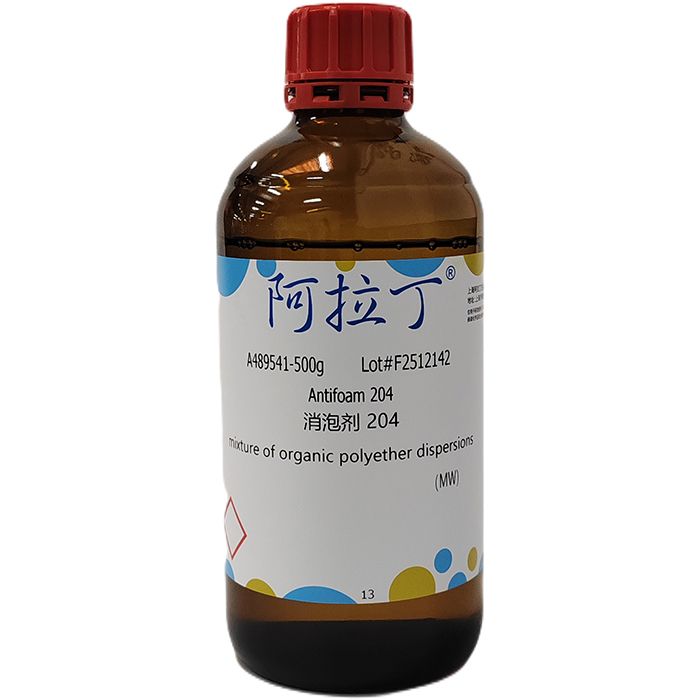
消泡剂起着有效抑泡剂的作用。204消泡剂含有100%活性成分,是一种有机非硅聚丙烯基聚醚分散体的混合物。它不含矿物油。204消泡剂本身可被视为一种表面活性剂,但其不含其他表面活性剂。该产品为合成产物,并非来源于动植物。204消泡剂可以反复灭菌。204消泡剂良好的流动性使得它可以根据需要泵入发酵罐。用于微生物培养基时,Alddin建议其起始浓度在0.005%到0.01%之间。
消泡剂以两种基本类型的组合物或两者的混合物形式提供。有机消泡剂是合成来源的。基于有机硅的消泡剂通常被认为是硅氧烷聚合物并且也是合成的。我们的供应商通常认为确切的成分是专有的。产品被列为分子生物学级,并经过测试可用于细菌发酵。大肠杆菌或枯草芽孢杆菌在添加有效浓度消泡剂的Terrific Broth 中生长时发现没有明显的抑制作用。这些产品可根据要求提供单独的数据表。
程序
消泡剂应在发生泡沫之前添加。或者,消泡剂可以按原样使用,方法是在填充喷嘴、处理桶的边缘或悬挂在起泡系统上方的筛网上进行擦拭。消泡剂最常见的应用之一是微生物发酵。由于无法预测消泡剂对特定应用的有效性,因此还应对消泡剂进行测试,以确保在每种微生物的代表性培养条件下具有足够的消泡效果。应使用为最终实验或发酵条件预期的培养基成分、温度、pH、混合和通气等变量。如果消泡剂在这些测试条件下无效,则可以添加更高量的消泡剂或测试不同类型的消泡剂。
应用
204消泡剂已用于:
在膜内异戊二烯定量过程中,抑制类囊体溶液中的鼓泡
用作分批补料连续培养发酵培养基的一种组分
抑制发酵罐中的剧烈起泡
消泡有机硅在微生物发酵技术中的应用。泡沫层的形成和随后的细胞损伤/损失被发现是影响细胞生长和单克隆抗体 (MAb) 生产的主要问题。补充和无血清培养基。培养基中的表面活性剂通过改变气泡的性质和形成的泡沫的质量对细胞生长产生了深远的影响。
向气泡柱中的杂交瘤细胞悬浮液中添加高浓度有机硅消泡剂可降低使用不含保护成分的培养基时的死亡率。在含有有机硅聚醚的非离子 Tritonä X-100 表面活性剂溶液中的消泡机制,即所谓的“浊点消泡剂”进行了调查。浊点 (CP) 研究表明,由于混合胶束的形成,Triton X-100/有机硅聚醚混合体系的 CP 介于起泡的 CP 和消泡表面活性剂之间。超临界二氧化碳用于直接萃取在分析之前从血浆中提取药物。超临界流体直接通过掺有中性(黄酮)或酸性(酮咯酸)药物的血浆样品。需要在提取之前向血浆中添加消泡剂以避免由于超临界流体使血浆蛋白变性而引起的限流器堵塞。
其他说明
包含 100% 活性成分,是多种无硅酮有机消泡剂的混合物,在多元醇中分散。可反复灭菌。
Antifoam function as an effective foam suppressor. Antifoam 204 contains 100% active components and is a mixture of organic non-silicone polypropylene-based polyether dispersions. It does not contain mineral oil. Antifoam 204 can itself be considered a surfactant, but it contains no other surfactants. This product is synthetic and not derived from animal or plant sources. Antifoam 204 can be sterilized repeatedly. The flow properties of Antifoam 204 are such that it can be pumped to a fermenter on an as-needed basis. For use in microbiological media, Alddin recommends a starting concentration of between 0.005% and 0.01%.
Antifoams are supplied as two basic types of composition or mixtures of the two. Organic antifoams are of synthetic origin. Silicone-based antifoams are generally considered to be siloxane polymers and are also synthetic. Our suppliers generally consider the exact composition to be proprietary.Products are listed as Molecular Biology Grade and have been tested for use in bacterial fermentation. No significant inhibition is found when E. coli or B. subtilis is grown in Terrific Broth supplemented with effective concentrations of antifoams. These products have individual data sheets available upon request.
Procedure
Antifoams should be added prior to the point where foaming occurs. Alternatively, antifoam can be used as supplied, by wiping on filling nozzles, rims of processing vats, or on a screen suspended above the foaming system. One of the most common applications for antifoams is in microbiological fermentation.Since one cannot predict the effectiveness of an antifoam for a particular application, antifoams should also be tested to ensure adequate defoaming effectiveness under representative culture conditions for each microorganism. The variables of medium composition, temperature, pH, mixing, and aeration anticipated for the final experimental or fermentation conditions should be used. If the antifoam is not effective under these test conditions either a higher amount of antifoam can be added or a different type of antifoam can be tested.
Applications
Antifoam 204 has been used:
to suppress bubbling in thylakoid solutions during intramembrane isoprene quantification
as a component of fed-batch continuous culture fermentation medium
to suppress severe foaming in fermenter
The application of antifoam silicones in the microbiological fermentation technique.Foam formation and the subsequent cell damage/ losses in the foam layer were found to be the major problems affecting cell growth and monoclonal antibody (MAb) production in stirred and sparged bioreactors for both serum-supplemented and serum-free media. Surfactants in the culture media had a profound effect on cell growth by changing both the properties of bubbles and the qualities of foam formed.
Addition of high concentrations of silicone antifoam to a suspension of hybridoma cells in a bubble column reduces the death rate when using medium without a protective component.The mechanism of antifoaming in a nonionic Tritonä X-100 surfactant solution with silicone polyethers, the so-called "cloud point antifoams," was investigated. The cloud point (CP) studies showed that the CP of a Triton X-100/silicone polyether mixed system is between the CP of the foaming and the antifoam surfactants, due to mixed micelle formation.Supercritical carbon dioxide was used for the direct extraction of drugs from plasma prior to analysis. The supercritical fluid was directly passed through plasma samples spiked with either a neutral (flavone) or an acidic (ketorolac) drug. The addition of an antifoam agent to the plasma prior to extraction was required to avoid restrictor plugging caused by denaturation of theplasma proteins by the supercritical fluid.
Other Notes
Contains 100% active components and is a mixture of non-silicone organic defoamers in a polyol dispersion. Can be sterilized repeatedly.
规格
规格或纯度
mixture of organic polyether dispersions
英文名称
Antifoam 204
储存条件
室温
运输条件
常规运输
名称和识别符
分子类型
未知
技术文档
高级数据
质检证书(CoA,COO,BSE/TSE 和分析图谱)
C of A & Other Certificates(BSE/TSE, COO):
输入批号以搜索分析图谱:
通过匹配包装上的批号来查找并下载产品的 COA,每批产品都进行了严格的验证,您可放心使用!
| 批号(Lot Number) | 证书类型 | 货号 |
|---|---|---|
 K2420333 |
分析证书 | A489541 |
| K2420332 |
分析证书 | A489541 |
| K2420331 |
分析证书 | A489541 |
| F2608417 |
分析证书 | A489541 |
| F2608416 |
分析证书 | A489541 |
| F2608415 |
分析证书 | A489541 |
| F2608221 |
分析证书 | A489541 |
| F2608219 |
分析证书 | A489541 |
| D2624057 |
分析证书 | A489541 |
| F2512142 |
分析证书 | A489541 |
| F2512141 |
分析证书 | A489541 |
| F2512121 |
分析证书 | A489541 |
| F2512120 |
分析证书 | A489541 |
| E2324099 |
分析证书 | A489541 |
| K2420334 |
分析证书 | A489541 |
| J2418156 |
分析证书 | A489541 |
| H2407135 |
分析证书 | A489541 |
| I2221200 |
分析证书 | A489541 |
| I2221201 |
分析证书 | A489541 |
| I2221202 |
分析证书 | A489541 |
| I2221199 |
分析证书 | A489541 |
| I2221203 |
分析证书 | A489541 |
| F2412086 |
分析证书 | A489541 |
| B2428031 |
分析证书 | A489541 |
此产品的引用文献
溶液计算器
产品仅提供给经过验证的企业、机构和合格的专业人员用于研发。不适用于人类、动物、诊断或治疗。
Copyright © 2023至今 上海阿拉丁生化科技股份有限公司 保留所有权利。


 危险品化学品经营许可证(带存储)