
计算溶液所需的质量、体积或浓度。
为什么选择此级别
提供 ≥99% 纯度,适用于对基线干扰要求严格的色谱和分析工作流程。
储存与运输
2-8°C储存。低温运输 。请查阅批次 COA 获取详细规格。
质量文档
SDS、COA、产品数据表及规格说明书均可下载。可通过批号查询获取批次 COA。
文献证明
在色谱分析、有机合成和交叉偶联反应领域已被 0 篇同行评审文献引用。
概述
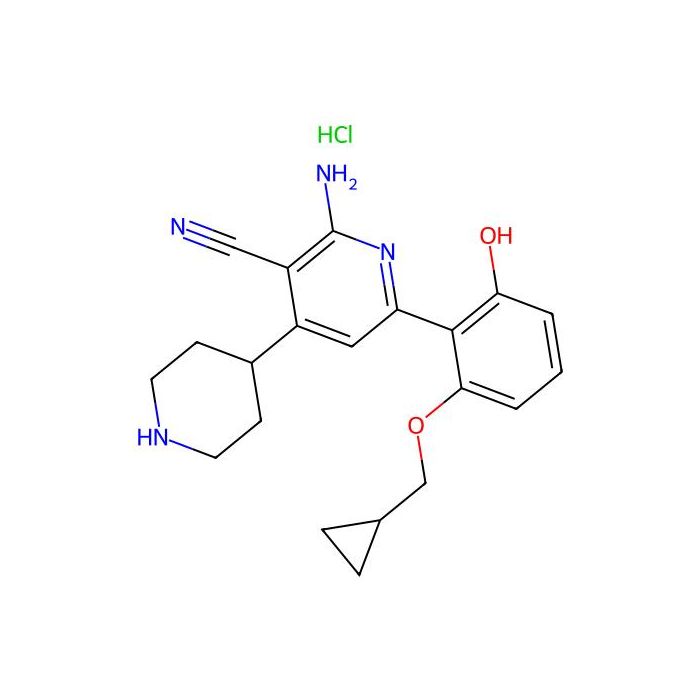
ACHP Hydrochloride (IKK-2 Inhibitor VIII) is a highly potent and selective IKK-β inhibitor with an IC 50 of 8.5 nM.
In Vitro
ACHP Hydrochloride (Compound 4j) exhibits potent IKK-β inhibitory (IC 50 : 8.5 nM) and cellular activities (IC 50 =40 nM, in A549 cells). ACHP moderately inhibits IKK-α with an IC 50 of 250 nM but exhibits good selectivity towards other kinases, such as IKK3, Syk and MKK4 (IC 50 >20,000 nM). Moreover, ACHP demonstrates quite potent activity in various cellular assays. ACHP inhibits NF-κB-dependent reporter gene activation in TNFα-activated HEK293 cells and PMA/calcium ionophore-activated Jurkat T cells. ACHP fails to inhibit PMA-induced AP-1 activation in MRC-5 cells and PMA/calcium ionophore induced NF-κB dependent reporter gene transcription in Jurkat cells even at concentrations exceeding 10 μM. ACHP selectively interferes with the NF-κB signaling cascade by inhibition of IKK-β in living cells. ACHP inhibits the growth of these cells in a dose-dependent manner. Tax-active cell lines are more susceptible to ACHP than Tax-inactive cell lines and Jurkat (IC 50 values in Tax-active cell lines, Tax-inactive cell lines or Jurkat are 3.1±1.3 μM, 10.7±1.7 μM and 23.6 μM, respectively), suggesting that the growth of Tax-active cells depends on NF-κB more than Tax-inactive cells. MCE has not independently confirmed the accuracy of these methods. They are for reference only.
In Vivo
ACHP (Compound 4j) is orally bioavailable in mice and rats and demonstrates significant in vivo activity in anti-inflammatory models (arachidonic acid-induced mouse ear edema model). ACHP has reasonable aqueous solubility (0.12 mg/mL in pH 7.4 isotonic buffer) and excellent Caco-2 permeability (P app 62.3×10 -7 cm/s), and demonstrates orally bioavailability in mice (BA: 16%) and rats (BA: 60%). The favourable bioavailability of ACHP in rats is likely due to its low clearance (0.33 L/h/kg). In an acute inflammation model, ACHP exhibits oral efficacy at 1 mg/kg in a dose-dependent manner . MCE has not independently confirmed the accuracy of these methods. They are for reference only.
Cell Assay
HTLV-1-infected T-cell lines, ATL-35T, 81-66/45, MJ, and MT-2 cells, human ATL cell lines established from ATL patients, ATL-102, ED-40515(−) and TL-Om1 cells, and a HTLV-1-negative T-cell leukemia cell line Jurkat are used in this study. Approximately 1.5×10 4 cells are cultured in 96-well plate in triplicates at 37°C. Growth inhibitory effect of ACHP (0.01, 0.1, 1, 5, 10, 50 and 100 μM) is determined using MTT assay. Optical densities (OD) at 570 and 630 nm are measured with multiplate reader. Cell viability (%) is calculated. MCE has not independently confirmed the accuracy of these methods. They are for reference only.
Form:Solid
IC50& Target:IKK-β 8.5 nM (IC 50 ) IKK-α 250 nM (IC 50 )
规格
别名
盐酸乙酰辅酶A
规格或纯度
≥99%
英文名称
ACHP Hydrochloride
生化机理
ACHP Hydrochloride(IKK-2 抑制剂 VIII)是一种高效、选择性 IKK-β 抑制剂,IC50 为 8.5 nM。
储存条件
2-8°C储存
运输条件
低温运输
作用类型
抑制剂
纯度
≥99%
名称和识别符
分子类型
小分子
Isomeric SMILES
C1CC1COC2=CC=CC(=C2C3=NC(=C(C(=C3)C4CCNCC4)C#N)N)O.Cl
PubChem CID
分子量
400.90
技术文档
高级数据
化学和物理性质
溶解性
DMSO : 50 mg/mL (124.72 mM; Need ultrasonic) H2O : <0.1 mg/mL (ultrasonic;warming;heat to 60°C) (insoluble)
分子量
400.900 g/mol
XLogP3
氢键供体数Hydrogen Bond Donor Count
4
氢键受体数Hydrogen Bond Acceptor Count
6
可旋转键计数Rotatable Bond Count
5
精确质量Exact Mass
400.167 Da
单同位素质量Monoisotopic Mass
400.167 Da
拓扑极表面积Topological Polar Surface Area
104.000 Ų
重原子数Heavy Atom Count
28
形式电荷Formal Charge
0
复杂度Complexity
540.000
同位素原子数Isotope Atom Count
0
定义的原子立体中心计数Defined Atom Stereocenter Count
0
未定义的原子立体中心计数Undefined Atom Stereocenter Count
0
定义的键立体中心计数Defined Bond Stereocenter Count
0
未定义的键立体中心计数Undefined Bond Stereocenter Count
0
所有立体化学键的总数The total count of all stereochemical bonds
0
共价键合单元计数Covalently-Bonded Unit Count
2
质检证书(CoA,COO,BSE/TSE 和分析图谱)
C of A & Other Certificates(BSE/TSE, COO):
输入批号以搜索分析图谱:
溶液计算器
产品仅提供给经过验证的企业、机构和合格的专业人员用于研发。不适用于人类、动物、诊断或治疗。
Copyright © 2023至今 上海阿拉丁生化科技股份有限公司 保留所有权利。


 危险品化学品经营许可证(带存储)