
计算溶液所需的质量、体积或浓度。
为什么选择此级别
提供 ≥99% 纯度,适用于对基线干扰要求严格的色谱和分析工作流程。
储存与运输
-20°C储存。超低温运输 。请查阅批次 COA 获取详细规格。
质量文档
SDS、COA、产品数据表及规格说明书均可下载。可通过批号查询获取批次 COA。
文献证明
在色谱分析、有机合成和交叉偶联反应领域已被 0 篇同行评审文献引用。
概述
Astragaloside VI could activate EGFR/ERK signalling pathway to improve wound healing.
In Vitro
Pretreatment with Astragaloside VI (AS-VI) at 1 μM increases EGFR activation in HaCaT cells. Astragaloside VI, a major intestinal metabolite of astragalosides, exerts the strongest EGFR activation. In HaCaT cells, the positive control, EGF expectedly results in 1.5±0.03-fold increase in cell proliferation, compared to the control. Astragaloside VI at the indicated concentrations also significantly promots cell proliferation in both HaCaT and HDF cells. Astragaloside VI promotes neural stem cell proliferation and enhances neurological function recovery in transient cerebral ischemic injury via activating EGFR/MAPK signaling cascades. MCE has not independently confirmed the accuracy of these methods. They are for reference only.
In Vivo
Astragaloside VI improves wound healing, compared to the control. In the simple noninfected wound model, wound healing in mice is accelerated by Astragaloside VI, where in the time required for wound closure is shortened by approximately 2-4 days, compared to that in the control group. Topical treatment with Astragaloside VI reduces the volume of pus produced, compared to the control group. Astragaloside VI treated wounds show an accelerated rate of healing, compared to the control and vaseline groups. By day 22, the Astragaloside VI -treated wounds fully close, whereas the blank and vaseline-treated wounds do not fully close until day 26. Angiogenesis is a crucial step in the formation of granulation tissue and wound healing. Astragaloside VI increases blood vessel formation in both the non-infected and infected wound models . Astragaloside VI could effectively activate EGFR/MAPK signaling cascades, promote NSCs proliferation and neurogenesis in transient cerebral ischemic brains, and improve the repair of neurological functions in post-ischemic stroke rats. MCE has not independently confirmed the accuracy of these methods. They are for reference only.
Form:Solid
IC50& Target:EGFR
规格
别名
黄芪苷Ⅵ
规格或纯度
≥99%
英文名称
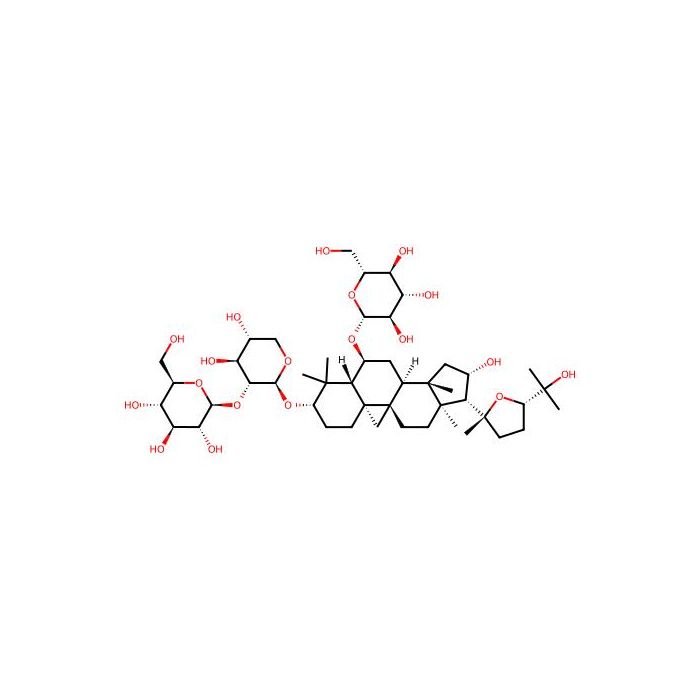
Astragaloside VI
生化机理
黄芪皂苷 VI 可激活表皮生长因子受体/ERK 信号通路,从而改善伤口愈合。
储存条件
-20°C储存
运输条件
超低温运输
纯度
≥99%
名称和识别符
分子类型
小分子
IUPAC Name
(2R,3R,4S,5S,6R)-2-[[(1S,3R,6S,8R,9S,11S,12S,14S,15R,16R)-6-[(2S,3R,4S,5R)-4,5-dihydroxy-3-[(2S,3R,4S,5S,6R)-3,4,5-trihydroxy-6-(hydroxymethyl)oxan-2-yl]oxyoxan-2-yl]oxy-14-hydroxy-15-[(2R,5S)-5-(2-hydroxypropan-2-yl)-2-methyloxolan-2-yl]-7,7,12,16-tetramethyl-9-pentacyclo[9.7.0.01,3.03,8.012,16]octadecanyl]oxy]-6-(hydroxymethyl)oxane-3,4,5-triol
INCHI
1S/C47H78O19/c1-41(2)26(64-40-35(28(52)21(51)18-60-40)65-39-34(58)32(56)30(54)24(17-49)63-39)9-11-47-19-46(47)13-12-43(5)36(45(7)10-8-27(66-45)42(3,4)59)20(50)15-44(43,6)25(46)14-22(37(41)47)61-38-33(57)31(55)29(53)23(16-48)62-38/h20-40,48-59H,8-19H2,1-7H3/t20-,21+,22-,23+,24+,25-,26-,27-,28-,29+,30+,31-,32-,33+,34+,35+,36-,37-,38+,39-,40-,43+,44-,45+,46-,47+/m0/s1
InChi Key
FLPVEPQEIRRVKG-SXCMWBRFSA-N
Smiles
CC1(C(CCC23C1C(CC4C2(C3)CCC5(C4(CC(C5C6(CCC(O6)C(C)(C)O)C)O)C)C)OC7C(C(C(C(O7)CO)O)O)O)OC8C(C(C(CO8)O)O)OC9C(C(C(C(O9)CO)O)O)O)C
Isomeric SMILES
C[C@]12CC[C@@]34C[C@@]35CC[C@@H](C([C@@H]5[C@H](C[C@H]4[C@@]1(C[C@@H]([C@@H]2[C@]6(CC[C@H](O6)C(C)(C)O)C)O)C)O[C@H]7[C@@H]([C@H]([C@@H]([C@H](O7)CO)O)O)O)(C)C)O[C@H]8[C@@H]([C@H]([C@@H](CO8)O)O)O[C@H]9[C@@H]([C@H]([C@@H]([C@H](O9)CO)O)O)O
PubChem CID
MeSH Entry Terms
astragaloside VI
分子量
947.11
技术文档
高级数据
系统学分类
分类树(Taxonomy Tree)
| 界(kingdom) | 有机化合物 |
|---|---|
| 超类(Superclass) | 脂质和脂质样分子 |
| 类(Class) | 类固醇和类固醇衍生物 |
| 亚类(Subclass) | 甾体糖苷 |
| 中间层级节点(Intermediate Tree Nodes) | 甾体皂苷 |
| 直接上位类(Direct Parent) | 葫芦素苷 |
| 其他上位类(Alternative Parents) | 三萜皂苷 三萜类化合物 环木菠萝醇及其衍生物 16-β-羟基类固醇 O-糖基化合物 双糖 氧烷 四氢呋喃 叔醇 仲醇 环状醇及其衍生物 缩醛 多元醇 二烷基醚 氧环化合物 伯醇 碳氢化合物衍生物 |
| 分子骨架(Molecular Framework) | 脂肪族杂多环化合物 |
| 取代基(Substituents) | 16-β-羟基类固醇 - 16-羟基类固醇 - 9b,19-环-羊毛烷烷骨架 - 乙醛酸 - 羟基苯甲酸酯 - 脂肪族杂多环化合物 - 苷元结构 - 环醇 - 环烷烃骨架 - 环烷醇骨架 - 二烷基醚 - 二糖 - 乙醚 - 糖基化合物 - 烃衍生物 - 羟基吡啶 - O-羧基化合物 - 有机氧化合物 - 有机杂环化合物 - 有机氧化合物 - 氧杂环 - 氧杂环丁烷 - 多醇 - 初级醇 - 醛基 - 三烷基醇 - 四氢呋喃 - 三萜苷 - 三萜皂苷 - 三萜类化合物 |
| 描述(Description) | 该化合物属于葫芦素苷类有机化合物。这类多环化合物通过糖苷键将碳水化合物衍生物连接至葫芦烷骨架。 |
| 外部描述符(External Descriptors) | 暂无 |
三维结构
交互式化学结构模型
化学和物理性质
溶解性
DMSO : 100 mg/mL (105.58 mM; Need ultrasonic)
分子量
947.100 g/mol
XLogP3
-0.300
氢键供体数Hydrogen Bond Donor Count
12
氢键受体数Hydrogen Bond Acceptor Count
19
可旋转键计数Rotatable Bond Count
10
精确质量Exact Mass
946.514 Da
单同位素质量Monoisotopic Mass
946.514 Da
拓扑极表面积Topological Polar Surface Area
307.000 Ų
重原子数Heavy Atom Count
66
形式电荷Formal Charge
0
复杂度Complexity
1770.000
同位素原子数Isotope Atom Count
0
定义的原子立体中心计数Defined Atom Stereocenter Count
26
未定义的原子立体中心计数Undefined Atom Stereocenter Count
0
定义的键立体中心计数Defined Bond Stereocenter Count
0
未定义的键立体中心计数Undefined Bond Stereocenter Count
0
所有立体化学键的总数The total count of all stereochemical bonds
0
共价键合单元计数Covalently-Bonded Unit Count
1
质检证书(CoA,COO,BSE/TSE 和分析图谱)
C of A & Other Certificates(BSE/TSE, COO):
输入批号以搜索分析图谱:
溶液计算器
产品仅提供给经过验证的企业、机构和合格的专业人员用于研发。不适用于人类、动物、诊断或治疗。
Copyright © 2023至今 上海阿拉丁生化科技股份有限公司 保留所有权利。


 危险品化学品经营许可证(带存储)