
计算溶液所需的质量、体积或浓度。
为什么选择此级别
提供 ≥95% 纯度,适用于对基线干扰要求严格的色谱和分析工作流程。
储存与运输
2-8°C储存,干燥。低温运输 。请查阅批次 COA 获取详细规格。
质量文档
SDS、COA、产品数据表及规格说明书均可下载。可通过批号查询获取批次 COA。
文献证明
在色谱分析、有机合成和交叉偶联反应领域已被 0 篇同行评审文献引用。
概述
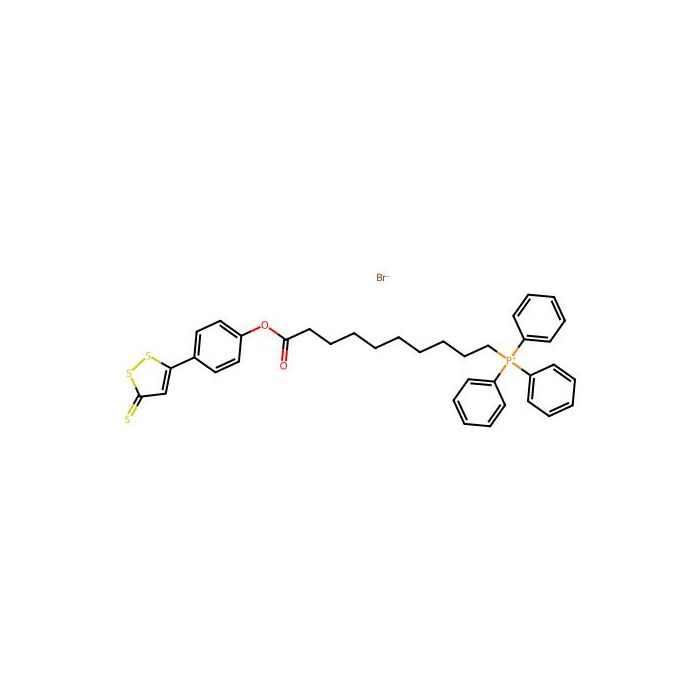
AP39 is a triphenylphosphonium derivatised anethole dithiolethione and mitochondria-targeting hydrogen sulfide (H 2 S) donor. AP39 increases intracellular H 2 S levels. AP39 exerts cytoprotective effects and maintains mitochondrial DNA integrity under oxidative stress conditions. AP39 protects against myocardial reperfusion injury in mice model and has the potential for Alzheimer's disease research .
In Vitro
AP39 (25,100 nM; for 24 h) results in increase in cell viability in APP/PS1 neurons and has no effect on cell viability in WT neurons. AP39 (100 nM) increases the levels of OPA1 and Mfn1 but not Mfn2. Moreover, AP39 decreases the levels of Fis1 but not Drp1. AP39 (25-250 nM; 2 h) induces a concentration-dependent increase in H 2 S generation and in the fluorescence of the H 2 S-detecting dye AzMC. AP39 (100 nM) significantly increases the basal respiratory rate and the OCR-linked maximal respiratory capacity of the APP/PS1 neurons. AP39 significantly increases the ATP production in WT and APP/PS1 neurons. AP39 significantly protects against mtDNA damage in APP/PS1 neurons by partially restoring mtDNA integrity. AP39 consists of a mitochondria-targeting motif, triphenylphosphonium (TPP + ), coupled to a H 2 S-donating moiety (dithiolethione) by an aliphatic linker.\nAP39 (100 nM) reduces intracellular oxidative stress and in the meantime it consequently sustaines the cell viability, mitochondrial respiration and mitochondrial DNA integrity. These effects tend to be stimulatory at lower concentrations (30 and 100 nM), but tend to diminish or convert into inhibitory effects at a higher concentration (300 nM). MCE has not independently confirmed the accuracy of these methods. They are for reference only.
In Vivo
AP39 (100 nM/kg/day; ip; for 6 weeks) ameliorates the learning and memory deficits of APP/PS1 mice. AP39 (25-250 nM/kg/day; ip; for 6 weeks) induces a dose-dependent increase in H 2 S generation in the cortex and hippocampus of WT and APP/PS1 mice . AP39 (0.01, 0.1, 1 μmol/kg; iv; bolus 10 min before reperfusion) dose‐dependently reduces infarct size anaesthetized by thiobutabarbital (200 mg/kg, i.p) in male Sprague Dawley rats, 300-350 g (9-11 weeks). MCE has not independently confirmed the accuracy of these methods. They are for reference only. Animal Model: 12-month-old WT or APP/PS1 mice Dosage: 100 nM/kg Administration: IP; daily; for 6 weeks Result: Reversed the spatial learning and memory deficits of the aged AD model mice. Alleviated brain atrophy and ventricle asymmetryand inhibited Aβ plaque deposition in the brains in AD model mice.
Form:Solid
规格
规格或纯度
≥95%
英文名称
AP39
生化机理
AP39 是一种三苯基膦衍生化的茴香硫醚二硫代二酮和线粒体靶向硫化氢(H 2 S)供体。AP39 可提高细胞内 H 2 S 的水平。AP39 具有细胞保护作用,并能在氧条件下保持线粒体 DNA 的完整性。
储存条件
2-8°C储存,干燥
运输条件
低温运输
纯度
≥95%
名称和识别符
分子类型
小分子
IUPAC Name
[10-oxo-10-[4-(5-sulfanylidenedithiol-3-yl)phenoxy]decyl]-triphenylphosphanium;bromide
INCHI
1S/C37H38O2PS3.BrH/c38-36(39-31-26-24-30(25-27-31)35-29-37(41)43-42-35)23-15-4-2-1-3-5-16-28-40(32-17-9-6-10-18-32,33-19-11-7-12-20-33)34-21-13-8-14-22-34;/h6-14,17-22,24-27,29H,1-5,15-16,23,28H2;1H/q+1;/p-1
InChi Key
PUEBFERUDPTIDR-UHFFFAOYSA-M
Smiles
C1=CC=C(C=C1)[P+](CCCCCCCCCC(=O)OC2=CC=C(C=C2)C3=CC(=S)SS3)(C4=CC=CC=C4)C5=CC=CC=C5.[Br-]
Isomeric SMILES
C1=CC=C(C=C1)[P+](CCCCCCCCCC(=O)OC2=CC=C(C=C2)C3=CC(=S)SS3)(C4=CC=CC=C4)C5=CC=CC=C5.[Br-]
PubChem CID
分子量
721.77
技术文档
高级数据
系统学分类
分类树(Taxonomy Tree)
| 界(kingdom) | 有机化合物 |
|---|---|
| 超类(Superclass) | 苯类化合物 |
| 类(Class) | 苯及其取代衍生物 |
| 亚类(Subclass) | 苯基膦及其衍生物 |
| 中间层级节点(Intermediate Tree Nodes) | 暂无 |
| 直接上位类(Direct Parent) | 苯基膦及其衍生物 |
| 其他上位类(Alternative Parents) | 苯酚酯 苯氧基化合物 脂肪酸酯 1,2-二硫代戊烯-3-硫酮 杂芳族化合物 羧酸酯 一元羧酸及其衍生物 有机硫化合物 有机磷化合物 有机氧化物 有机溴化盐 碳氢化合物衍生物 羰基化合物 有机阳离子 |
| 分子骨架(Molecular Framework) | 芳香族杂单环化合物 |
| 取代基(Substituents) | 1,2-二硫醇 - 1,2-二硫醇-3-硫酮 - 芳香族杂单环化合物 - 羰基 - 羧酸衍生物 - 羧酸酰胺 - 二硫醇 - 脂肪酸酯 - 脂肪酰基 - 杂芳香族化合物 - 烃衍生物 - 单羧酸或其衍生物 - 有机溴化物 - 有机铵盐 - 有机氧化物 - 有机氧化合物 - 有机盐 - 有机杂环化合物 - 有机氧化合物 - 有机磷化合物 - 有机硫化合物 - 苯酚酯 - 苯氧基化合物 - 苯基膦 - 三苯基磷 |
| 描述(Description) | 该化合物属于有机化合物中的苯基膦及其衍生物类。这类化合物含有苯基膦结构单元,即膦基取代基与苯基相连。 |
| 外部描述符(External Descriptors) | 暂无 |
三维结构
交互式化学结构模型
作用机制
| 作用机制 | Action Type | target ID | Target Name | Target Type | Target Organism | Binding Site Name | 参考文献 |
|---|
化学和物理性质
溶解性
DMSO : 100 mg/mL (138.55 mM; Need ultrasonic)
质检证书(CoA,COO,BSE/TSE 和分析图谱)
C of A & Other Certificates(BSE/TSE, COO):
输入批号以搜索分析图谱:
溶液计算器
产品仅提供给经过验证的企业、机构和合格的专业人员用于研发。不适用于人类、动物、诊断或治疗。
Copyright © 2023至今 上海阿拉丁生化科技股份有限公司 保留所有权利。


 危险品化学品经营许可证(带存储)