Molecular chaperone that promotes the maturation, structural maintenance and proper regulation of specific target proteins involved for instance in cell cycle control and signal transduction. Undergoes a functional cycle that is linked to its ATPase activity which is essential for its chaperone activity. This cycle probably induces conformational changes in the client proteins, thereby causing their activation. Interacts dynamically with various co-chaperones that modulate its substrate recognition, ATPase cycle and chaperone function.
Engages with a range of client protein classes via its interaction with various co-chaperone proteins or complexes, that act as adapters, simultaneously able to interact with the specific client and the central chaperone itself.
Recruitment of ATP and co-chaperone followed by client protein forms a functional chaperone. After the completion of the chaperoning process, properly folded client protein and co-chaperone leave HSP90 in an ADP-bound partially open conformation and finally, ADP is released from HSP90 which acquires an open conformation for the next cycle .
Plays a critical role in mitochondrial import, delivers preproteins to the mitochondrial import receptor TOMM70.
Apart from its chaperone activity, it also plays a role in the regulation of the transcription machinery. HSP90 and its co-chaperones modulate transcription at least at three different levels .
In the first place, they alter the steady-state levels of certain transcription factors in response to various physiological cues.
Second, they modulate the activity of certain epigenetic modifiers, such as histone deacetylases or DNA methyl transferases, and thereby respond to the change in the environment .
Third, they participate in the eviction of histones from the promoter region of certain genes and thereby turn on gene expression .
Binds bacterial lipopolysaccharide (LPS) and mediates LPS-induced inflammatory response, including TNF secretion by monocytes.
Antagonizes STUB1-mediated inhibition of TGF-beta signaling via inhibition of STUB1-mediated SMAD3 ubiquitination and degradation .
Mediates the association of TOMM70 with IRF3 or TBK1 in mitochondrial outer membrane which promotes host antiviral response.
(Microbial infection) Seems to interfere with N.meningitidis NadA-mediated invasion of human cells. Decreasing HSP90 levels increases adhesion and entry of E.coli expressing NadA into human Chang cells; increasing its levels leads to decreased adhesion and invasion.
ISGylated; S-nitrosylated; negatively regulates the ATPase activity and the activation of eNOS by HSP90AA1; Ubiquitinated via 'Lys-63'-linked polyubiquitination by HECTD1. Ubiquitination promotes translocation into the cytoplasm away from the membrane and secretory pathways.
宿主种属
小鼠(Mouse)
特异性
Human Hsp90 alpha
种属反应性
人(Human)
免疫原
Recombinant protein corresponding to Hsp90 alpha
阳性对照
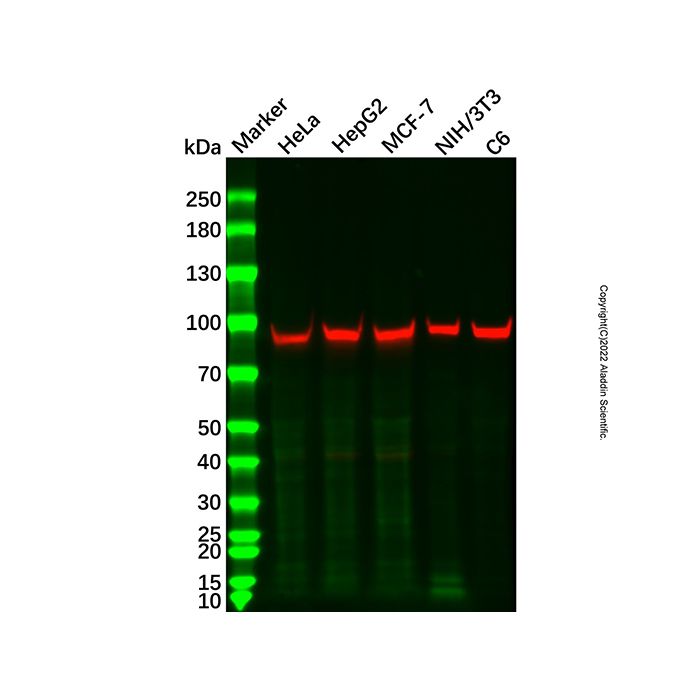
WB: HeLa; HepG2; MCF-7; NIH/3T3; C6
偶联
Unconjugated
克隆类型
单克隆抗体
Format
Whole IgG
轻链亚型
kappa
纯化方法
Protein A purified
浓度
1.0 mg/mL
分子类型
抗体
产品线
生物产品
储存与运输
储存缓冲液
PBS, pH 7.2
储存条件
-20°C储存,避免反复冻融
运输条件
超低温运输
稳定性与储存
Store at 2-8℃ short term (1-2 weeks). Store at -20℃ long term (24 months). Upon receipt, it is recommended to aliquot. Avoid freeze/thaw cycle.
图片
Hsp90 alpha Mouse mAb (Ab156230) - Western Blot
All lanes: Hsp90 alpha Mouse mAb (Ab156230) at 1/2000 dilution
Samples: Lysates at 20 µg per lane
Secondary: Goat Anti-Mouse IgG H&L (HRP) (Ab179001) at 1/20000 dilution

 ZJ25F1129879


 危险品化学品经营许可证(带存储)