主动型阻断剂,推荐用于IgM检测产品。
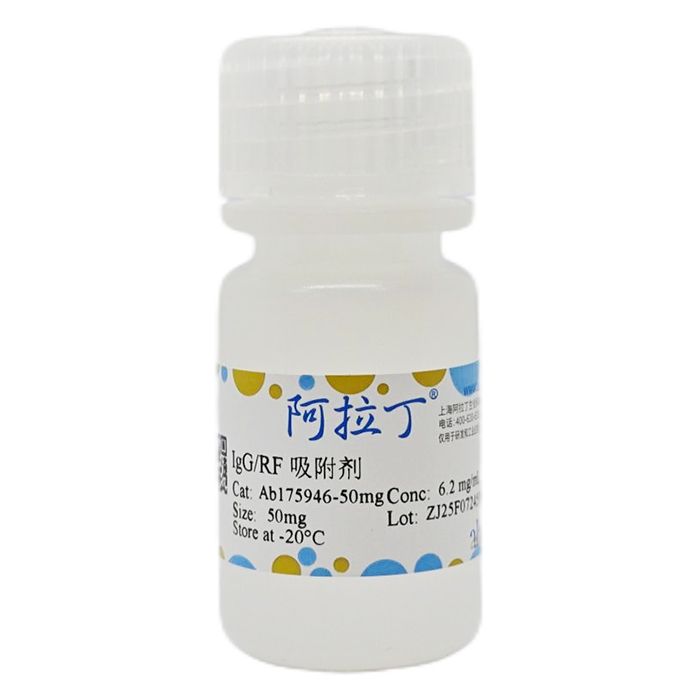
IgM抗体检测是判断病原体初次感染或早期感染的有效诊断方法,血清样本中类风湿因子(RF)及特异性IgG抗体可能影响检测试剂的特异性和灵敏性,导致错误结果。使用IgG/RF吸附剂对样本进行预处理,去除上述可能产生干扰的物质,是提高检测特异性和灵敏性以及稳定性最简单、快速的方法。
羊抗人IgG(Fc)抗体(0.01M PBS,pH7.4),抗原亲和层析纯化,纯度≥95%,0.2μm过滤,不添加防腐剂。
过滤: 0.2um
注意事项:
长期存放应≤-20℃,产品不开封情况下可短期储存于 2℃-8℃, 储存时间应不超过 7 天,因本产品未添加任何防腐剂,若开封启用, 不建议在 2-8℃长期保存,应分装后保存至≤-20℃环境。
技术背景:
特异性 IgM 检测是判断病原体初次感染或早期感染的血清学诊断方法,血清样本中类 风湿因子(RF)及特异性 IgG 抗体可能影响检测试剂的特异性和灵敏性,导致错误结果。 使用 IgM 检测专用阻断剂即 IgG/RF 吸附剂,对样本进行预处理,去除上述可能产生干扰的 物质,是提高检测特异性和灵敏性以及稳定性最简单、快速的方法。
作用原理:
吸附剂与样本接触后,血清中的 IgG 抗体与吸附剂反应形成 IgG 复合物,阻止其与待检 IgM 竞争结合抗原,提高检测的灵敏度,同时样本中可能存在的类风湿因子(RF)会被 IgG 复合物吸附,去除其对检测过程的干扰。
使用方法:
1. 免疫层析产品
可将吸附剂按一定浓度加入样品处理垫,使用浓度根据样本使用量通过梯度试验确定。
2. ELISA 产品
2.1. 可采取对样本进行预处理方式,将吸附剂添加到样本稀释液中。
2.2. 根据相应产品的样本使用量和稀释度确定吸附剂在样本稀释液中的含量,应通过梯度试 验确定最适合的使用浓度。
2.3. 预处理时间在 5-30 分钟之间,应通过实验确定。
2.4. 预处理后的样本可能出现 IgG 复合物导致的浑浊,可通过低速离心 2-3 分钟去除沉淀取 上清进行检测,若通过验证确定浑浊样本对实验结果无影响,则可直接进行检测。
2.5. 应充分考虑样本稀释液中添加吸附剂后对反应体系的影响,以保证样本稀释液中有效成 分不受吸附剂影响。
3. 其他 IgM 检测产品 应根据相应技术路线和检测方法确定吸附剂的使用方式和使用浓度,不合适的吸附剂使 用浓度可能导致产生沉淀,应通过实验选择最适合的浓度
Product Description:
Active blocker, recommended for IgM detection products.
IgM antibody detection is an effective diagnostic method to determine the initial or early infection of pathogens. Rheumatoid factor (RF) and specific IgG antibodies in serum samples may affect the specificity and sensitivity of detection reagents, resulting in erroneous results. Using IgG/RF adsorbent to pretreat samples to remove the above-mentioned substances that may interfere is the simplest and fastest way to improve detection specificity, sensitivity and stability.
Goat anti-human IgG (Fc) antibody (0.01M PBS, pH7.4), purified by antigen affinity chromatography, with a purity ≥ 95%, filtered through 0.2 μm, without adding preservatives.
Filtration: 0.2um
Notes:
Long-term storage should be ≤-20°C. The product can be stored at 2°C-8°C for a short period of time without opening, and the storage time should not exceed 7 days. Because this product does not add any preservatives, if it is opened and used, it is not recommended to store it at 2-8°C. For long-term storage at ℃, it should be subpackaged and stored at ≤-20℃.
Technical background:
Specific IgM detection is a serological diagnostic method for judging the initial or early infection of pathogens. Rheumatoid factor (RF) and specific IgG antibodies in serum samples may affect the specificity and sensitivity of detection reagents, resulting in erroneous results. It is the simplest and fastest way to improve the specificity, sensitivity and stability of detection by using IgG/RF adsorbent, a special blocking agent for IgM detection, to pretreat the sample to remove the above-mentioned substances that may interfere.
Action principle:
After the adsorbent is in contact with the sample, the IgG antibody in the serum reacts with the adsorbent to form an IgG complex, which prevents it from competing with the IgM to be tested for antigen binding, and improves the detection sensitivity. At the same time, the rheumatoid factor (RF) that may exist in the sample will be eliminated. The IgG complex is adsorbed to remove its interference to the detection process.
Method of application:
1. Immunochromatographic products
The adsorbent can be added to the sample processing pad at a certain concentration, and the concentration used is determined through a gradient test according to the amount of sample used.
2. ELISA products
2.1. The sample can be pretreated by adding the adsorbent to the sample diluent.
2.2. Determine the content of the adsorbent in the sample diluent according to the sample usage and dilution of the corresponding product, and the most suitable concentration should be determined through a gradient test.
2.3. The pretreatment time is between 5 and 30 minutes and should be determined experimentally.
2.4. The pretreated sample may appear turbid due to IgG complexes. It can be centrifuged at low speed for 2-3 minutes to remove the precipitate and take the supernatant for detection. If it is verified that the turbid sample has no effect on the experimental results, it can be directly tested.
2.5. The effect of adding adsorbents on the reaction system in the sample dilution should be fully considered to ensure that the active ingredients in the sample dilution are not affected by the adsorbent.
3. Other IgM detection products The use method and concentration of the adsorbent should be determined according to the corresponding technical route and detection method. An inappropriate concentration of the adsorbent may cause precipitation, and the most suitable concentration should be selected through experiments

 ZJ24F0607005


 危险品化学品经营许可证(带存储)