Adhesive protein that mediates cell-to-cell interactions.
Acts as a receptor for thrombospondin THBS1 and as modulator of integrin signaling through the activation of heterotrimeric G proteins
Involved in signal transduction, cardiovascular homeostasis, inflammation, apoptosis, angiogenesis, cellular self-renewal, and immunoregulation
Plays a role in modulating pulmonary endothelin EDN1 signaling
Modulates nitrous oxide (NO) signaling, in response to THBS1, hence playing a role as a pressor agent, supporting blood pressure
Plays an important role in memory formation and synaptic plasticity in the hippocampus
Receptor for SIRPA, binding to which prevents maturation of immature dendritic cells and inhibits cytokine production by mature dendritic cells
Interaction with SIRPG mediates cell-cell adhesion, enhances superantigen-dependent T-cell-mediated proliferation and costimulates T-cell activation
Positively modulates FAS-dependent apoptosis in T-cells, perhaps by enhancing FAS clustering
Plays a role in suppressing angiogenesis and may be involved in metabolic dysregulation during normal aging
In response to THBS1, negatively modulates wound healing
Inhibits stem cell self-renewal, in response to THBS1, probably by regulation of the stem cell transcription factors POU5F1/OCT4, SOX2, MYC/c-Myc and KLF4
May play a role in membrane transport and/or integrin dependent signal transduction
May prevent premature elimination of red blood cells
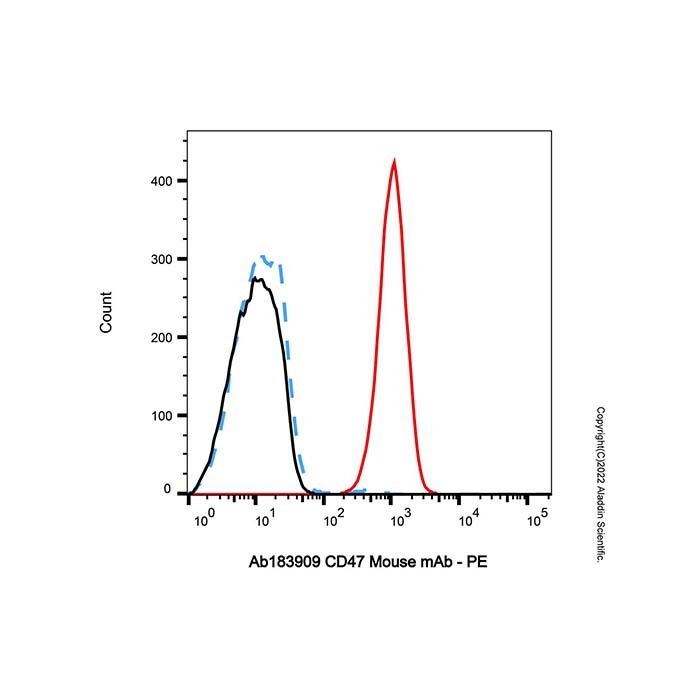
CD47 Mouse mAb (Ab183909) - Flow Cytometry Flow Cytometry analysis of Jurkat cells stained with CD47 Mouse mAb (Ab183909) (Red) at 0.625 μg/mL for 1 hour at 4°C. The Goat Anti-Mouse IgG H&L (PE) (Ab179006) was used as the secondary antibody. Unlabeled sample (Black) was used as a negative control. Mouse IgG1-kappa, anti-E8L(Ab213557) was used as an isotype control (Blue).

 ZJ25F0622508


 危险品化学品经营许可证(带存储)