Multifunctional transcription factor that exhibits positive and negative control on a large number of cellular and viral genes by binding to sites overlapping the transcription start site.
Binds to the consensus sequence 5'-CCGCCATNTT-3'; some genes have been shown to contain a longer binding motif allowing enhanced binding; the initial CG dinucleotide can be methylated greatly reducing the binding affinity.
The effect on transcription regulation is depending upon the context in which it binds and diverse mechanisms of action include direct activation or repression, indirect activation or repression via cofactor recruitment, or activation or repression by disruption of binding sites or conformational DNA changes.
Its activity is regulated by transcription factors and cytoplasmic proteins that have been shown to abrogate or completely inhibit YY1-mediated activation or repression.
For example, it acts as a repressor in absence of adenovirus E1A protein but as an activator in its presence.
Acts synergistically with the SMAD1 and SMAD4 in bone morphogenetic protein (BMP)-mediated cardiac-specific gene expression.
Binds to SMAD binding elements (SBEs) (5'-GTCT/AGAC-3') within BMP response element (BMPRE) of cardiac activating regions.
May play an important role in development and differentiation. Proposed to recruit the PRC2/EED-EZH2 complex to target genes that are transcriptional repressed.
Involved in DNA repair .
In vitro, binds to DNA recombination intermediate structures (Holliday junctions). Plays a role in regulating enhancer activation.
Recruits the PR-DUB complex to specific gene-regulatory regions.
Proposed core component of the chromatin remodeling INO80 complex which is involved in transcriptional regulation, DNA replication and probably DNA repair; proposed to target the INO80 complex to YY1-responsive elements.
Phosphorylation at Ser-118 by CK2 prevents proteolytic cleavage by caspase-7 (CASP7) during apoptosis.
Proteolytically cleaved by caspase-7 (CASP7) in response to apoptosis.
Phosphorylation at Ser-118 protects against proteolytic cleavage.
Transiently poly-ADP-ribosylated by PARP1 upon DNA damage, with the effect of decreasing affinity of YY1 to its cognate DNA binding sites.
Ubiquitinated.
宿主种属
小鼠(Mouse)
特异性
Human YY1
种属反应性
人(Human)
免疫原
Recombinant full length protein corresponding to Human YY1
阳性对照
WB: MCF-7; HeLa; Jurkat; K562; NIH/3T3; C6
偶联
Unconjugated
克隆类型
单克隆抗体
Format
Whole IgG
纯化方法
Protein A purified
浓度
1.0 mg/mL
分子类型
抗体
产品线
生物产品
储存与运输
储存缓冲液
PBS, pH 7.2
防腐剂
kappa
储存条件
-20°C储存,避免反复冻融
运输条件
超低温运输
稳定性与储存
Store at 4°C short term (1-2 weeks). Store at -20°C or -80°C. Avoid freeze / thaw cycle.
图片
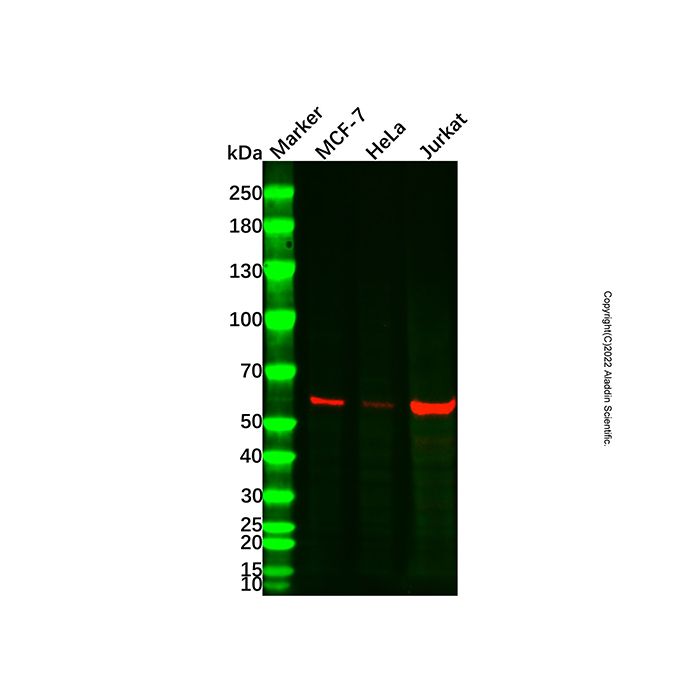
YY1 Mouse mAb (Ab231036) - Western Blot All lanes: YY1 Mouse mAb (Ab231036) at 1/1000 dilution Samples: Lysates at 20 µg per lane Secondary: Goat Anti-Mouse IgG H&L (HRP) (Ab179001) at 1/20000 dilution Predicted band size: 45 kDa Observed band size: 58 kDa Exposure time: 60.0 s
YY1 Mouse mAb (Ab231036) - Western Blot All lanes: YY1 Mouse mAb (Ab231036) at 1/1000 dilution Samples: Lysates at 20 µg per lane Secondary: Goat Anti-Mouse IgG H&L (HRP) (Ab179001) at 1/20000 dilution Predicted band size: 45 kDa Observed band size: 60 kDa Exposure time: 30.0 s

 ZJ25F0927968


 危险品化学品经营许可证(带存储)