Single-stranded DNA-dependent ATP-dependent helicase that plays a key role in DNA non-homologous end joining (NHEJ) by recruiting DNA-PK to DNA.Required for double-strand break repair and V(D)J recombination.Also has a role in chromosome translocation.Has a role in chromosome translocation.The DNA helicase II complex binds preferentially to fork-like ends of double-stranded DNA in a cell cycle-dependent manner .It works in the 3'-5' direction.During NHEJ, the XRCC5-XRRC6 dimer performs the recognition step: it recognizes and binds to the broken ends of the DNA and protects them from further resection.Binding to DNA may be mediated by XRCC6.The XRCC5-XRRC6 dimer acts as a regulatory subunit of the DNA-dependent protein kinase complex DNA-PK by increasing the affinity of the catalytic subunit PRKDC to DNA by 100-fold.The XRCC5-XRRC6 dimer is probably involved in stabilizing broken DNA ends and bringing them together.The assembly of the DNA-PK complex to DNA ends is required for the NHEJ ligation step.Probably also acts as a 5'-deoxyribose-5-phosphate lyase (5'-dRP lyase), by catalyzing the beta-elimination of the 5' deoxyribose-5-phosphate at an abasic site near double-strand breaks.5'-dRP lyase activity allows to 'clean' the termini of abasic sites, a class of nucleotide damage commonly associated with strand breaks, before such broken ends can be joined.The XRCC5-XRRC6 dimer together with APEX1 acts as a negative regulator of transcriptio.In association with NAA15, the XRCC5-XRRC6 dimer binds to the osteocalcin promoter and activates osteocalcin expression.Plays a role in the regulation of DNA virus-mediated innate immune response by assembling into the HDP-RNP complex, a complex that serves as a platform for IRF3 phosphorylation and subsequent innate immune response activation through the cGAS-STING pathway. Negatively regulates apoptosis by interacting with BAX and sequestering it from the mitochondria.Might have deubiquitination activity, acting on BAX.
Phosphorylation by PRKDC may enhance helicase activity. Phosphorylation of Ser-51 does not affect DNA repair.
ADP-ribosylated by PARP3.
Methylation by SETD4 leads to accumulation in the cytoplasm and is a prerequisite for acetylation, possibly due to the change of subcellular from the nucleus to the cytosol initiated by methylation, acetylation occurring in the cytosol.
Acetylation can be catalyzed in vitro by CREBBP/CBP and KAT2B/PCAF.
宿主种属
小鼠(Mouse)
特异性
Human XRCC6
种属反应性
人(Human)
预测反应种属
黑猩猩(Chimpanzee)
免疫原
Recombinant protein corresponding to Human XRCC6
阳性对照
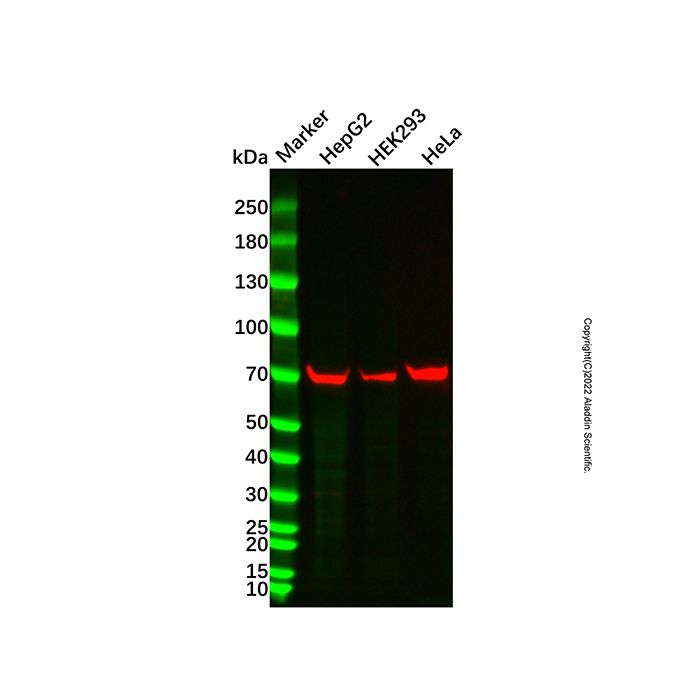
WB: HepG2;HEK293; HeLa
偶联
Unconjugated
克隆类型
单克隆抗体
Format
Whole IgG
轻链亚型
kappa
纯化方法
Protein A purified
浓度
1.0 mg/mL
分子类型
抗体
产品线
生物产品
储存与运输
储存缓冲液
PBS, pH 7.2
储存条件
-20°C储存,避免反复冻融
运输条件
超低温运输
稳定性与储存
短期储存2-8℃(1-2周);长期储存-20℃(24个月);收货后建议分装,避免反复冻融。
图片
Ku70 Mouse mAb (Ab302044) - Western Blot
All lanes: Ku70 Mouse Antibody (Ab302044) at 1/2000 dilution
Samples: Lysates at 20 µg per lane
Secondary: Goat Anti-Mouse IgG H&L (HRP) (Ab179001) at 1/20000 dilution

 ZJ25F1129966


 危险品化学品经营许可证(带存储)