Peripheral membrane component of the cis-Golgi stack that acts as a membrane skeleton that maintains the structure of the Golgi apparatus, and as a vesicle thether that facilitates vesicle fusion to the Golgi membrane (Probable).
Required for normal protein transport from the endoplasmic reticulum to the Golgi apparatus and the cell membrane (By similarity).
Together with p115/USO1 and STX5, involved in vesicle tethering and fusion at the cis-Golgi membrane to maintain the stacked and inter-connected structure of the Golgi apparatus. Plays a central role in mitotic Golgi disassembly: phosphorylation at Ser-37 by CDK1 at the onset of mitosis inhibits the interaction with p115/USO1, preventing tethering of COPI vesicles and thereby inhibiting transport through the Golgi apparatus during mitosis (By similarity).
Also plays a key role in spindle pole assembly and centrosome organization.
Promotes the mitotic spindle pole assembly by activating the spindle assembly factor TPX2 to nucleate microtubules around the Golgi and capture them to couple mitotic membranes to the spindle: upon phosphorylation at the onset of mitosis, GOLGA2 interacts with importin-alpha via the nuclear localization signal region, leading to recruit importin-alpha to the Golgi membranes and liberate the spindle assembly factor TPX2 from importin-alpha. TPX2 then activates AURKA kinase and stimulates local microtubule nucleation. Upon filament assembly, nascent microtubules are further captured by GOLGA2, thus linking Golgi membranes to the spindle.
Regulates the meiotic spindle pole assembly, probably via the same mechanism.
Also regulates the centrosome organization.
Also required for the Golgi ribbon formation and glycosylation of membrane and secretory proteins.
Cleaved by caspases at the onset of apoptosis.
Methylation by PRMT5 is required for Golgi ribbon formation. While dimethylation at Arg-30 and Arg-35 are confirmed in vivo, it is unclear whether Arg-18 is methylated in vivo.
Phosphorylated at Ser-37 by CDK1 at the onset of mitosis, inhibiting the interaction with p115/USO1 and triggering Golgi disassembly.
Phosphorylated at Ser-37 in prophase as the Golgi complex starts to break down, and remains phosphorylated during further breakdown and partitioning of the Golgi fragments in metaphase and anaphase. In telophase, GM130 is dephosphorylated by PP2A as the Golgi fragments start to reassemble (By similarity).
宿主种属
小鼠(Mouse)
特异性
Human GM130
种属反应性
人(Human)
免疫原
Recombinant protein corresponding to Human GM130
阳性对照
WB: HeLa; MCF-7; K562
偶联
Unconjugated
克隆类型
单克隆抗体
Format
Whole IgG
轻链亚型
kappa
纯化方法
Protein A purified
浓度
1 mg/mL
分子类型
抗体
产品线
生物产品
储存与运输
储存缓冲液
PBS, pH 7.2
储存条件
-20°C储存,避免反复冻融
运输条件
超低温运输
稳定性与储存
短期储存2-8℃(1-2周);长期储存-20℃(24个月);收货后建议分装,避免反复冻融.
图片
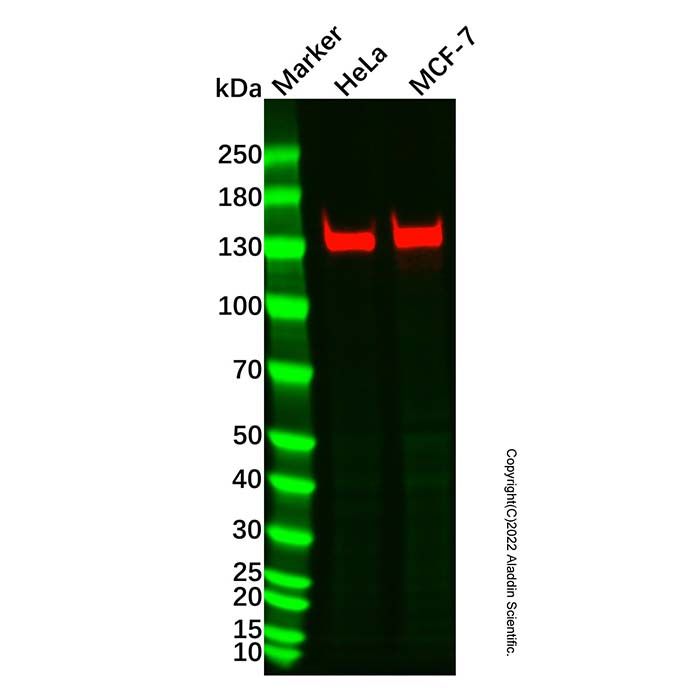
GM130 Mouse mAb (Ab305179) - Western Blot
All lanes: GM130 Mouse Antibody (Ab305179) at 1/1000 dilution
Samples: Lysates at 20 µg per lane
Secondary: Goat Anti-Mouse IgG H&L (HRP) (Ab179001) at 1/20000 dilution
Predicted band size: 112 kDa
Observed band size: 139.5 kDa
Exposure time: 60.0 s
GM130 Mouse mAb (Ab305179) - Western Blot
All lanes: GM130 Mouse Antibody (Ab305179) at 1/1000 dilution
Samples: Lysates at 20 µg per lane
Secondary: Goat Anti-Mouse IgG H&L (HRP) (Ab179001) at 1/20000 dilution

 ZJ26F0130873


 危险品化学品经营许可证(带存储)