


计算溶液所需的质量、体积或浓度。
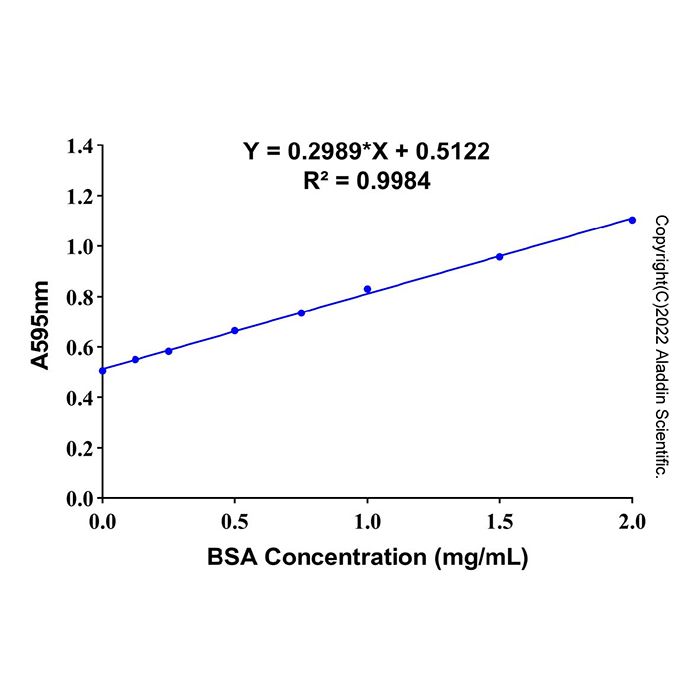
Ready-to-use Bradford Protein Assay Kit (B1507335) - Protein standard curve
Typical standard curve for bovine serum albumin (BSA) in the Bradford Protein Assay. The kits include ready-to-use BSA Standard.
BioReagent,即用型,用于蛋白分析 级 ,适用于对基线干扰要求严格的色谱和分析工作流程。
2-8°C储存,避光。低温运输 。请查阅批次 COA 获取详细规格。
SDS、COA、产品数据表及规格说明书均可下载。可通过批号查询获取批次 COA。
在色谱分析、有机合成和交叉偶联反应领域已被 0 篇同行评审文献引用。
背景介绍
Bradford蛋白定量试剂盒是一种即用型、稳定的传统 Bradford 检测试剂配方,用于测定相比于蛋白标准品的总蛋白浓度。试剂盒包括Bradford测定染液和稀释好的即用型BSA标准品,试剂盒最初由 Bradford 在 1976 年描述。与蛋白溶液混合时,酸性考马斯染料试剂的颜色以与样品中存在的蛋白量成比例的方式从棕色变为蓝色。通过与通常制备作为牛血清白蛋白 (BSA) 或牛丙种球蛋白 (BGG) 的已知稀释系列的蛋白检测标准品的颜色响应进行比较,进行蛋白测定。简单程序适用于几乎任何体积标度,包括试管、比色皿和微孔板。蛋白检测与蛋白样品中遇到的大多数盐、溶剂、缓冲液、硫醇、还原性物质和金属螯合剂兼容。
产品特点
1、检测速度极快,10-80个样品只需不足10分钟即可完成。
2、方便快捷,提供即用型标准品,省去繁琐的稀释步骤。
3、灵敏度高,检测浓度下限达到25 μg/mL。
4、在50-2000 μg/mL浓度范围内有较好的线性关系。
5、Bradford法测定蛋白浓度不受绝大部分样品中的化学物质的影响。但受略高浓度的去垢剂影响。需确保Triton X-100低于1%,Tween 20低于0.008%,Brij35低于1%。含去垢剂的样品推荐使用我们生产的BCA蛋白定量试剂盒(货号B1507333)或即用型Bradford蛋白定量试剂盒(去垢剂兼容型)(货号B1509656)。
6、适用于分光光度计或酶标仪。
图1. 本试剂盒蛋白标准曲线的实测效果图。图中数据仅供参考,实际的检测效果可能会略有不同。
使用方法
A. 标准微孔板测定法(检测范围=50-2000 μg/mL)
1. 各取5 μL的标准品和未知样品至相应标记的微孔板中。
2. 滴加250 μL Bradford测定染液至每孔混匀并充分震荡30秒。
3. 停止震荡。对于大多数情况,在室温下孵育样品10分钟。
4. 在读数仪器中测量595nm时的吸光值。可以立即测定吸光度,也可以在2小时内测定,2小时内检测数据无显著变化。
5. 绘制标准曲线,计算样品中的蛋白浓度。
B. 微量微孔板测定法(检测范围=1-25 μg/mL)
1. 各取150 μL的标准品和未知样品至相应标记的微孔板中。
2. 滴加150 μL Bradford测定染液至每孔混匀并充分震荡30秒。
3. 停止震荡。对于大多数情况,在室温下孵育样品10分钟。
4. 在读数仪器中测量595nm时的吸光值。可以立即测定吸光度,也可以在2小时内测定,2小时内检测数据无显著变化。
5. 绘制标准曲线,计算样品中的蛋白浓度。
注意事项:
1、将G250染液恢复到室温再使用,有利于提高检测的灵敏度,G250染液使用前请颠倒3-5次,混匀。
2、有些阳离子,如K⁺、Na⁺、Mg²⁺、(NH₄)₂SO₄、乙醇等物质不干扰测定,但大量的去污剂如TritonX-100、SDS等严重干扰测定。
3、建议每次测定蛋白样品浓度时,都须绘制标准曲线,以获得准确数据。如果蛋白浓度不在标准曲线范围内, 请稀释样品后测定。
4、为了您的安全和健康,请穿实验服并戴一次性手套操作。
干扰素物质附表

Background Introduction
The Bradford Protein Assay Kit is a ready-to-use, stable traditional Bradford assay formulation for determining total protein concentration relative to a protein standard. The kit includes Bradford assay solution and ready-to-use diluted BSA standard solution, which was originally described by Bradford in 1976. When mixed with protein solutions, the color of the acidic Coomassie dye reagent changes from brown to blue in a manner proportional to the amount of protein present in the sample. Protein determination is performed by comparing the color response with that of a protein detection standard prepared as a known dilution series, typically as bovine serum albumin (BSA) or bovine gamma globulin (BGG). The simple procedure is suitable for almost any volume scale, including test tubes, cuvettes, and microplates. The protein detection is compatible with most salts, solvents, buffers, thiols, reducing substances, and metal chelators encountered in protein samples.
Product Features
1. The detection speed is extremely fast, with 10 to 80 samples completed in less than 10 minutes.
2. Convenient and efficient, it provides ready-to-use standards, eliminating the need for cumbersome dilution procedures.
3. It has high sensitivity, with a detection concentration lower limit of 25 μg/mL.
4. It has a good linear relationship within the concentration range of 50-2000 μg/mL.
5. The Bradford method for protein concentration determination is not affected by most chemical substances in the samples. However, it is affected by slightly higher concentrations of detergents. It is necessary to ensure Triton X-100 is less than 0.1%, and Tween 20 less than 0.008%. For samples containing detergents, it is recommended to use our BCA Protein Assay Kit (catalog number B1507333) or Ready-to-use Bradford Protein Assay Kit (Detergent Compatible) (catalog number B1509656).
6. Applicable to spectrophotometers or microplate readers.
Figure 1. The actual measurement result of the protein standard curve of this kit. The data shown in the figure are for reference only; the actual detection outcome may vary slightly.
Instruction for use
A. Microplate quantification assay (detection range = 50-2000 μg/mL)
1. Take 5 μL of the BSA standard and unknown samples respectively to the corresponding labeled microplate wells.
2. Add 250 μL of the bradford sssay solution to each well, mix well and shake thoroughly for 30 seconds.
3. Stop shaking. For most cases, incubate the samples at room temperature for 10 minutes.
4. Measure the absorbance at 595 nm in the reading instrument. The absorbance can be measured immediately, or within 2 hours. There is no significant change in the detection data within 2 hours.
5. Draw a standard curve and calculate the protein concentration in the sample.
B. Micro-microplate quantification assay (detection range = 1-25 μg/mL)
1. Take 150 μL of the BSA standard and unknown samples respectively to the corresponding labeled microplate wells.
2. Add 150 μL of bradford assay solution to each well, mix well and shake thoroughly for 30 seconds.
3. Stop shaking. For most cases, incubate the sample at room temperature for 10 minutes.
4. Measure the absorbance value at 595 nm in the reading instrument. The absorbance can be determined immediately or within 2 hours. There is no significant change in the detection data within 2 hours.
5. Draw a standard curve and calculate the protein concentration in the sample.
Matters needing attention
1. Reverting the G250 staining solution to room temperature before use is beneficial for enhancing the sensitivity of the detection. Before using the G250 staining solution, please invert it 3-5 times and mix well.
2. Some cations, such as K⁺, Na⁺, Mg²⁺, (NH₄)₂SO₄, ethanol and other substances do not interfere with the measurement, but large amounts of detergents such as TritonX-100, SDS, etc. severely interfere with the measurement.
3. It is recommended that a standard curve be plotted each time the concentration of the protein sample is determined, in order to obtain accurate data. If the protein concentration is not within the range of the standard curve, please dilute the sample and measure it again.
4. For your safety and health, please wear laboratory coats and use disposable gloves during the operation.
Interferon Substance Table

B1507335 | Components | 1000T | storage temperature | Quantity Per Test |
B1507335A | Bradford测定染液 | 250 mL | 2-8°C,避光 | 250 μL |
B1507335B | BSA标准品 (2 mg/mL) | 1 mL | 2-8°C | 5μL |
B1507335C | BSA标准品 (1.5 mg/mL) | 1 mL | 2-8°C | 5μL |
B1507335D | BSA标准品 (1.0 mg/mL) | 1 mL | 2-8°C | 5μL |
B1507335E | BSA标准品 (0.75 mg/mL) | 1 mL | 2-8°C | 5μL |
B1507335F | BSA标准品 (0.5 mg/mL) | 1 mL | 2-8°C | 5μL |
B1507335G | BSA标准品 (0.25 mg/mL) | 1 mL | 2-8°C | 5μL |
B1507335H | BSA标准品 (0.125 mg/mL) | 1 mL | 2-8°C | 5μL |
B1507335I | BSA标准品 (0 mg/mL) | 1 mL | 2-8°C | 5μL |
通过匹配包装上的批号来查找并下载产品的 COA,每批产品都进行了严格的验证,您可放心使用!
| 批号(Lot Number) | 证书类型 | 货号 |
|---|---|---|
 ZJ26F0434207 |
分析证书 | B1507335 |
我们的级别选择指南涵盖了目录中所有的变体的纯度、稳定剂状态和应用适用性。
查看 BioReagent 级别指南 → 查看 Ready-to-use 级别指南 → 查看 for Protein analysis 级别指南 →

 危险品化学品经营许可证(带存储)