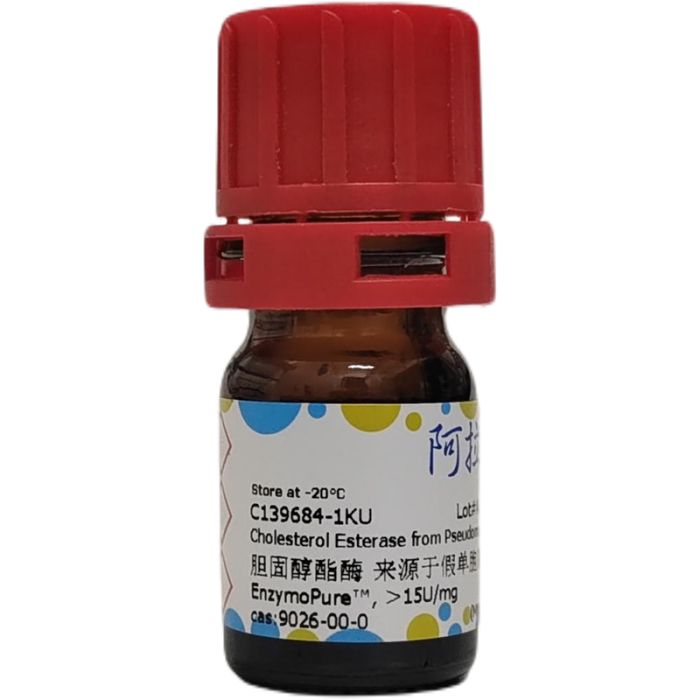
Cholesterol esterase is an enzyme that hydrolyzes cholesterol ester to cholesterol and free fatty acid in the intestinal lumen. Cholesterol synthesized in the acinar cells and is stored in zymogen granules. Cholesterol esterase is also known as bile salt-stimulated lipase and carboxy ester lipasea, acts function for acceleration of cholesterol absorption.
CATALYSIS : Cholesterol ester + H₂O → Cholesterol + Fatty acid
SPECIFICATIONS:
Activity: ≥15 U/mg enzyme powder
Appearance: Light yellowish white to light brown powder, lyophilized
Contaminants: Catalase ≤ 5 × 10⁻¹%
Additives: BSA
CHARACTERISTICS:
Molecular weight: 30,000 (SDS-PAGE)
Isoelectric point: 6.0
Km value: 3 × 10⁻⁵ M
Activator: Triton X-100
Inhibitors: Ag⁺, Hg²⁺
Stabilizers: Mg²⁺, Ca²⁺
Opt. pH: 7.0 Fig. 1
Opt. temperature: 37°C Fig. 2
Stable pH range: 5.0 – 9.0 (37°C, 1 hr.) Fig. 3
Stable temp. range: below 50°C (pH7.0, 10 min.) Fig. 4
Substrate specificity Table 1
APPLICATIONS:
This enzyme is used for the enzymatic determination of cholesterol in serum by cou-pling with cholesterol oxidase or cholesterol dehydrogenase in clinical diagnosis.
Assay Method of Cholesterol Esterase
Principle
The appearance of quinoneimine dye formed by coupling with 4-aminoantipyrine and phenol is measured at 500 nm by spectrophotometry.
Unit Definition
One unit is defined as the enzyme quantity which hydrolyzes one μ mole of cholesterol ester per minute under the conditions described below.
Reagents
A. Aminoantipyrine Solution (5 mg/ml)
Weigh 0.25 g of 4-aminoantipyrine and dissolve in 20 ml of deionized water. Fill up to 50 ml with deionized water.
B. Triton X-100 Solution (50 mg/ml)
Weigh 5.0 g of Triton X-100 and dissolve in 30 ml of deionized water with heating. After cooling, fill up to 100 ml with deionized water.
C. Phenol Solution (50 mg/ml)
Weigh 5.0 g of phenol and dissolve in 30 ml of deionized water. Fill up to 100 ml with deionized water.
D. 0.15 M Phosphate Buffer (KH₂PO₄-KOH, pH 7.0)
E. Aminoantipyrine-Phenol Solution
Weigh 2.04 g of KH₂PO₄ and dissolve in 70 ml of deionized water. Add 75 mg of sodium azide, 6 ml of Aminoantipyrine Solution (A) and 2 ml of Phenol Solution (C), then adjust the pH to 7.0 with 1N KOH.
Add 300 purpurogallin units of Peroxidase and 50 units of Cholesterol Oxidase to the solution and fill up to 100 ml with deionized water. (Expires after 21 days at 2 – 8°C in dark place)
F. Substrate Solution
Weigh 20 mg of cholesterol linoleate (produced by Nakarai Tesque Inc.*) and dissolve in 4 ml of 2-propanol with heating (Prepared Solution).
Mix 35 ml of deionized water and 10 ml of Triton X-100 Solution (B). Keep the solution at 75 ± 2°C. Add Prepared Solution slowly into the solution with stirring, then keep this mixture at 75 ± 2°C for 30 minutes.
After cooling with running tap water, fill up the mixture to 50 ml with deionized water. (Expires after 21 days at 2 – 8°C)
G. Enzyme Solution
Weigh some of Cholesterol Esterase and dissolve in 0.15 M Phosphate Buffer (D).
Enzyme Solution should be prepared so that the value of ΔOD/minute becomes in the range of 0.020 ± 0.005.
Procedure
Pipette 2.0 ml of Aminoantipyrine-Phenol Solution (E) and 1.0 ml of Substrate Solution (F) respectively into a cuvette (d=10 mm), and keep the solution at 37 ± 0.1°C for 10 minutes. Then, pipette 0.10 ml of Enzyme Solution (G) into the cuvette and mix well immediately. Keep the reaction mixture at 37 ± 0.1°C.
Exactly at 3 minutes and 6 minutes after the addition of Enzyme Solution (G), measure the absorbances of the reaction mixture at 500 nm (A3 and A6).
As a blank, pipette 0.15 M Phosphate Buffer (D) into another cuvette (d=10 mm) instead of Enzyme Solution (G) and take the same procedure described above (Ab3 and Ab6).
Calculation
3: Reaction time
13.6: Millimolar extinction coefficient of quinoneimine dye
1/2: Factor based on the fact that two moles of H₂O₂ form one mole of quinoneimine dye
3.1: Final volume of the reaction mixture
0.1: Volume of Enzyme Solution
Dm: Dilution multiple of Enzyme Solution



 J2616427


 危险品化学品经营许可证(带存储)