肌酸激酶(CK)主要存在于心脏、肌肉以及脑等组织中,能可逆地催化肌酸与ATP之间的转磷酰基反应,在能量运转、肌肉收缩和ATP再生中有重要作用,是临床诊断心脑疾病的一个重要指标。
测定原理: CK催化磷酸肌酸和ADP生成肌酸和ATP,己糖激酶催化ATP与葡萄糖形成6-磷酸葡萄糖,6-磷酸 葡萄糖脱氢酶催化6-磷酸葡萄糖与NADP+生成NADPH,导致340nm光吸收值增加。
Component
| 50T | Storage |
| 提取液 | 60 mL | 2-8℃ |
| 试剂一 | 1EA | 2-8℃. Store in the dark. |
| 试剂二 | 15 mL | 2-8℃ |
试剂一:粉剂1瓶,4℃避光保存,使用前加15ml蒸馏水溶解。
工作液:临用前根据用量将试剂一和试剂二以1:1混合。使用前37℃温育2min。
自备仪器和用品
天平、低温离心机、恒温水浴锅、紫外分光光度计、1ml石英比色皿和蒸馏水。
粗酶液提取:
1、组织样本:按照组织质量(g):提取液体积(ml)为1:5~10的比例(建议称取约0.1g组织,加入1ml 提取液)进行冰浴匀浆,然后10000g,4℃离心15min,取上清,置冰上待测。
2、血清样本:直接测定。
测定步骤:
1、紫外分光光度计预热30min,调节波长至340nm,蒸馏水调零。
2、在1ml石英比色皿中加入200μl样本和300μl蒸馏水,最后加入500μl工作液,立即混匀,37℃下测定初始吸光值A1与1min后的吸光值A2,ΔA=A2-A1。
CK酶活性计算:
1、按组织蛋白含量计算
酶活定义:37℃、pH 7.0 条件下,每毫克蛋白质每分钟催化产生 1 nmol NADPH 为一个酶活单位。
计算公式:
CK活性 (nmol/min/mg prot)=ΔA/(ε×d)×V反总÷(V样×Cpr)÷T=804×ΔA÷Cpr
2、按组织样本质量计算
酶活定义:37℃、pH 7.0 条件下,每克样品每分钟催化产生 1 nmol NADPH 为一个酶活单位。
计算公式:
CK活性 (nmol/min/g 鲜重)=ΔA/(ε×d)×V反总÷(V样÷V样总×W)÷T=804×ΔA÷W
(3)按血清计算
酶活定义:37℃、pH 7.0 条件下,每升血清每分钟催化产生 1 nmol NADPH 为一个酶活单位。
计算公式:
CK活性 (nmol/min/L)=ΔA/(ε×d)×V反总÷V样÷T=804×ΔA
参数说明:
注意事项
1、正式测定前务必取2-3个预期差异较大的样本做预测定。
2、配制好的工作液4℃稳定7天,请配制后尽快使用。
3、血清的CK不稳定,采集样本后尽快测定,4℃避光保存可稳定24h。
4、样品蛋白质含量需要另外测定,可选用BCA蛋白含量测定试剂盒进行测定。
5、OD 值大于0.5可用提取液适当稀释样品,并在计算公式中相应的改变稀释倍数。
Introduction
Creatine Kinase (CK) is primarily found in tissues such as the heart, muscle, and brain. It reversibly catalyzes the transphosphorylation reaction between creatine and ATP, playing a vital role in energy transfer, muscle contraction, and ATP regeneration. It is a crucial clinical indicator for diagnosing heart and brain diseases.
Assay Principle
CK catalyzes the conversion of Phosphocreatine and ADP to Creatine and ATP. Hexokinase then catalyzes the reaction of ATP with Glucose to form Glucose-6-Phosphate (G6P). Subsequently, Glucose-6-Phosphate Dehydrogenase (G6PDH) catalyzes the oxidation of G6P with NADP⁺ to generate NADPH, leading to an increase in absorbance at 340 nm.
Component
| 50T | Storage |
Extraction Buffer
| 60 mL | 2-8℃ |
Reagent 1
| 1EA | 2-8℃. Store in the dark. |
Reagent 2
| 15 mL | 2-8℃ |
Reagent 1: Powder in one bottle. Store at 4°C protected from light. Dissolve in 15 mL distilled water before use.
Working Solution: Prepare immediately before use by mixing the dissolved Reagent 1 and Reagent 2 at a 1:1 ratio. Incubate the Working Solution at 37°C for 2 minutes prior to use.
Required Materials and Equipment (Not Provided)
Balance, refrigerated centrifuge, constant temperature water bath, UV spectrophotometer, 1 ml quartz cuvette, and distilled water.
Crude Enzyme Extraction:
Tissue Samples: Homogenize the tissue on ice in Extraction Buffer at a ratio of 1:5-10 (w/v) (e.g., weigh ~0.1g tissue, add 1 mL Extraction Buffer). Centrifuge the homogenate at 10,000 g, 4°C for 15 min. Collect the supernatant and keep it on ice for assay.
Serum Samples: Assay directly.
Assay Procedure:
Preheat the UV spectrophotometer for at least 30 minutes. Set the wavelength to 340 nm. Zero the instrument with distilled water.
In a 1 ml quartz cuvette, add:
CK Enzyme Activity Calculation:
General Parameters:
ε (NADPH molar extinction coefficient) = 6220 L/mol/cm
d (Cuvette light path) = 1.0 cm
Vₜₒₜₐₗ (Total reaction volume) = 1.0 mL (1000 μL)
Vₛₐₘₚₗₑ (Sample volume in reaction) = 0.2 mL (200 μL)
T (Reaction time) = 1 min
Cpr (Sample protein concentration, mg/mL)
W (Sample mass, g)
Vₛₐₘₚₗₑₜₒₜₐₗ (Total extract volume) = Assumed 1 mL for tissue calculations
1. Based on Tissue Protein Content:
Definition: One unit of activity is defined as the amount of enzyme that generates 1 nmol of NADPH per minute per mg of protein at 37°C, pH 7.0.
Calculation:
CK Activity (nmol/min/mg prot) = [ΔA / (ε × d)] × Vₜₒₜₐₗ ÷ (Vₛₐₘₚₗₑ × Cpr) ÷ T
Simplified Formula: CK (nmol/min/mg prot) = 804 × ΔA ÷ Cpr
2. Based on Tissue Sample Mass:
Definition: One unit of activity is defined as the amount of enzyme that generates 1 nmol of NADPH per minute per gram of fresh tissue at 37°C, pH 7.0.
Calculation:
CK Activity (nmol/min/g fresh weight) = [ΔA / (ε × d)] × Vₜₒₜₐₗ ÷ (Vₛₐₘₚₗₑ / Vₛₐₘₚₗₑₜₒₜₐₗ × W) ÷ T
Simplified Formula: CK (nmol/min/g fresh weight) = 804 × ΔA ÷ W
3. Based on Serum:
Definition: One unit of activity is defined as the amount of enzyme that generates 1 nmol of NADPH per minute per liter of serum at 37°C, pH 7.0.
Calculation:
CK Activity (nmol/min/L) = [ΔA / (ε × d)] × Vₜₒₜₐₗ ÷ Vₛₐₘₚₗₑ ÷ T
Simplified Formula: CK (nmol/min/L) = 804 × ΔA
Notes
Before the formal assay, it is essential to perform a pilot test with 2-3 samples expected to have significant differences in activity.
The prepared Working Solution is stable at 4°C for 7 days. However, it is recommended to use it as soon as possible after preparation.
CK in serum is unstable. Determine the activity as soon as possible after sample collection. It can be stored protected from light at 4°C for up to 24 hours.
Sample protein content needs to be determined separately. A BCA Protein Assay Kit can be used for this purpose.
If the absorbance value (ΔA) is greater than 0.5, dilute the sample appropriately with Extraction Buffer and account for the dilution factor (D) in the calculation formulas (e.g., 804 × ΔA × D ÷ Cpr).




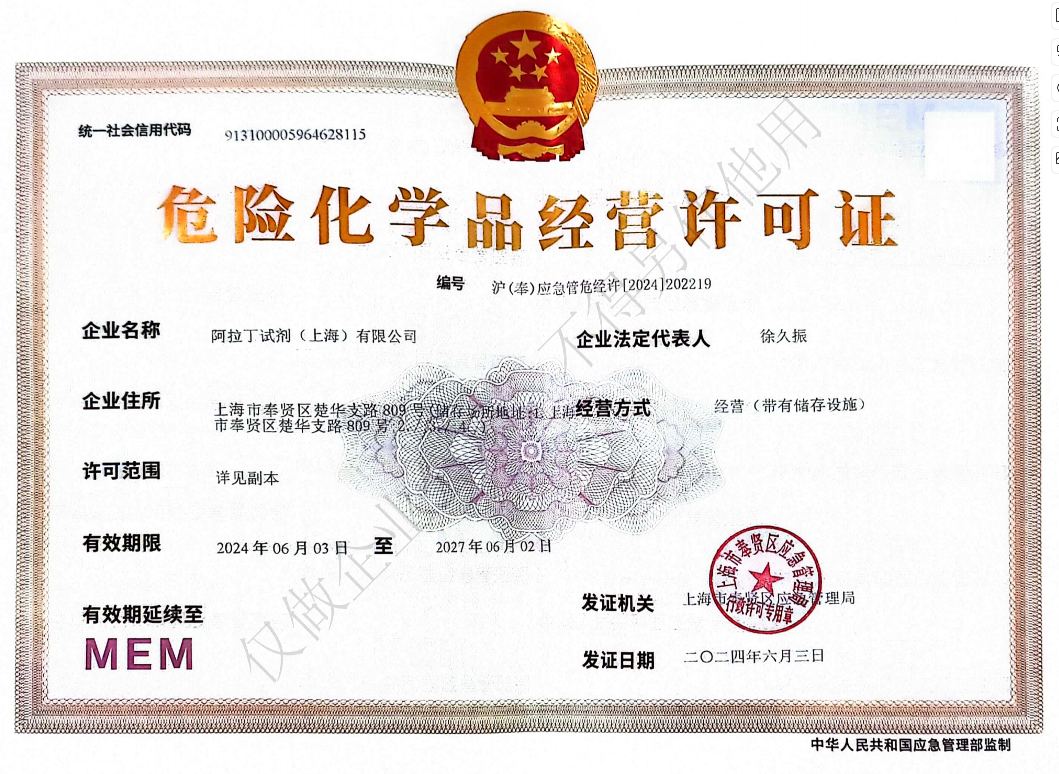 危险品化学品经营许可证(带存储)